By Spencer Frost August 15, 2026
A customer pays by tapping a phone or watch, then returns a week later with the physical card. Your POS receipt shows one set of last four digits, the customer points to a different set on the card, and the processor dashboard may display yet another payment reference.
That situation can look like a payment error. Usually, it is a normal result of payment tokenization.
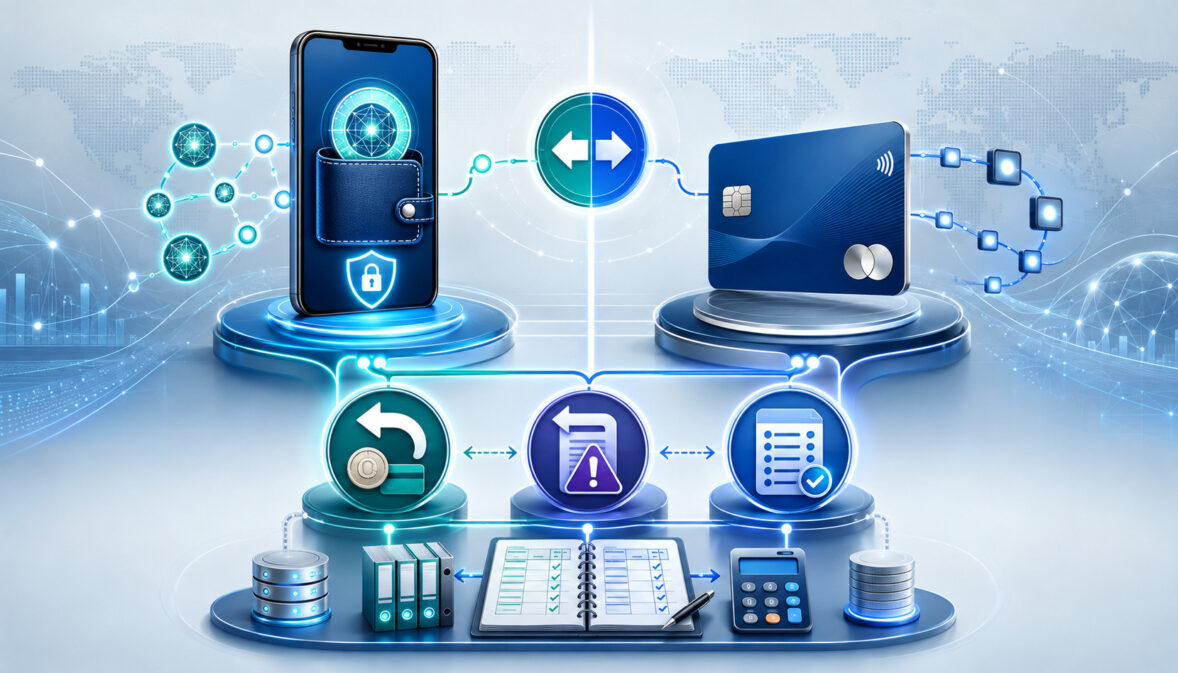
Digital wallets can replace the underlying card number used in payment messaging with a tokenized credential. That can change what merchants see in authorization, receipts, refunds, dispute records, and reconciliation systems, even though the transaction still maps back to the customer’s underlying card account through the payment ecosystem.
EMVCo describes payment tokenization as replacing a Primary Account Number (PAN) with an alternative payment token that can be restricted to a particular device, merchant, or payment scenario.
That distinction matters operationally. A customer-service employee may search for a refund using the physical card’s last four digits and find nothing.
A finance analyst may see different identifiers in the ecommerce platform, gateway, processor report, settlement batch, and bank deposit. A dispute specialist may receive a chargeback tied to a payment credential that does not look like the card number the customer remembers.
The solution is not to force every system to expose the same PAN. The better approach is to understand what each identifier represents and build refunds, dispute management, reporting, and tokenized transaction reconciliation around durable transaction references rather than last-four digits alone.
This guide explains Digital Wallet Tokens vs PANs, including DPAN vs FPAN terminology, wallet and network tokens, gateway tokens, refund behavior, chargebacks, device changes, recurring payments, settlement, PCI DSS considerations, and the records merchants should preserve.
PAN, FPAN, and DPAN: The Payment Identifiers Merchants Need to Understand
The first source of confusion is terminology. PAN, FPAN, DPAN, gateway token, merchant token, and transaction identifier can all appear somewhere in the same payment environment, but they do not describe the same thing.
At a high level, the PAN identifies a payment card account. A payment token can substitute for that PAN in a particular payment context. A gateway or merchant token can separately represent a credential inside a provider’s storage environment. Transaction identifiers, meanwhile, identify individual payment events rather than the underlying account credential.
EMVCo specifically notes that EMV payment tokens can coexist with other forms of tokenization. It also defines a Payment Account Reference, or PAR, that can help payment-industry participants link tokenized transactions with the PAN for which tokens were issued without treating the visible token itself as the underlying PAN.
What Is a PAN?
A Primary Account Number (PAN) is the payment account number associated with a card account. In a conventional card transaction, it is the credential that helps identify the relevant payment account as the transaction moves through the card-payment system.
A PAN should not be confused with a consumer’s checking-account or savings-account number. It belongs to the payment-card environment.
Depending on how a merchant accepts and stores payment data, the full PAN may never be visible to ordinary merchant staff. Interfaces commonly display only a masked or truncated representation, such as the final four digits. PAN masking allows employees to distinguish payment methods without routinely exposing the entire card number.
Traditional card workflows sometimes led employees to treat those final four digits as a convenient customer lookup field. Digital wallets make that practice less dependable because the number presented by a wallet transaction can be a payment token rather than the underlying card PAN.
What Is an FPAN?
FPAN, commonly expanded as Funding PAN, is terminology used in some network, gateway, and wallet implementations for the underlying PAN associated with the payment card that funds a tokenized credential. The terminology is useful, but merchants should not assume every card network, wallet, gateway, or report uses the term FPAN in exactly the same way.
Mastercard Payment Gateway documentation, for example, describes the FPAN as the PAN of the payer’s card associated with a device-specific DPAN. Visa documentation also uses Funding PAN terminology in certain provisioning contexts while describing its broader token service primarily in terms of a PAN and payment token.
For merchant operations, the practical concept is more important than the acronym: there is an underlying payment account credential, and a wallet may use a separate tokenized credential to represent it during payment.
Merchants generally should not design refund, accounting, or customer-support workflows that require employees to obtain the full underlying FPAN. Appropriate transaction references and supported tokenized workflows are preferable.
What Is a DPAN?
A DPAN, often called a Device PAN or Device Primary Account Number in payment-industry usage, is a device- or wallet-associated tokenized payment credential used instead of exposing the underlying funding PAN in applicable digital-wallet transactions.
Apple refers to the credential used by Apple Pay as a Device Account Number. Apple states that after user authentication, the Device Account Number and a transaction-specific security code are used for payment, while the full card number is not shared with the merchant.
Mastercard Payment Gateway documentation uses DPAN and FPAN terminology directly, describing a card added to a device as being assigned a device-specific DPAN associated with the funding PAN.
Google Pay documentation also distinguishes between PAN-based card data and tokenized cards containing a device PAN and cryptographic payment data in supported integrations.
That does not mean every digital wallet uses an identical DPAN architecture. Wallet, network, device, issuer, region, and integration method can affect terminology and processing.
DPAN vs FPAN at a Glance
| Attribute | FPAN / Underlying PAN | DPAN / Wallet Token |
| Represents | Underlying payment-card account credential | Tokenized payment credential associated with an eligible wallet/device context |
| Typically visible to merchant | Often not in full; may be masked or unavailable | May appear masked, including different last four digits |
| Used in wallet authorization | Associated underlying credential | Frequently presented through the tokenized wallet payment flow |
| Device/wallet specific | Not inherently | Can be device- or wallet-specific depending on implementation |
| Refund implications | Merchant normally should not need to collect the full number for a referenced refund | Original wallet transaction or token-related data may be used by the processor’s supported refund workflow |
| Dispute mapping | Remains connected to the underlying cardholder account | Payment ecosystem maintains information needed to route and identify tokenized transactions |
| Reconciliation role | Poor primary accounting key | Also a poor primary accounting key; useful as supporting payment-method information |
The central lesson in DPAN vs FPAN is that they are related credentials, not interchangeable labels. One underlying PAN can also be associated with more than one device token in implementations that create a separate credential for each device.
How Digital Wallet Tokenization Changes the Payment Flow and the Last Four Digits
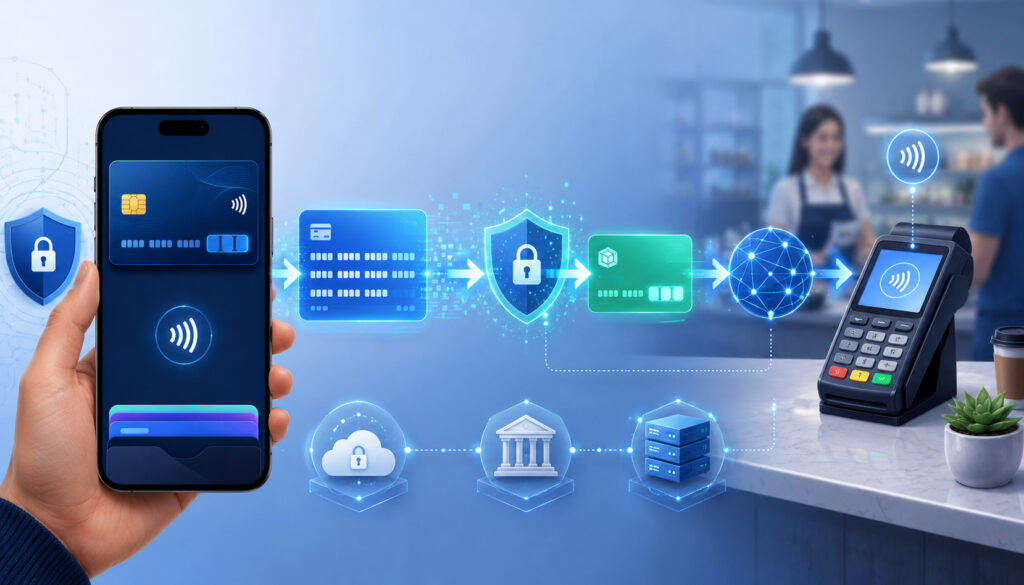
At a high level, payment tokenization changes the credential used to represent the payment account without requiring the merchant to understand the network’s proprietary mapping systems.
EMVCo’s payment-tokenization framework is designed to substitute an EMV Payment Token for a PAN and to allow that token’s use to be limited by factors such as device, merchant, or payment scenario.
A typical wallet flow can be understood in six stages:
- The customer adds an eligible payment card to a digital wallet.
- The wallet, issuer, network, and other relevant participants perform provisioning and verification.
- A tokenized payment credential is provisioned or associated with the wallet/device when the implementation uses one.
- The customer initiates and authenticates a wallet payment.
- Tokenized payment information moves through the merchant’s acceptance environment and payment-processing chain.
- The network and issuer process the transaction using the appropriate relationships between the payment token and underlying account, after which authorization, capture, clearing, settlement, and merchant funding proceed.
Visa’s token-service documentation, for example, describes replacing a PAN with a digital token and using network infrastructure to map the appropriate token and PAN information through payment processing. EMVCo similarly describes EMV payment tokens as being used from the point of purchase through the acquiring and network environment to authorization.
This explains one of the most common merchant questions: Why don’t the last four digits on a wallet receipt match the physical card?
They may be the last four digits of different credentials.
A terminal or processor may show a masked wallet/device payment credential, while the physical card displays digits from the underlying PAN. The customer could therefore compare the receipt against the plastic card and see two legitimate but different numbers.
Apple explicitly tells customers that their physical card number and Apple Pay card number are different and notes that a merchant may ask for the last four digits of the Apple Pay card number when processing a return.
Different merchant systems can complicate the picture further. Depending on integration and processor behavior, the POS, gateway, processor dashboard, settlement file, and dispute system may expose different masked credentials or transaction references.
Mastercard Payment Gateway documentation, for example, documents circumstances in which both masked FPAN and masked DPAN information may be returned, subject to acquirer availability.
So a mismatch among the physical card, receipt, and processor interface does not by itself establish fraud, duplicate billing, or token corruption.
For additional context on where data changes as a card payment progresses, see CardAccept’s guide to the credit card transaction lifecycle.
Digital Wallet Tokens vs Gateway Tokens and Card-on-File Tokens
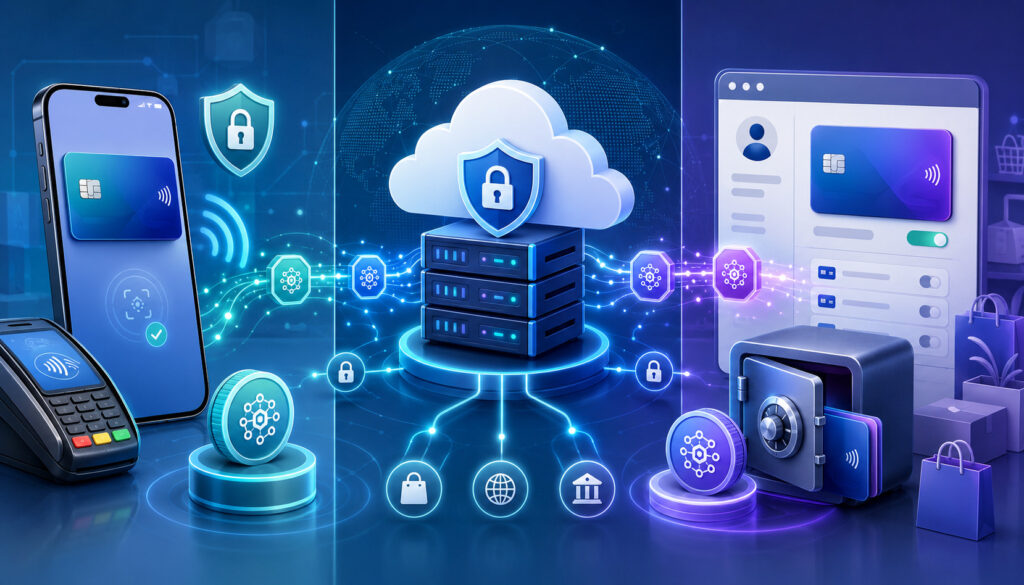
The word token becomes dangerous when a payment operation treats every token as the same object. A wallet/network payment token, gateway token, merchant vault token, and transaction identifier may all be present in a single transaction, yet each solves a different problem.
A wallet or network token substitutes for the underlying PAN within a payment-network tokenization framework. It can have domain controls that restrict where or how it is used. EMVCo expressly notes that payment tokens can be limited to a particular merchant, device, or payment scenario and can coexist with other forms of tokenization.
A gateway token generally represents stored payment information inside a gateway or payment provider’s environment. Instead of a merchant application repeatedly handling the underlying card number, it can send the gateway’s token when the provider supports subsequent transactions.
A merchant vault token serves a similar abstraction purpose within a merchant’s or provider’s credential vault. Its exact format, portability, scope, and lifecycle depend on the system that created it.
A transaction identifier is different again. It identifies a particular authorization, payment, capture, refund, or related processing event. It is not a substitute name for the customer’s account.
This distinction becomes particularly important in ecommerce. A merchant could conceptually have:
Customer → Stored gateway token → Network token → Underlying PAN
while separately recording:
Order ID → Gateway transaction ID → Processor transaction ID → Settlement reference
The exact chain varies by provider, and merchants should never assume that one provider’s fields have a universal meaning.
Digital Wallet Tokens vs Card-on-File Tokens
Card-on-file tokenization covers credentials stored for future ecommerce, subscription, or merchant-initiated use. It is not inherently the same thing as a device-wallet token created for phone, watch, in-app, or contactless payment.
Network tokenization can also support card-on-file use cases. Visa, for example, describes network-token credential management for stored digital-commerce credentials and lifecycle updates when underlying credentials change.
That means the useful distinction is not simply “wallet token versus tokenized card.” Ask who created the token, what credential it represents, where it can be used, how its lifecycle is managed, and which system can submit transactions against it.
Merchant token vs network token is therefore an architectural distinction. A merchant or gateway token usually has meaning within that provider’s environment. A network token participates in card-network payment tokenization.
What Changes for Digital Wallet Refunds?
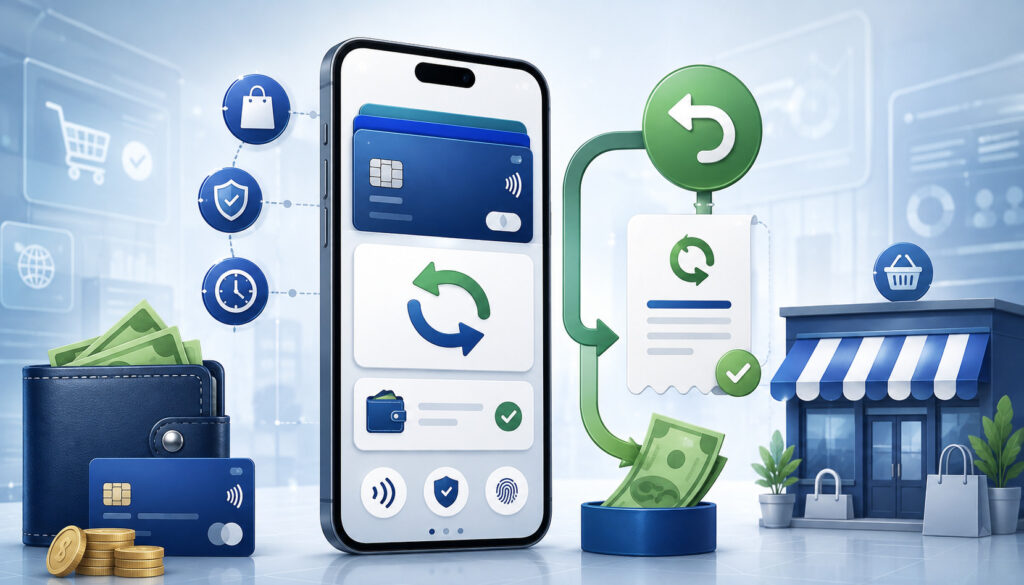
The good news is that accepting a tokenized wallet payment does not mean a merchant must somehow recover the customer’s underlying card number before issuing a refund. Well-designed payment systems can support post-transaction processing without exposing the PAN to ordinary merchant workflows.
PCI Security Standards Council tokenization guidance has specifically discussed architectures where subsequent functions, including refunds and chargeback-related processing, can occur without the merchant retrieving the PAN. The exact merchant workflow, however, depends on the processor, gateway, acquiring relationship, wallet implementation, and transaction status.
For most merchants, the safest operational starting point for the digital wallet tokenization refund process is the original transaction.
A typical referenced workflow is:
- Find the original sale in the POS, gateway, ecommerce platform, or processor.
- Confirm that the transaction is eligible for a refund rather than a void.
- Select the provider’s supported refund function against that original payment.
- Enter the approved full or partial refund amount.
- Preserve the new refund transaction identifier.
- Monitor its processing and settlement status.
- Escalate exceptions to the processor rather than attempting to collect the customer’s full PAN.
This approach keeps the relationship between the refund and original payment intact.
Do You Need the DPAN to Issue a Refund?
Usually, merchants using a referenced refund do not manually type the DPAN. They select or reference the original transaction, and their POS, gateway, or processor submits the information required by that platform.
But merchant implementations differ. Apple notes that some merchants can handle a return from the receipt, while others may ask for the last four digits of the customer’s Apple Pay card number. In some in-person scenarios, the customer may also be asked to present the same device/payment card in Wallet at the contactless reader.
That is why the technically correct answer is:
A merchant generally should use the processor’s supported refund workflow for the original wallet transaction rather than requesting or manually re-entering the underlying physical-card PAN. Whether the wallet token, device, receipt, or another reference is required depends on the acceptance system.
A standalone or unlinked credit is different from a refund tied to an original transaction. Availability and rules vary considerably, so merchants should follow their processor’s documented procedures rather than treating standalone refunds as equivalent to referenced refunds.
What Happens When the Customer Changes Phones or the Card Is Reissued?
Digital payment credentials have a lifecycle. Events can include token provisioning, suspension, resumption, deletion, device replacement, wallet reprovisioning, expiration, and changes to the underlying account credential.
Visa, for example, exposes lifecycle capabilities for token activation, suspension, resumption, and deletion, while network credential-management products can support updates when underlying card information changes.
A customer who replaces a phone may receive a newly provisioned device credential rather than simply carrying forward the same visible token. Removing a card from a wallet can also change the token’s state. An issuer replacing an underlying card because of expiration, loss, or fraud can introduce another lifecycle event.
Merchants should not promise that every refund to every retired, deleted, or replaced token will succeed automatically. Routing can depend on network, issuer, token-service, processor, original transaction references, and the credential’s lifecycle state.
The merchant’s best evidence remains the original transaction and the provider-supported refund request. If a refund fails, preserve the decline or error details and escalate through the processor rather than asking the customer to disclose a complete PAN.
Refunds vs Voids vs Reversals
A void generally cancels a transaction before it completes settlement through the normal sales lifecycle. A refund creates a credit after the payment has progressed far enough that returning value requires a separate financial transaction.
A reversal generally refers to a message or process that cancels or adjusts an authorization so an unnecessary authorization hold can be released. The exact terminology exposed to merchants varies by platform.
These terms should not be used interchangeably. CardAccept’s explanation of payment authorization and settlement provides additional background on how authorization, capture, clearing, settlement, refunds, voids, and reversals occupy different points in a transaction’s lifecycle.
What Changes for Chargebacks and Digital Wallet Disputes?
Tokenization improves the protection of payment credentials, but it does not make a transaction immune to disputes or chargebacks. A wallet transaction can still become disputed through the cardholder’s issuer and proceed through applicable card-network and acquiring processes.
A chargeback is fundamentally tied to a disputed transaction, not to whether merchant staff can recognize the customer’s physical card number.
Mastercard’s chargeback materials describe chargebacks as rules-based mechanisms initiated through the issuing and acquiring ecosystem, with specific conditions, timeframes, and documentation requirements depending on the dispute category.
The tokenized payment still relates to an underlying cardholder account through network and issuer systems. EMVCo’s architecture also defines mechanisms such as Payment Account Reference to help authorized ecosystem participants link tokenized and PAN-related activity for specified purposes.
For merchant teams, DPAN vs FPAN chargeback management is therefore primarily a transaction-matching problem.
Do not reject or misclassify a dispute simply because its payment identifier does not match the last four digits on a physical-card image, an old support ticket, or a customer profile.
Instead, match the dispute using the strongest identifiers your processor provides, which may include:
- processor dispute or case number;
- original processor transaction ID;
- gateway transaction ID;
- network reference or Acquirer Reference Number (ARN), where available;
- authorization code;
- merchant order or invoice ID;
- merchant transaction reference;
- transaction amount;
- transaction date and time;
- location or ecommerce channel; and
- token or masked-card last four as supporting information.
No single field on that list is universally exposed by every processor.
A strong payment dispute management system preserves the relationship between the merchant’s commercial evidence and the processor’s payment record.
Order confirmations, delivery or service records, customer communications, applicable acceptance evidence, refund records, and other relevant documentation should be associated with the original transaction ID.
Does Tokenization Change Chargeback Liability?
Not universally.
Wallet tokenization can provide stronger payment-security and authentication signals than exposing reusable PAN data. EMVCo says tokenization limits the value of compromised payment data because tokens can be restricted to defined payment contexts.
Apple Pay also requires user authentication before payment information is transmitted in supported device flows.
Those security properties can influence fraud risk and may interact with network-specific dispute or liability rules. But merchants should not translate “tokenized” into “no chargeback liability” or assume that every wallet transaction receives the same liability treatment.
Liability can depend on the network, payment channel, transaction type, authentication method, merchant and terminal capabilities, data submitted, geography, reason code, and applicable rules. Merchant teams should verify any claimed liability shift against the relevant network and processor documentation for their exact acceptance setup.
Tokenization also does not prevent non-fraud disputes. Customers can still raise issues involving merchandise, services, cancellations, duplicate charges, credits not processed, recurring transactions, or other applicable dispute categories. Mastercard’s dispute documentation, for example, includes numerous non-fraud chargeback scenarios.
Tokenized Transaction Reconciliation: How to Match Wallet Payments Reliably
Reconciliation is where tokenized payment architecture becomes most visible to finance teams. One customer purchase can generate identifiers in systems operated by the merchant, wallet, gateway, processor, card network, acquirer, and bank.
A simplified record chain may look like:
Order ID → POS/Ecommerce Payment → Wallet Token → Gateway Transaction ID → Processor Reference → Network Reference → Settlement Batch → Merchant Deposit
Not every merchant sees every link. Some providers collapse several stages into one dashboard, while enterprise merchants may receive separate authorization, capture, settlement, fee, dispute, and funding files.
The key accounting rule is simple: the wallet token should not be the primary reconciliation key.
Tokens represent payment credentials. Accounting systems need to reconcile payment events.
A useful reconciliation design stores a durable merchant payment ID or order ID and maps it to each provider-generated transaction identifier as the payment progresses. The token’s last four digits can remain useful for customer recognition, but they should be supplemental.
Recommended Matching Hierarchy
Start with the identifiers that most directly describe the merchant transaction:
- merchant order or payment ID;
- gateway transaction/reference ID;
- processor transaction ID;
- settlement or batch reference;
- refund or dispute reference when applicable;
- amount, currency, date, location, and channel for validation;
- authorization code where useful and available;
- wallet/token last four only as supporting information.
This method also works when a merchant uses payment gateway token reconciliation. The gateway token can identify a stored payment credential while a separate gateway transaction ID identifies the sale. The processor can then assign another reference to the transaction, and settlement can group that payment into a batch.
Treating all three as “the card token” creates reconciliation errors.
| Identifier | Created/Managed By | Best Used For | Primary Matching Key? |
| Order ID | Merchant | Linking payment to commercial order | Yes, when unique and consistently maintained |
| Wallet/DPAN last four | Wallet/network ecosystem | Customer recognition and payment-method context | No |
| Gateway token | Gateway/provider | Referring to a stored credential in that environment | Usually no |
| Gateway transaction ID | Gateway | Tracking the gateway payment event | Often yes |
| Processor transaction ID | Processor | Processor research, refunds, reporting | Often yes |
| Authorization code | Authorization flow | Supporting transaction research | Usually supplemental |
| Settlement batch ID | Processor/acquirer | Grouping settled activity | Yes for batch-level reconciliation |
| Bank deposit reference | Bank/acquirer/provider | Matching funding | Yes for deposit-level reconciliation |
Your exact fields will depend on the processor. CardAccept’s overview of monthly merchant statements is a useful background for comparing batches, settled transactions, adjustments, and funding rather than expecting gross sales to equal a bank deposit automatically.
Authorization, Capture, Clearing, Settlement, and Funding
Reconciliation also improves when teams stop treating “approved” and “paid” as synonyms.
Authorization asks whether the payment can proceed. The issuer returns an approval or decline through the payment chain.
Capture tells the processing system that an approved transaction should move toward financial completion. Depending on the business model, capture can happen immediately or later.
Clearing exchanges and finalizes transaction information needed for the financial process.
Settlement handles financial obligations between participating institutions based on cleared activity.
Merchant funding is when the acquiring/processing side ultimately credits the merchant according to its funding arrangement.
These stages can create different timestamps, statuses, references, and report entries. A tokenized credential does not eliminate those stages. It simply changes part of the credential environment moving through them.
For that reason, the bank deposit should not be treated as an individual card-transaction record. Deposits may combine batches and reflect refunds, fees, reserves, disputes, adjustments, or other activity depending on the merchant agreement and processor setup.
Refund and Chargeback Reconciliation
For a refund, finance should preserve a chain resembling:
Original Sale → Refund Transaction → Processor Credit/Adjustment → Settlement Record → Merchant Funding/Bank Effect
For a chargeback, preserve:
Original Sale → Dispute Case → Processor/Network Reference → Financial Adjustment → Merchant Response or Representment → Outcome → Final Financial Effect
The refund itself should have its own transaction ID. The dispute should have its own case or reference number. Neither event should overwrite the identifier for the original sale.
This is especially important for partial refunds, multiple refunds, reopened disputes, or transactions where the customer uses several wallet devices over time.
Apple Pay, Google Pay, Network Tokens, Receipts, and PCI DSS
Wallet implementations should be discussed according to their actual documentation rather than assuming every wallet functions identically.
For Apple Pay tokenization, Apple states that the Device Account Number and a transaction-specific security code are used when a customer makes an authenticated payment. Apple also states that the full card numbers are not shared with merchants through that process.
That architecture helps explain why an Apple Pay receipt may display different last-four digits from the physical card. Apple’s official Apple Pay refund guidance specifically tells users that the Apple Pay card number can differ from the physical card number and that some merchants may use the last four digits of the Apple Pay card number during a return.
For Google Pay tokenization, implementation details depend on how the merchant integrates. Google’s official payment-data documentation describes payment methods that can include PAN-based cards or tokenized cards containing device-PAN information and cryptographic payment data. Merchants therefore should not assume that every Google Pay transaction has the same credential structure or reporting behavior.
Likewise, a network token can support more than device-wallet payments. Network-token frameworks can also be used in ecommerce and card-on-file scenarios. Visa’s token-service documentation describes tokens for online, mobile, in-app, and contactless use cases, while credential-management services can support stored payment credentials and lifecycle updates.
What Digital Wallet Receipts May Show
Receipts and merchant interfaces may show information such as:
- card brand;
- payment or wallet indicator;
- a masked token or payment credential;
- last four digits of the credential supplied to that system;
- authorization information;
- merchant order or transaction number; and
- other provider-specific payment references.
A merchant does not need to print a full PAN to make the receipt operationally useful. In fact, payment-data minimization should be the objective.
Support employees should also understand how to answer, “Those aren’t my card’s last four digits.”
A useful response is that a phone or wallet can use a separate payment credential to protect the underlying card number, so the last four digits on the receipt may identify the wallet payment credential rather than the physical card.
Staff can then verify the purchase through the receipt, order number, transaction amount, and merchant records without requesting the customer’s complete card number.
PCI DSS and What Merchants Should Store
Tokenization can reduce exposure to PAN, but it does not automatically remove all PCI DSS responsibilities.
The PCI Security Standards Council’s tokenization guidance explains that scope depends on architecture. Systems that store, process, or transmit PAN, or that can retrieve PAN from tokens, may remain relevant to the cardholder data environment.
Merchants should therefore minimize cardholder data rather than viewing a wallet logo as a compliance exemption.
Useful records can include:
- merchant order ID;
- internal payment ID;
- processor transaction ID;
- gateway transaction ID;
- appropriately tokenized credential reference where operationally necessary;
- masked payment information supplied by the processor;
- amount and currency;
- transaction date/time;
- payment channel or wallet indicator;
- authorization result;
- capture status;
- settlement/batch reference;
- refund transaction ID; and
- dispute/case reference.
Avoid collecting or storing full PAN data merely because a support or reconciliation process was designed around card-number lookup.
For a broader overview of how gateways, processors, issuers, and networks interact, see how credit card processing works.
Common Tokenized Payment Mistakes and an Operational Checklist
Most tokenization problems in merchant operations are not failures of the underlying payment token. They are data-model and workflow failures.
A common mistake is assuming a DPAN must equal the PAN printed or encoded on the physical card. Another is searching for a digital-wallet transaction only by the physical card’s last four digits.
Teams also get into trouble when they call a gateway vault token a “DPAN,” treat token deletion as proof that the underlying account has closed, or assume that every processor exposes the same network references.
Other recurring errors include assuming tokenized payments cannot be charged back, failing to preserve processor transaction IDs, storing unnecessary PAN data, and reconciling against customer names or screenshots instead of provider-generated transaction records.
A mature payment operation treats credential identity and transaction identity as separate concepts.
Operational Checklist for Tokenized Payments
At authorization
- Retain a unique merchant order or payment ID.
- Capture the gateway and/or processor transaction reference.
- Record the payment method or wallet indicator when it helps operations.
- Store only masked or tokenized credential information that is legitimately required.
- Preserve authorization information needed for later research.
At refund
- Locate the original payment first.
- Determine whether the correct action is a void, reversal, or refund.
- Use the processor’s supported referenced-refund workflow whenever applicable.
- Preserve the refund’s own transaction ID.
- Monitor refund status instead of assuming submission equals final posting.
- Escalate token-lifecycle exceptions through the processor.
At chargeback
- Match the dispute to the original processor transaction.
- Preserve the processor’s case/reference number.
- Connect the case to the merchant order record.
- Collect relevant fulfillment, communication, refund, and authorization evidence.
- Do not dismiss a match because the wallet last four differs from the physical card.
At reconciliation
- Match merchant, gateway, processor, settlement, and funding records.
- Reconcile refunds and disputes as separate financial events.
- Use token last-four digits only as supplemental data.
- Investigate missing references before relying on approximate customer details.
Refund, Chargeback, and Reconciliation Comparison
| Workflow | PAN-Based Transaction | Digital Wallet Token Transaction | Main Merchant Concern |
| Refund | Original payment may be represented by masked PAN data | Original payment may display tokenized credential data | Reference the original processor transaction |
| Void | Cancels eligible unsettled payment | Same basic lifecycle concept | Transaction status matters more than visible PAN |
| Chargeback | Dispute maps to original card transaction | Dispute still maps to tokenized original transaction/account ecosystem | Match processor and dispute references |
| Customer lookup | Physical-card last four may help | Physical-card last four may not match | Use order/transaction identifiers |
| Reconciliation | PAN last four sometimes used as supplemental field | Token last four may appear instead | Never make last four the primary accounting key |
| Reporting | Masked PAN may appear | Wallet/token, gateway, and processor identifiers may coexist | Understand each field’s owner and purpose |
What should never be your only reconciliation key?
Do not rely solely on last four digits, customer name, wallet name, card brand, or a screenshot of the receipt. None reliably identifies a unique payment event.
Questions to Ask Your Processor or Gateway
Before changing a production reconciliation or refund workflow, obtain specific answers from your provider:
- Which field represents a wallet or network token?
- Do your APIs and reports expose DPAN or token last four?
- Can any report expose a masked underlying PAN, and under what circumstances?
- Which transaction reference should our system use for refunds?
- How are partial and referenced refunds represented?
- What happens to refunds after device replacement, token deletion, or card reissue?
- How are wallet-originated transactions represented in disputes?
- Which identifier persists from authorization through settlement?
- Which references appear in chargeback reports?
- Is an ARN or equivalent network reference available?
- How does your gateway token map to processor transactions?
- How are network-token and card-on-file transactions reported?
- Which identifier should finance use for daily reconciliation?
- Which identifiers should customer service use for transaction lookup?
- What payment data should we retain, and for how long, under our agreement and compliance program?
The answers should become part of your integration documentation rather than remaining tribal knowledge.
Frequently Asked Questions
What is the difference between a digital wallet token and a PAN?
A PAN is the payment account number associated with a card account. A digital wallet token is an alternative payment credential that can represent that account within a controlled payment context.
EMVCo describes payment tokens as alternatives to PANs whose use can be limited to specific devices, merchants, or scenarios. The merchant may therefore receive or display masked token information rather than the underlying PAN.
What is a DPAN?
DPAN commonly means Device PAN and refers to a device-associated tokenized payment credential in implementations using that terminology. Mastercard Payment Gateway documentation explicitly describes a device-specific DPAN, while Apple uses the term Device Account Number for its payment credential.
Terminology and implementation can differ among wallet and network ecosystems, so DPAN should not be treated as a universal label for every digital-wallet credential.
What is an FPAN?
FPAN commonly means Funding PAN. In payment systems using this terminology, it refers to the underlying PAN associated with the card funding the tokenized wallet credential.
Mastercard gateway documentation uses FPAN this way, and Visa uses Funding PAN terminology in certain provisioning documentation. Other documentation may simply use PAN rather than FPAN, so merchants should verify the field definitions supplied by their processor.
Why do Apple Pay or other wallet purchases show different last four digits?
The wallet can transact using a tokenized payment credential rather than exposing the physical card’s underlying number.
Apple specifically states that the Apple Pay card number and physical card number are different and tells customers where to find their Apple Pay card-number last four for returns. A different last-four value on a receipt is therefore not automatically evidence of an incorrect card or fraudulent transaction.
Can a merchant refund a digital wallet transaction?
Yes, supported digital-wallet purchases can be refunded through merchant payment systems. The workflow varies by POS, gateway, processor, and transaction status.
A merchant will commonly locate the original transaction and submit a referenced refund rather than requesting the full underlying card number. Apple likewise notes that merchants may process Apple Pay refunds using a receipt or, in some cases, wallet-card information.
Do I need the original DPAN to issue a refund?
Not necessarily. In many merchant systems, you initiate the refund against the original processor or gateway transaction, so staff do not manually enter the DPAN. Some in-person systems may request wallet-card information or presentation of the device.
Follow your processor’s documented workflow rather than assuming either the DPAN or underlying PAN must always be entered.
What happens to a refund if the customer changes phones?
Replacing a device can affect the lifecycle of a device-associated token and may result in a different credential after reprovisioning. Whether an existing refund routes successfully depends on the payment network, issuer, processor, original transaction reference, and credential lifecycle.
Merchants should submit the refund against the original transaction and escalate failures through their processor rather than promising that every retired token will behave identically.
Can a refund go through after the card is reissued?
It may, but merchants should not make a universal promise. Payment networks and issuers have credential-lifecycle and account-update mechanisms, but behavior depends on the particular card, token, issuer, network, processor, and reason for reissue.
Use the original transaction’s supported refund function first. If the processor rejects it, preserve the error and ask the processor for the appropriate exception workflow.
Do digital wallet transactions have chargebacks?
Yes. Payment tokenization does not eliminate the cardholder dispute system. Wallet transactions can still be disputed and handled according to applicable issuer, network, acquirer, processor, and merchant rules.
Merchants should connect the dispute’s case/reference information to the original transaction and supporting order evidence rather than attempting to match the case using only physical-card last four.
Does tokenization reduce chargeback liability?
Not automatically. Tokenization can protect account credentials and wallet flows can provide useful authentication and security signals, but liability depends on network-specific rules, transaction type, payment channel, authentication, merchant capabilities, region, and dispute reason.
Merchants should verify liability-shift claims with their processor and applicable card-network rules instead of assuming every tokenized payment transfers fraud liability.
How do merchants reconcile tokenized transactions?
Use durable merchant and payment-event identifiers. Start with the order/payment ID and map it to gateway transaction IDs, processor references, settlement batches, refund IDs, dispute references, and deposits.
Use amount, date, authorization information, and payment method as validation fields. Wallet token or DPAN last-four data should remain supplemental because a credential is not the same thing as a unique transaction.
Is a gateway token the same as a DPAN?
No. A gateway token generally represents a payment credential inside a gateway or provider’s storage environment. A DPAN refers to a device-associated payment credential in systems using DPAN terminology.
A merchant can encounter both in one payment lifecycle, along with separate transaction IDs. EMVCo specifically recognizes that EMV payment tokens can coexist with other tokenization systems.
Is a network token the same as a stored card token?
Not necessarily. A network token is issued and managed through a payment-network tokenization framework. A stored card token could instead be a gateway or merchant-vault reference.
However, network tokenization can also support card-on-file ecommerce credentials, so “stored” does not automatically mean “gateway token.” Identify the token based on who created and manages it and where it can be used.
Does digital wallet tokenization reduce PCI scope?
It can reduce PAN exposure, but accepting tokenized wallet payments does not automatically eliminate PCI DSS obligations or guarantee that every merchant system is out of scope.
Scope depends on how payment information is captured, transmitted, stored, retrieved, and integrated. Systems capable of receiving or recovering PAN data require particular attention under PCI requirements and applicable validation guidance.
What identifiers should merchants retain for refunds and disputes?
Preserve a unique merchant order/payment ID, gateway and processor transaction references, payment date and amount, authorization and capture information where relevant, refund transaction IDs, settlement references, and dispute case numbers.
Appropriately masked token information can help support staff recognize payment methods, but it should not replace transaction identifiers. Retain only data legitimately required for operations, compliance, accounting, or dispute management.
Conclusion
The biggest operational difference between Digital Wallet Tokens vs PANs is not that wallet payments require an entirely new accounting system. It is that merchants can no longer assume the number visible to them is the same payment credential printed on the customer’s physical card.
The PAN identifies the underlying card payment account. FPAN is terminology used in some ecosystems for that funding PAN. A DPAN or Device Account Number can represent a separate device- or wallet-associated payment credential.
A network token, gateway token, merchant vault token, and transaction identifier each have their own role and should never be treated as interchangeable.
For refunds, the original transaction reference is usually more useful than manually identifying the physical card. For DPAN vs FPAN chargeback management, processor transaction IDs and dispute references are more reliable than last-four matching.
For wallet transaction reconciliation, finance teams should follow the chain from order to payment transaction to settlement and funding.
The operational model to remember is:
Identify the transaction with transaction identifiers. Identify the credential with credential identifiers. Do not use one as a substitute for the other.
When a customer changes phones, removes a wallet credential, or receives a replacement card, token-lifecycle behavior can add complexity. That is another reason to preserve the original transaction relationship and use provider-supported refund and dispute workflows.
The same discipline improves payment security. Merchants generally do not need to collect the full PAN merely to troubleshoot a return, investigate a chargeback, or reconcile a deposit.
Tokenization can reduce unnecessary exposure to sensitive payment data when it is implemented within an appropriate architecture, but merchants must still understand and meet their PCI DSS responsibilities.
Ultimately, reliable tokenized-payment operations depend less on memorizing whether a particular screen says FPAN or DPAN and more on maintaining accurate mappings among orders, authorizations, processor transactions, refunds, disputes, batches, and deposits.
Informational and payment-security disclaimer: This article provides general educational information about payment operations and tokenized card transactions. Network rules, processor functionality, wallet implementations, contractual requirements, dispute procedures, refund capabilities, security requirements, and PCI DSS scope can vary and change.
Merchants should confirm implementation-specific requirements with their acquirer, processor, gateway, qualified security professionals, and applicable card-network documentation before changing production payment, refund, security, or reconciliation procedures.