By Spencer Frost August 15, 2026
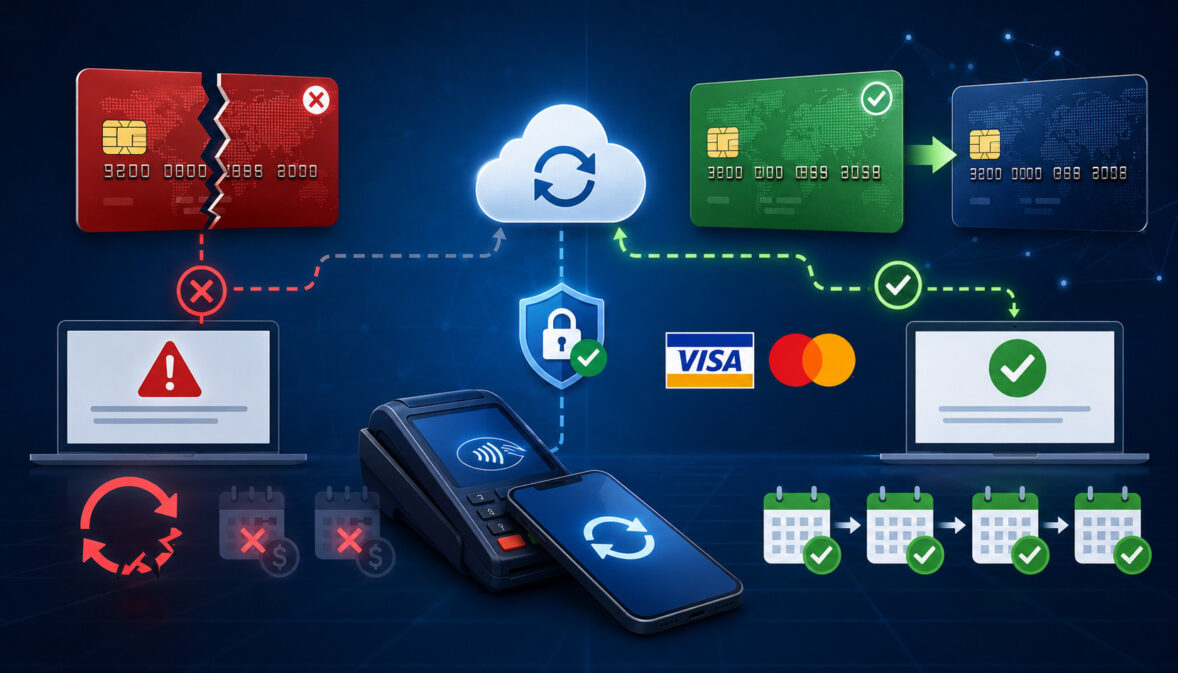
Recurring billing depends on something customers rarely think about: the payment credential saved when they first subscribed. That credential may work for months or years, but cards do not remain unchanged forever. They expire, are replaced after fraud, are reissued after being lost or stolen, and sometimes receive entirely new account numbers.
Recurring payments can fail when a customer’s stored card expires, is replaced after fraud, or is reissued with a new account number or expiration date.
Card account updater services can provide participating merchants with eligible updated credentials so some recurring transactions continue without requiring the customer to manually re-enter card information.
Visa describes Visa Account Updater, or VAU, as a secure exchange of updated account information between participating issuers and acquirers for credential-on-file merchants. Mastercard’s Automatic Billing Updater, or ABU, similarly provides access to updated card numbers and expiration dates and can provide account-status information when supported.
For subscription businesses, SaaS companies, membership organizations, ecommerce merchants, and other recurring-payment businesses, this matters because a failed renewal does not necessarily mean the customer intends to cancel. A subscriber may still value the service while the merchant’s stored credential has quietly become outdated.
A card account updater can help address that specific payment credential lifecycle problem. It cannot solve every recurring payment decline, however, and it does not replace customer authorization, proper credential-on-file configuration, intelligent payment retries, secure card storage, or customer outreach.
This guide explains how Visa VAU, Mastercard ABU, payment vaults, tokenization, retries, and recurring billing recovery fit together.
Why Reissued Cards Break Recurring Billing
A recurring payment generally relies on payment information established earlier in the customer relationship. Depending on the implementation, the merchant may retain a token, a gateway payment profile, a network token, or protected card information in an appropriately secured system.
The problem appears when the payment account changes but the merchant’s stored reference does not.
For example, imagine a SaaS customer subscribed with a card ending in 4821. Six months later, the issuing bank replaced the card because of suspected fraud. The customer receives another card and continues using the SaaS product, but the billing platform may still attempt the next renewal against the original credentials.
When the old credential is no longer valid for that transaction, the authorization may fail.
Card lifecycle events that can affect recurring billing include:
- Normal card expiration or renewal
- Replacement with a new expiration date
- Fraud-related card replacement
- Lost or stolen card replacement
- Changes to the primary account number
- Portfolio or product changes
- Account closure
- Other issuer-driven account changes
Visa’s current VAU documentation specifically describes support for account renewal or replacement, lost or stolen card replacement, account closures, portfolio-related changes, and updated PAN or expiration information.
The important distinction is customer intent versus credential validity. A customer can fully intend to continue a membership while the particular stored card credential has become outdated.
This is one source of involuntary churn: customers losing access or subscriptions ending because payment recovery failed rather than because they intentionally canceled.
The same issue affects ecommerce merchants that keep cards on file for repeat purchases, although recurring subscription billing makes the problem particularly visible because charges occur automatically over long periods.
For a broader view of where authorization fits into the payment process, CardAccept’s guide to payment authorization and settlement explains how gateways, processors, networks, issuers, and merchants interact during a transaction.
What Is a Card Account Updater?
A card account updater is a service designed to help eligible credential-on-file merchants obtain qualifying payment account changes made by participating card issuers.
Instead of waiting for a customer to notice a failed payment and manually enter a replacement card, the merchant’s payment provider may be able to receive updated credentials through a card-network updater program.
The core participants are generally:
- Card issuer: Maintains the cardholder account and originates eligible account changes.
- Card network: Operates the updater program and facilitates eligible update information.
- Updater service: Handles supported lifecycle information and merchant inquiries or subscriptions.
- Acquirer, processor, gateway, PSP, or billing provider: Often provides merchant access to updater functionality.
- Merchant or billing platform: Uses the current eligible credential or payment reference for subsequent transactions.
This does not mean merchants normally build a direct network integration themselves. Visa describes participating merchants as accessing VAU through their acquirers, while payment providers frequently expose account updater capabilities inside gateways, vaults, subscription platforms, or processing products.
Mastercard also supports registered merchants and acquirers through its ABU ecosystem and documents both account inquiries and account subscriptions.
A well-integrated recurring billing account updater can therefore operate largely behind the scenes. An expired or replaced credential may be refreshed before a later renewal attempt, or a provider may query for an update as part of its payment-recovery workflow.
Coverage is not universal. Whether an update is available can depend on card network rules, issuer participation, card and account eligibility, geography, merchant eligibility, processor implementation, customer preferences, and the specific lifecycle event.
Visa Account Updater
Visa Account Updater (VAU) allows eligible account information changes to be exchanged between participating Visa issuers and the acquiring side for qualified credential-on-file use cases.
Visa states that participating issuers provide account changes to VAU and that merchants, through their acquirers, can inquire about eligible stored credentials. Available information can include new account numbers, expiration-date changes, closed-account information, and certain cardholder advice information.
Visa currently documents several integration channels on the acquiring side, including batch, API, Real Time VAU, and a Push Subscribe Service. That does not mean every merchant processor exposes every model or that merchants can freely select among them; the implementation available to a business depends on its payment-provider relationship.
Visa also states that VAU information can be shared with Visa Token Vault, illustrating how card account lifecycle management and tokenized payment infrastructure may interact.
The merchant-facing result is relatively simple: when an eligible Visa credential changes and the required parties support the service, the merchant may be able to continue using an updated payment credential rather than relying on the outdated information originally stored.
VAU should not be interpreted as permission to continue billing indefinitely. The merchant must still have a valid basis and customer authorization for the recurring transaction.
Mastercard Automatic Billing Updater
Mastercard Automatic Billing Updater (ABU) performs a similar lifecycle-management function for qualifying Mastercard credentials but has its own program rules, enrollment requirements, interfaces, and terminology.
Mastercard states that ABU provides updated payment credentials, including account numbers and expiration dates, for ecommerce and recurring billing merchants. Issuers provide lifecycle information when accounts are created, changed, or closed, and eligible registered merchants or acquirers can request or subscribe to updates.
Mastercard currently documents both a Pull inquiry model, in which an account is proactively queried, and a Push subscription model, in which an integrator subscribes to receive eligible future account updates. Batch account inquiries are also supported.
Mastercard’s documented push notifications distinguish several types of outcomes, including an account number and expiration-date change, an expiration-only change, and an account-closed notification.
Merchants should not assume these categories map directly to a particular processor’s user-interface labels or reporting codes. A gateway or billing provider may translate network information into its own status names or token-management workflow.
Visa VAU vs. Mastercard ABU
Visa VAU and Mastercard ABU address the same broad operational problem: keeping eligible credential-on-file payment information aligned with card-account lifecycle changes.
They should nevertheless be treated as separate card-network programs rather than as interchangeable implementations.
| Feature | Visa Account Updater | Mastercard ABU |
| Network | Visa | Mastercard |
| Main purpose | Exchange eligible updated account information for qualifying credential-on-file use cases | Keep eligible stored Mastercard payment credentials current |
| Merchant access | Commonly through acquirers, processors, gateways, or other payment providers | Through eligible registered merchants, acquirers, processors, or provider integrations |
| Typical credential updates | Updated PAN, expiration information, account closure and supported account-status information | Account number and expiration changes, expiration-only changes, account closure and supported lifecycle information |
| Documented integration models | Batch, API, Real Time VAU and Push Subscribe Service on supported acquiring implementations | Pull inquiries, Push subscriptions and batch inquiries |
| Vault integration | Provider-dependent | Provider-dependent |
| Coverage | Depends on program eligibility, issuer/network participation and provider implementation | Depends on program eligibility, issuer/network participation and provider implementation |
| Guaranteed payment approval? | No | No |
Visa’s public documentation describes participating issuers sending updated account details to VAU and participating merchants accessing information through the acquiring side. Mastercard documents a global lifecycle repository supporting registered merchants and acquirers.
Neither service eliminates the authorization step. Even after an automatic card updater supplies valid replacement credentials, the next recurring transaction can still be declined for unrelated reasons.
That is why payment teams should think of account updater services as credential maintenance infrastructure, not as complete subscription payment recovery.
Provider capabilities also matter. One gateway might automatically map a replacement card to an existing token. Another might require a scheduled updater process. A third might check for changes only when a payment is attempted.
The correct implementation question is therefore not simply, “Do you support VAU or ABU?” It is, “How does your implementation receive, apply, report, and use those updates within our recurring billing lifecycle?”
How Card Account Updater Services Work
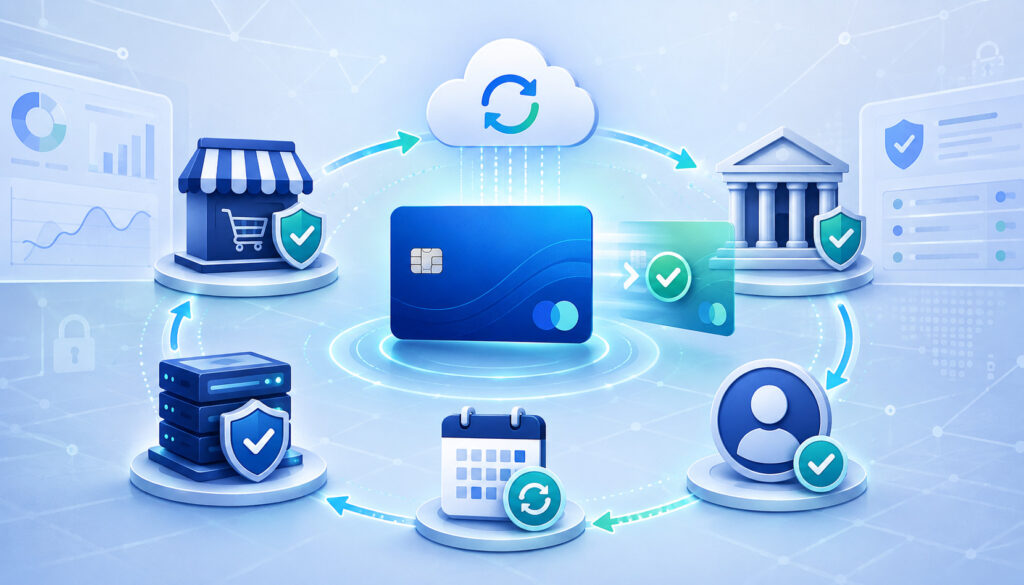
Although implementations vary, a simplified card-on-file updater workflow looks like this:
- The customer authorizes a merchant to store or reference an eligible payment credential.
- The merchant, gateway, or payment platform securely stores a token or appropriately protected credential.
- The issuer later changes the account because of expiration, replacement, fraud, loss, theft, product conversion, or another supported event.
- The issuer makes eligible update information available through the applicable network updater program.
- The merchant’s processor, acquirer, gateway, or updater integration receives or requests the information.
- The relevant vaulted payment reference or credential is updated where supported.
- A future recurring payment uses the current eligible credential.
- The merchant records the authorization outcome and reconciles the subscription status.
This sequence is intentionally simplified. Merchants should rely on their processor’s current integration documentation for the exact workflow.
For context on how a card transaction normally proceeds after the credential is selected, see CardAccept’s overview of the credit card transaction lifecycle.
Batch Updater vs. Real-Time and Push Models
Account updater programs are no longer limited to one universal scheduled-file model.
Visa publicly documents batch and API access along with Real Time VAU and Push Subscribe capabilities on supported integrations. Mastercard documents Pull, Push, API, and batch-oriented approaches.
Provider implementations can add another layer. Adyen, for example, documents both asynchronous Batch Account Updater and a Real Time Account Updater implementation that can check for card changes during payment processing.
Scheduled or batch processing can be useful when a billing team wants eligible payment methods refreshed before an upcoming renewal cycle. The merchant or provider processes groups of credentials according to the provider’s workflow and then applies qualifying results.
Real-time or transaction-triggered approaches can check closer to the point of payment. Push subscription models take another approach by allowing an eligible integrator to listen for future lifecycle changes associated with subscribed accounts.
None of these models should be described as universally available. Ask your provider exactly which updater method it supports, how frequently any scheduled processes operate, whether updates are automatically applied to vaulted profiles, and what happens when no new credential is available.
What Information Can an Account Updater Change?
Depending on the card network, issuer, provider, and lifecycle event, an updater may return or apply information such as:
- A replacement card or account number
- A new expiration date
- Both an updated account number and expiration date
- Account-closed information
- Supported account-status or cardholder-advice information
Visa’s VAU documentation specifically references updated PANs, expiration dates, closed accounts, and cardholder advice information. Mastercard’s ABU push documentation includes account-number changes, expiration changes, and account-closed notifications.
An update does not necessarily mean the merchant should receive or manipulate raw card numbers. Modern gateway and vault implementations can update the payment method behind an existing token or stored profile.
That approach is generally preferable operationally because billing applications can continue referencing the same customer payment object while the sensitive credential is handled by authorized payment infrastructure.
What Card Account Updaters Cannot Fix
A card account updater addresses stale or changed credentials. It is not a universal decline-repair system.
A perfectly current card can still fail authorization.
Common problems an updater generally does not solve include:
- Insufficient funds or insufficient available credit
- A legitimate issuer decline unrelated to credential age
- Fraud or security restrictions
- A locked or restricted card
- Merchant or processor configuration problems
- Invalid recurring-payment indicators
- Merchant-account restrictions
- A customer’s intentional cancellation
- A closed account for which no qualifying replacement information is available
- Problems with the underlying recurring agreement or authorization
- Technical connectivity failures
- Duplicate or otherwise inappropriate transaction attempts
If an updater reports that the account is closed, that information may actually tell the business not to continue using the old credential. Mastercard, for example, documents an account-closed notification in ABU’s push model with guidance that another payment method is required.
Similarly, a replacement credential does not guarantee that a transaction will be authorized. The issuer still evaluates the subsequent authorization request.
This distinction prevents an important operational mistake: repeatedly retrying a charge because an updater exists.
The better approach is to classify the problem, use any available credential update, make an appropriate authorization attempt, and determine whether the customer needs to take action.
Reissued, Expired, Lost, Stolen, and Closed Cards
Different card lifecycle events have different consequences for recurring billing. Treating all of them as an “expired card problem” hides important distinctions.
Reissued Cards After Fraud
Fraud-related card replacement is particularly disruptive because an issuer may change the account number rather than merely extend the expiration date.
The legitimate cardholder may continue wanting every subscription associated with the original card. At the same time, the issuer must prevent unauthorized parties from continuing to use compromised credentials.
An account updater may make qualifying replacement information available for eligible merchant relationships, but merchants should never assume that every fraud-related replacement will be updated. Program rules, issuer decisions, merchant eligibility, cardholder preferences, regional requirements, and provider implementation can affect the result.
Visa includes card replacement and lost/stolen replacement among supported VAU lifecycle scenarios. Mastercard’s ABU documentation likewise describes account lifecycle updates and replacement credentials.
If no update is available, the business should move to a secure customer payment-update workflow rather than repeatedly charging stale credentials.
Expired Cards
An expiration date is part of the credential used in many card-not-present transactions. When the value stored by the merchant no longer matches the active payment credential, future billing may fail.
Updater services can help when an eligible issuer provides a refreshed expiration date. Mastercard documents an ABU notification specifically for a changed expiration date while the account number remains unchanged. Visa includes expiration-date updates in VAU.
An expired card updater is therefore especially useful for long-lived subscription relationships in which customers may not revisit checkout for years.
Expiration is not the same as account closure. A card that reaches its printed expiration date may have been renewed, while a closed account may no longer have any valid credential that the merchant can use.
Billing systems should therefore preserve the updater’s actual account-status meaning rather than turning every result into a generic “new card” event.
Lost, Stolen, and Closed Cards
Lost and stolen cards can result in replacement credentials, but availability through updater services should never be portrayed as automatic.
Visa explicitly lists lost or stolen replacement among supported VAU scenarios, while Mastercard’s lifecycle model can provide qualifying replacement information when made available.
Closed accounts require a different response. When the updater indicates that an account has closed without a replacement credential appropriate for the merchant, the business should treat the payment method as unusable and request another method when continued billing is valid.
Do not interpret updater access as a mechanism for bypassing a cardholder’s decision to end a payment relationship.
Recurring Billing, Credential-on-File Rules, and Customer Authorization

Account updater services operate inside a broader stored-credential framework. Billing teams need to understand that framework because keeping a card current is only one part of processing recurring transactions correctly.
A credential-on-file payment involves credentials that are stored or referenced for future use. The storage may occur through a merchant system, gateway vault, processor profile, or tokenized environment.
A cardholder-initiated transaction (CIT) occurs with the cardholder actively participating in the transaction. A merchant-initiated transaction (MIT) is initiated by the merchant under an established agreement and without the cardholder actively participating at that moment.
Recurring subscription charges are commonly processed as merchant-initiated transactions after an appropriate customer relationship has been established.
Visa’s stored-credential framework requires merchants and relevant third parties to obtain cardholder consent for storing credentials and to use appropriate indicators for subsequent transactions.
Mastercard Gateway documentation likewise distinguishes cardholder-initiated and merchant-initiated payments and describes recurring transactions as being tied to an agreement with the payer.
An account updater does not create that agreement.
If a customer canceled a membership, receiving a technically valid replacement card number does not create permission to restart billing. Likewise, if the business lacks appropriate recurring-payment authorization, an automatic credential update does not cure that problem.
Businesses should maintain:
- Clear subscription terms
- Accurate recurring amounts or calculation methods
- Billing-frequency disclosures
- Appropriate consent for stored credentials
- Clear cancellation procedures
- Records of the customer relationship and authorization
- Correct transaction indicators
- Appropriate handling when a payment agreement ends
Payment teams should work with their acquirer or processor to validate current network requirements for their use case.
Account Updater vs. Network Tokenization vs. Gateway Vault
Account updater services, tokenization, and vaulting are often discussed together because all three affect stored payment methods. They perform different jobs.
Account Updater
An account updater deals with payment credential lifecycle changes.
When eligible underlying card information changes, Visa VAU, Mastercard ABU, or a provider-integrated updater can help make supported replacement information available to the merchant’s payment infrastructure.
The merchant might never see the new PAN. A gateway may simply update the payment profile behind a token.
This is valuable for recurring billing because the application can continue referencing a durable payment-method identifier even as eligible underlying card information changes.
Account updating does not inherently replace the PAN with another form of credential. Its purpose is to keep qualifying stored account information current.
Network Tokenization
Network tokenization uses a payment token in place of a PAN for supported transaction environments.
EMVCo explains that an EMV Payment Token can be constrained to a specific merchant, device, or payment scenario, reducing the usefulness of compromised payment data outside its intended context.
Network tokens can also support lifecycle management through the applicable network and token service provider. That makes network tokens particularly relevant to recurring and credential-on-file strategies, although the exact update behavior depends on the implementation.
Account updaters and network tokens are not mutually exclusive. A payment stack can use tokenization for credential security and lifecycle features while still relying on account updater infrastructure in appropriate circumstances.
The practical question for a merchant is whether the processor’s vault, network token service, and updater program work together so the billing application sees one stable payment method rather than multiple disconnected representations.
Gateway or Processor Vault
A payment vault securely stores or references payment credentials and gives the merchant a token or profile ID to use for later transactions.
The vault answers, “Where and how is this payment method securely maintained?”
The account updater answers, “What happens when the underlying eligible card details change?”
Network tokenization answers yet another question: “Can a network-issued payment token be used instead of the PAN for this supported payment relationship?”
Provider integrations may combine these capabilities. Adyen, for example, documents automatic token updates when its tokenization service is used with its Real Time Account Updater.
CardAccept’s guide to accepting credit cards for business also discusses tokenization, subscription management, and payment links in the broader card-acceptance environment.
How Reissued Cards Affect Subscription Businesses and Involuntary Churn
A failed renewal triggers more than a single decline.
The billing platform may retry the transaction. The customer may receive an email. The account may enter a grace period. Premium features may be suspended. Customer service may receive a ticket. Finance may need to reconcile unpaid balances.
When this happens because a customer intentionally canceled, the outcome reflects customer choice.
When it happens because the customer still wants the service but the merchant is using outdated payment credentials, it contributes to involuntary churn.
Involuntary churn is customer loss caused by payment failure or another unintended interruption rather than an affirmative cancellation decision.
Account updater services can reduce one category of involuntary churn by lowering the number of payments attempted with stale eligible credentials. They may also reduce the number of subscribers who must manually revisit an account page merely because an issuer renewed or replaced their card.
Potential operational benefits include:
- Fewer avoidable recurring payment declines
- Less friction for customers whose eligible credentials changed
- Fewer payment-update emails
- Reduced support workload related to expired cards
- Better continuity for legitimate subscriptions
- Fewer unnecessary service interruptions
Results vary substantially by merchant, customer base, network mix, issuing banks, payment architecture, region, processor implementation, and decline profile. No universal recovery percentage should be assumed.
The strongest recurring-payment program therefore combines credential maintenance with good authorization data, compliant recurring configuration, disciplined retries, customer outreach, and secure self-service payment updates.
Account Updater vs. Payment Retry Strategy
Card account updater services and payment retries solve different problems.
| Tool | Primarily Solves | Does Not Solve |
| Account updater | Stale, replaced, or expired eligible credential issues | Insufficient funds and many unrelated issuer declines |
| Smart or rules-based retry | Temporary authorization failures when another attempt is appropriate | An obsolete credential if no update is available |
| Customer outreach | Manual payment recovery and collection of a new payment method | Automatic credential maintenance |
| Network tokenization | Payment-data security and supported credential lifecycle benefits | Every recurring transaction decline |
| Gateway vault | Secure storage/reference of payment methods | Automatic recovery of every outdated credential |
A retry strategy should respond to the nature of the failure rather than blindly repeating the same authorization.
Terms such as hard decline and soft decline are often used operationally. In general, a hard decline suggests that repeating the transaction without changed circumstances is unlikely to succeed, while a soft decline may indicate a condition that can sometimes change.
Those labels are not universal network response-code definitions. Gateways and processors can classify responses differently, and merchants should follow the specific retry guidance their provider supplies.
Building a Recurring Payment Recovery Flow
A practical subscription payment recovery sequence can look like this:
- Attempt the scheduled recurring transaction with the correctly configured stored credential.
- Record and classify the processor’s authorization result.
- Determine whether a current credential update is available through the provider’s updater or token lifecycle tools.
- Apply the qualifying update through the secure payment infrastructure.
- Retry only when the result, processor guidance, card-network rules, and business policy support another attempt.
- Notify the customer when manual action is needed.
- Provide a secure hosted page or authenticated account flow for payment updates.
- Reconcile the final invoice, subscription, retry, and payment-method status.
- Stop retrying when policy, customer authorization, network guidance, or the account status indicates that attempts should end.
Retry timing should consider the decline category, network rules, processor recommendations, billing cycle, customer experience, and the merchant’s own risk policy.
Unlimited or aggressive retries are not an appropriate substitute for diagnosing a failed payment.
For teams evaluating their payment operations, CardAccept’s explanation of monthly merchant statements provides useful context on authorization fees, gateway charges, reconciliation, recurring billing, and other payment-processing activity.
PCI DSS, Security, and Privacy Considerations
A card account updater should reduce friction without encouraging merchants to unnecessarily handle sensitive card data.
The PCI Security Standards Council’s guidance emphasizes minimizing stored payment-card data and protecting PAN wherever it must be stored. Sensitive authentication data such as card verification codes must not be retained after authorization.
For most subscription businesses, the preferred architecture is therefore to rely on an appropriately implemented payment gateway, processor vault, tokenization service, or other authorized payment infrastructure rather than maintaining raw PANs inside business applications.
Using an updater does not automatically eliminate PCI DSS responsibilities.
A merchant’s PCI scope depends on its payment environment, integrations, systems, data flows, service providers, ability to access payment data, and other factors. PCI SSC has also noted that tokenization can help reduce the amount of cardholder data present in merchant environments, but tokenized systems still require scope analysis based on the design.
Security practices should include:
- Minimize unnecessary PAN storage.
- Use secure vaulting and tokenization where appropriate.
- Restrict access to payment systems.
- Avoid exposing updated card numbers in operational dashboards.
- Never request payment credentials through ordinary email or unsecured chat.
- Avoid storing card data in spreadsheets or support notes.
- Use secure, authenticated customer payment-update flows.
- Monitor access to billing and vault-management systems.
- Keep processor and gateway integrations maintained.
Privacy should also be considered. Merchants should understand how customer payment credentials are stored, updated, used, and described in relevant notices and agreements.
Updater technology should be used to maintain legitimate payment relationships, not to disregard a customer’s cancellation or withdrawal of authorization.
Account Updater Costs, ROI, Reporting, and Reconciliation
Account updater pricing is provider-specific.
Depending on the payment partner and implementation, costs may be presented as inquiry-based charges, update-based fees, platform features, recurring service charges, or bundled pricing. Merchants should obtain the current pricing directly from their processor, gateway, acquirer, or billing provider rather than relying on generic published estimates.
The more useful question is whether the service creates sufficient operational and revenue value for a particular recurring-payment portfolio.
Consider:
- Monthly recurring card-payment volume
- Number of long-lived stored payment methods
- Existing decline rate
- Percentage of declines associated with outdated credentials
- Average renewal amount
- Customer lifetime value
- Manual recovery workload
- Customer support costs
- Updater service costs
- Recovery performance after an update
A simple hypothetical model is:
Recovered Revenue = Successfully Recovered Recurring Payments × Average Renewal Amount
Suppose a hypothetical merchant ultimately recovers 300 subscription renewals attributable to credential updates and each renewal is $40.
300 × $40 = $12,000 in recovered renewal revenue.
That calculation is only an illustration. It does not estimate what any particular updater service will recover. Actual update availability and authorization outcomes vary.
Metrics to Monitor
Useful recurring-payment metrics include:
Recurring authorization approval rate
Approved recurring authorizations ÷ total recurring authorization attempts.
Updater hit or update rate
Credentials receiving qualifying update information ÷ eligible credentials submitted or checked, using definitions consistent with the provider’s reporting model.
Payment recovery rate
Failed renewals later recovered ÷ failed renewals included in the merchant’s defined recovery population.
Retry success rate
Successful qualifying retry attempts ÷ qualifying retry attempts.
Customer payment-update completion rate
Customers completing a requested secure payment-method update ÷ customers sent into that update flow.
Involuntary churn rate
Customers lost because of defined payment-recovery failures ÷ the merchant’s chosen active-subscriber denominator for the measurement period.
Metrics should clearly distinguish updater results from authorization results. A card can be updated and still decline.
Reporting should also identify:
- Credentials submitted or monitored for updates
- Successful credential changes
- Expiration-only changes
- Account-closed responses
- No-update results
- Subsequent authorization results
- Retry attempts and outcomes
- Customer-entered replacement methods
- Final invoice disposition
- Recovered recurring revenue
Reconciliation between the updater system, payment gateway, billing platform, general ledger, and subscription database prevents apparently successful recovery events from becoming accounting or access-control problems.
Common Card Account Updater Mistakes
The largest updater mistakes usually come from treating the service as broader than it actually is.
One common error is assuming every reissued card will be updated. Account updater coverage depends on eligible networks, issuers, credentials, rules, provider capabilities, and merchant configuration.
Another is assuming a successful updater response means the next authorization will succeed. It does not. The issuer still determines whether the payment is approved.
Other recurring mistakes include:
- Retrying every decline the same way
- Treating closed accounts like temporary failures
- Confusing a card-on-file updater with network tokenization
- Assuming tokenization automatically solves every lifecycle event
- Keeping stale PAN data in unnecessary business systems
- Ignoring updater reporting
- Failing to map new credentials to the correct customer profile
- Continuing attempts after a customer has legitimately canceled
- Assuming an account updater establishes recurring billing authorization
- Using customer emails as a substitute for secure payment-update forms
- Ignoring recurring transaction indicators
- Failing to reconcile updater outcomes against actual authorizations
- Depending entirely on automation without a customer recovery path
The best payment recovery architecture layers multiple controls. Updater services address credential changes; retry logic addresses suitable temporary failures; customer outreach handles cases requiring action; vaulting and tokenization improve credential management; authorization and recurring-payment configuration ensure transactions are submitted appropriately.
Card Account Updater Implementation Checklist
Before enabling or changing an updater workflow, payment operations, engineering, finance, and billing teams should review both business and technical requirements.
| Item | What to Verify |
| Processor/gateway support | Whether the current provider offers account updater functionality |
| Visa VAU availability | Whether Visa Account Updater is supported for the relevant merchant setup |
| Mastercard ABU availability | Whether Mastercard Automatic Billing Updater is supported |
| Credential vault integration | Whether qualifying updates automatically modify the existing payment profile |
| Stored credential indicators | Whether recurring and stored-payment transactions are configured appropriately |
| Recurring billing configuration | How initial and subsequent transactions are identified |
| Update process | Batch, API, push, transaction-time, or another provider-supported workflow |
| Retry policy | Which failed payments qualify for retries and when |
| Customer notification | When customers are contacted and how they securely update payment information |
| PCI scope | Whether architecture changes affect PCI DSS responsibilities |
| Reporting | Which updater and account-status results are available |
| Reconciliation | How update events connect to authorizations, invoices, and subscription status |
Questions worth asking your processor, gateway, acquirer, or subscription platform include:
- Do you support Visa Account Updater?
- Do you support Mastercard ABU?
- Is account updater enrollment automatic or optional?
- What merchant or credential eligibility requirements apply?
- How frequently are eligible credentials checked?
- Do you support batch, push, real-time, or transaction-triggered updates?
- What account-status information is exposed to merchants?
- Are vaulted tokens updated automatically?
- How do updates interact with network tokens?
- What reporting is available?
- What fees apply?
- How are closed accounts handled?
- How should retry logic respond to updater outcomes?
- Which card products, issuers, regions, or transaction types may not be covered?
- How are customer cancellations or opt-out conditions handled?
- Does an updated payment method keep the same gateway token or profile ID?
Answers should come from the provider’s current implementation documentation because the network’s underlying capabilities may differ from what a specific merchant integration exposes.
Frequently Asked Questions
What is a card account updater?
A card account updater is a payment service that helps eligible merchants maintain current stored card credentials when participating issuers make qualifying account changes. Those changes can include a new card number, a new expiration date, or account-status information.
Visa operates Visa Account Updater, while Mastercard operates Automatic Billing Updater. Merchants usually access these programs through an acquirer, processor, gateway, payment service provider, or billing platform rather than building directly to the card network.
An updater is particularly useful for recurring billing and credential-on-file payments because customers may not return to checkout before their stored card changes. It reduces one source of avoidable payment failure but does not guarantee authorization.
What is a Visa Account Updater?
Visa Account Updater, commonly abbreviated Visa VAU, is Visa’s account lifecycle service for eligible credential-on-file relationships.
Visa describes VAU as a secure exchange through which participating issuers provide account changes and participating merchants, generally through their acquirers, can receive qualifying updated information.
Visa’s documentation includes updated PANs, expiration dates, closed-account information, and supported advice information.
The network currently documents multiple integration approaches, but the options actually available to a merchant depend on its processor or acquiring relationship. VAU does not guarantee a replacement credential for every reissue and does not guarantee approval of a subsequent charge.
What is Mastercard Automatic Billing Updater?
Mastercard Automatic Billing Updater, or Mastercard ABU, is Mastercard’s account lifecycle service for eligible stored payment credentials.
Mastercard states that ABU provides updated card numbers and expiration dates and receives lifecycle information from participating issuers. Registered merchants and acquiring participants can query accounts or, when appropriately enabled, subscribe for future updates. Mastercard also documents batch inquiry capabilities.
The ABU push model can provide notifications for account-and-expiration changes, expiration-only changes, and closed accounts.
As with VAU, actual merchant functionality depends on eligibility, network rules, issuer participation, geography, and the payment provider’s implementation.
Why do recurring payments fail when cards are reissued?
Recurring billing systems generally use a payment credential or token established earlier in the customer relationship. If an issuer replaces the card and the stored information no longer represents a valid credential for the transaction, the next recurring authorization can fail.
Common triggers include normal renewal, fraud, a lost card, theft, account-number changes, and expiration-date changes.
The failure can occur even when the customer still wants the subscription. That is why reissued credit card subscription payments are important to involuntary-churn management.
Account updater programs can help when qualifying replacement information is available, but the merchant must still submit an otherwise valid recurring transaction and receive issuer authorization.
Can an account updater obtain a new card number?
It can in qualifying situations.
Visa documentation states that participating issuers may submit a new account number and expiration date when cards are reissued, while Mastercard ABU can provide updated payment account credentials through supported lifecycle events.
That does not mean merchants will always receive a raw replacement PAN. A processor or vault may update the sensitive credential behind a token without exposing the complete card number to the merchant.
A replacement number is also not guaranteed for every account event. Eligibility, issuer participation, cardholder status, network rules, merchant enrollment, geography, and provider implementation can all affect availability.
Does an account updater work for expired cards?
It can help when the issuer has made an eligible updated expiration date available.
Both Visa VAU and Mastercard ABU document support for expiration-related account changes. Mastercard’s push documentation specifically identifies an expiration-update scenario where the expiration date changes while the account number remains the same.
This can allow a recurring billing system to use current credential information without asking the customer to manually re-enter the renewed card.
However, an expired card is not always equivalent to a routine renewal. An account may be closed, replaced with different credentials, restricted, or otherwise ineligible for an update.
Does an updater work after a lost or stolen card is replaced?
Sometimes, merchants should not assume replacement credentials will always be provided.
Visa lists lost and stolen card replacement among lifecycle situations supported by VAU. Mastercard ABU also supports account replacement lifecycle events when eligible information is provided through the program.
Whether the merchant ultimately receives usable updated credentials can depend on issuer participation, cardholder preferences, account status, network rules, merchant eligibility, geography, and the merchant’s payment provider.
When no update is available, the correct recovery method is usually to request another payment method through a secure customer-facing payment-update flow rather than repeatedly submitting the old card.
Is Mastercard ABU the same as Visa VAU?
No. They address similar problems but are separate network programs.
Visa Account Updater operates within Visa’s ecosystem, while Mastercard Automatic Billing Updater operates within Mastercard’s ecosystem. Each has its own participation rules, integration options, terminology, lifecycle processes, and technical documentation.
Both can help keep eligible credential-on-file payment information current, but merchants should not assume that update statuses, timing, technical fields, enrollment procedures, or account coverage are identical.
Your gateway or processor may normalize both services into a single “account updater” product, which can make them appear unified from the merchant dashboard. Underneath that interface, however, they remain distinct network services.
Do all issuers participate in account updater services?
No merchant should assume universal coverage.
Visa describes VAU as involving participating issuers, acquirers, and merchants, while Mastercard ABU also operates within its enrollment and eligibility framework.
Actual availability can vary according to the issuer, card product, account status, region, network program, processor, merchant implementation, and other eligibility conditions.
A merchant therefore needs a fallback process for credentials that cannot be updated automatically. That usually includes sensible retry logic when appropriate, customer notification, and a secure payment-method update page.
Ask your provider how it reports unsupported credentials and “no update available” outcomes so those results are not mistaken for successful maintenance.
Can account updater services prevent all subscription declines?
No.
Account updater services primarily address recurring billing failures caused by stale or changed payment credentials. They do not eliminate declines caused by insufficient funds, issuer risk controls, fraud restrictions, merchant configuration issues, closed accounts without replacement information, technical errors, or other authorization conditions.
Even when an updater returns a current credential, the issuer still decides whether to approve the subsequent recurring transaction.
The most effective subscription payment recovery strategy therefore combines account updater services with correct credential-on-file configuration, payment retries that follow processor and network guidance, tokenization or secure vaulting, customer communications, reconciliation, and an authenticated payment-update flow when customer action is required.
What is the difference between an account updater and network tokenization?
An account updater manages qualifying changes to stored underlying card information. Network tokenization replaces a PAN with a payment token intended for a defined payment environment.
EMVCo states that EMV Payment Tokens may be constrained to a specific merchant, device, or payment scenario, helping reduce the value of stolen payment credentials.
Network tokens can also support credential lifecycle functionality depending on the network and provider implementation.
The technologies can complement one another. A merchant may use a gateway vault or network token while the payment provider also uses account updater services to maintain eligible underlying credentials. Merchants should ask their provider exactly how token lifecycle management and card account updates interact.
Does using an account updater reduce PCI scope?
An account updater by itself does not automatically reduce PCI DSS scope.
PCI scope depends on how payment card data flows through the merchant’s systems, which systems can access or influence that data, how tokenization is implemented, and which service providers participate in the payment environment.
PCI SSC guidance emphasizes minimizing stored cardholder data and protecting PAN when storage is necessary. Tokenization can reduce the number of places where PAN appears, but the architecture still needs to be evaluated appropriately.
A merchant should work with its qualified security resources and payment providers when determining the PCI DSS implications of a recurring-payment, vault, tokenization, or account-updater design.
How much do card account updater services cost?
There is no single universal price.
Account updater pricing is determined by the acquirer, processor, gateway, payment platform, or other provider delivering the merchant-facing service. Depending on the provider, account updater charges may be structured around inquiries, updates, platform access, recurring features, or bundled payment services.
Merchants should request the current fee schedule and clarify exactly what event generates a charge.
Cost analysis should also consider operational value. Compare provider costs with recovered renewal revenue, average subscription value, customer lifetime value, support workload, manual payment-recovery costs, and the number of declines associated with stale payment credentials.
Avoid using generic industry price assumptions when evaluating ROI.
How should businesses retry failed recurring payments?
Retry logic should respond to the reason for the failure.
First record the authorization outcome and determine whether the processor considers another attempt appropriate. Check whether a qualifying credential update is available, and apply it through the secure vault or payment-provider workflow before another authorization when relevant.
Retry timing should reflect processor guidance, network rules, decline type, customer experience, billing terms, and business policy. Avoid unlimited or indiscriminate attempts.
If retries are unlikely to succeed, contact the customer and provide an authenticated payment-update experience. A recurring payment recovery process should always have a clear stopping condition and reconciliation step.
Can a merchant keep charging a replaced card without customer authorization?
An updated credential does not create recurring-payment authorization.
Card updater technology helps maintain an existing legitimate credential-on-file relationship. Merchants still need the customer authorization, agreement, disclosures, transaction configuration, and other requirements applicable to their recurring payment arrangement.
Visa’s stored-credential framework requires appropriate customer consent for credential storage, and Mastercard’s gateway documentation similarly describes recurring merchant-initiated transactions as being based on an agreement with the payer.
If the customer cancels or the merchant’s authorization to bill ends, the existence of a replacement card or automatic account update does not give the business permission to continue charging it.
Conclusion
Reissued cards break recurring billing because a subscription can outlive the specific payment credential used when the customer originally signed up. Cards expire, issuers replace compromised credentials, lost cards are replaced, account numbers change, and some accounts close altogether.
Visa Account Updater and Mastercard Automatic Billing Updater address that lifecycle problem by allowing eligible updated credential information to move through participating card-network and acquiring ecosystems.
Visa’s Visa Account Updater documentation and Mastercard’s Automatic Billing Updater documentation provide the authoritative starting points for understanding their current network programs.
For payment security, merchants should also review the PCI Security Standards Council and EMVCo’s guidance on EMV Payment Tokenisation when designing recurring credential storage and token strategies.
The strongest recurring billing architecture does not depend on one recovery tool. It combines secure vaulting or tokenization, appropriate stored-credential configuration, card account updater services, disciplined payment retries, meaningful reporting, secure customer payment-update flows, and respect for the customer’s recurring-payment authorization.
When those pieces work together, businesses are better equipped to distinguish a customer who wants to leave from a customer whose card simply changed.
Informational and payment-security disclaimer: This article is educational and does not replace current card-network rules, processor requirements, PCI DSS guidance, contractual obligations, or legal advice.
Card-network programs and provider implementations can change. Merchants should verify current requirements with their acquirer, processor, gateway, payment platform, PCI DSS resources, and appropriate professional advisers before implementing or modifying recurring-payment workflows.