
Subscription pricing models determine how customers pay for continued access to a product, service, membership, platform, or recurring benefit. The chosen model affects far more than the amount shown on a pricing page.
It influences customer expectations, recurring revenue, cash flow, product packaging, billing operations, payment acceptance, retention, upgrades, cancellations, and financial reporting.
No single subscription pricing structure works for every business. A flat-rate subscription may be ideal for a straightforward membership, while a software product may need tiered or per-user pricing.
A utility-style service may be better suited to usage-based pricing, and a complex service may combine a base fee with metered charges, add-ons, or premium support.
Effective subscription business model pricing connects three elements: what customers value, how they use the offering, and what it costs the business to provide it. It must also be understandable.
A theoretically sophisticated model can underperform when customers cannot estimate their bills, employees cannot explain the plans, or the billing system cannot calculate charges accurately.
This guide explains the main subscription pricing models, their advantages and limitations, suitable use cases, and the operational issues businesses should evaluate before launching or changing a recurring billing strategy.
What Subscription Pricing Means
Subscription-based pricing requires customers to make recurring payments in exchange for continued access to a product, service, experience, or set of benefits. Payments may occur monthly, annually, or according to another defined billing cycle.
The customer is generally paying for continued availability rather than purchasing permanent ownership through a single transaction. A digital service subscription, for example, may allow access only while the account remains active. A membership may provide recurring discounts, community access, appointments, content, deliveries, or other benefits.
Subscription pricing differs from several similar arrangements:
- One-time pricing involves a single payment for a completed purchase or permanent right of use.
- Installment payments divide a fixed purchase price into multiple payments. Once the balance is paid, the payment obligation ends.
- Recurring invoicing means invoices are sent repeatedly, but each invoice may represent a separate service engagement rather than an automatically renewing subscription.
- Subscription billing generally continues until the customer cancels, the agreement expires, payment cannot be collected, or another termination condition applies.
The distinction matters because subscription arrangements create ongoing obligations. Businesses must clearly explain the recurring price, billing frequency, renewal terms, cancellation process, trial conditions, usage rules, and any circumstances that could change the amount charged.
Authorities responsible for recurring-payment protections have emphasized clear disclosure, informed consent, and reasonable cancellation mechanisms.
Businesses should review the rules that apply to their customers, sales channels, and billing arrangements rather than assuming one disclosure standard applies everywhere. This guidance on recurring subscription practices provides useful background on transparent enrollment and cancellation expectations.
How Subscription Pricing Supports a Recurring Revenue Model

Subscription pricing strategies convert individual purchases into an ongoing commercial relationship. Instead of asking customers to make a new buying decision for every transaction, the business provides continuing value and bills according to an agreed schedule or level of consumption.
Recurring revenue can make financial planning more structured because the business can identify active accounts, scheduled renewals, committed contract value, likely usage charges, and expected payment dates.
That does not make revenue guaranteed. Customers may cancel, downgrade, reduce usage, dispute charges, or experience failed payments.
The pricing model also shapes product packaging. A business must decide which features are included, which limits apply, whether support levels differ, and what causes the bill to increase. These choices become part of the customer experience rather than merely financial calculations.
Retention is especially important in a subscription business. The original sale is only the beginning of the relationship. Customers must continue receiving enough value to justify each renewal.
Billing accuracy, responsive support, clear renewal notices, flexible upgrades and downgrades, and an understandable cancellation process all affect whether that relationship continues.
Subscription plan pricing can support predictable planning by helping finance teams estimate:
- Recurring revenue from active subscriptions
- Expected annual and monthly billing
- Likely renewals and cancellations
- Payment-processing expenses
- Service and support costs
- Deferred or recognized revenue
- Refund and credit exposure
- Usage-related revenue variability
Pricing and billing should therefore be designed together. A business should not introduce metered billing without reliable consumption tracking, offer immediate upgrades without proration rules, or promise annual discounts without deciding how early cancellations and refunds will be handled.
Major Subscription Pricing Models
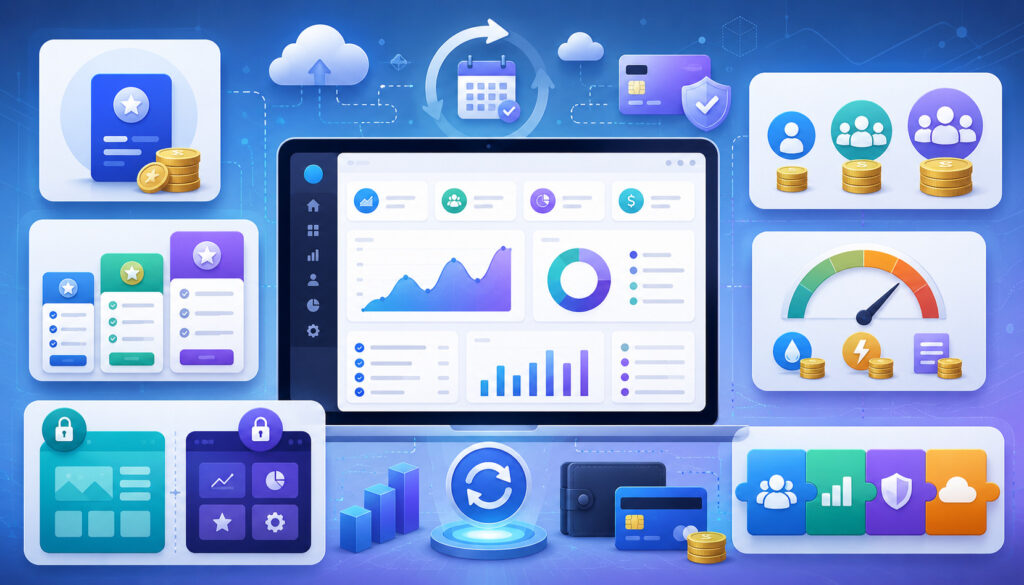
The principal pricing models for subscription businesses differ in what causes the customer’s price to change. It may remain fixed, increase according to the selected plan, depend on the number of users, follow actual consumption, or combine several variables.
Flat-Rate Pricing
Flat-rate pricing charges every subscriber the same recurring amount for the same offering. The customer receives one defined package, and the price remains fixed during each billing cycle unless the subscription terms change.
This model is easy to explain, display, bill, and reconcile. It may work well for straightforward memberships, content libraries, simple service plans, maintenance programs, or products whose customers use approximately the same level of resources.
Its main limitation is that different customers may receive very different levels of value while paying the same price. A light user may feel the flat-rate subscription is expensive, while a heavy user may consume substantially more support, storage, service time, or infrastructure without paying more.
Flat-rate pricing can also restrict customer segmentation. A small customer may not need every included feature, while a larger customer may be willing to pay more for advanced capabilities or higher limits. Businesses considering fixed pricing should examine whether usage and service costs remain reasonably consistent across the customer base.
Example: A professional membership charges one amount for access to monthly training sessions, a resource library, and community discussions. The simplicity supports easy enrollment, but the organization must monitor whether a small group of highly active members creates disproportionate support costs.
Tiered Pricing
Tiered pricing provides multiple subscription plans, commonly organized as basic, standard, and premium options. Each tier may differ by features, usage limits, storage, service levels, support availability, reporting tools, response times, or customer type.
The model allows businesses to serve customers with different requirements. A small team can select a lower-cost plan, while a larger or more complex customer can choose a plan with higher limits and additional capabilities.
Effective tiered pricing requires meaningful differences between plans. Customers should be able to identify why one tier costs more and which plan fits their situation. Artificially restricting essential functions merely to force upgrades can create dissatisfaction.
Too many tiers can also produce decision fatigue. A pricing page with numerous plans, overlapping limits, and unclear exceptions may cause customers to postpone the purchase. Three or four clearly differentiated plans are often easier to understand than a large collection of narrowly separated options, although the right number depends on the offering.
Per-User or Per-Seat Pricing
Per-user pricing charges according to the number of people authorized to use the subscription. The customer may pay one amount per user, select a package containing a set number of seats, or commit to a minimum number of accounts.
This structure is common when value increases as more employees, members, practitioners, students, or collaborators gain access. It is easy to connect account growth with revenue growth, and customers can often estimate the cost by multiplying the rate by the number of users.
Businesses must define what counts as a billable user. Possibilities include registered users, active users, assigned seats, administrators, or anyone who logged in during the billing period. Ambiguous definitions can lead to disputes.
Shared accounts are another concern. Customers may attempt to reduce costs by sharing credentials, which can weaken security and distort usage data. Reasonable account controls, role-based access, and clear licensing terms can address the issue without creating unnecessary friction.
Billing systems must also handle seat changes. The business should determine whether added users are charged immediately, prorated for the remaining cycle, or included at the next renewal. Removed seats may generate credits, reduce the next invoice, or remain committed until the contract period ends.
Usage-Based and Metered Pricing
Usage-based pricing charges customers according to actual consumption. The pricing metric might be transactions, messages, processing time, storage, appointments, deliveries, data volume, minutes, requests, or another measurable unit.
This model aligns payment with consumption. A customer using very little pays less, while a customer receiving more value or creating more cost pays more. It can reduce the barrier to adoption because customers do not need to commit to a large fixed plan before understanding their needs.
However, variable invoices can make budgeting difficult. Customers may worry about unexpectedly high charges, especially when usage is hard to monitor or predict. Businesses can improve predictability through spending alerts, usage dashboards, caps, estimates, and clear unit definitions.
Metered billing also requires accurate measurement. The system must record consumption, apply the correct rate, address duplicate or delayed events, preserve an audit trail, and explain calculations on invoices.
Some businesses use a minimum commitment. The customer pays for a baseline amount even when actual usage is lower, then pays additional charges beyond the included allowance. This approach provides a degree of recurring revenue predictability while preserving the flexibility of pay-as-you-go pricing.
Volume-Based and Graduated Pricing
Volume-based and graduated pricing both reduce the unit rate as consumption increases, but they calculate the final charge differently.
With volume-based pricing, one rate applies to all units based on the customer’s total volume. Suppose the first pricing level charges one amount per unit and the next level charges a lower amount. Once the customer reaches the second level, the lower rate may apply to every unit consumed.
With graduated pricing, separate rates apply to separate usage ranges. The customer pays the first rate for units in the first range, a second rate for units in the next range, and so forth.
This difference can materially affect the invoice. Volume pricing may create sudden price changes when a customer crosses a threshold. In some structures, consuming one additional unit could reduce the total charge because all prior units are repriced.
Graduated pricing usually produces a smoother progression because only the units in each range receive that range’s rate.
Businesses should show examples before enrollment. Terms such as “volume discount” do not tell customers which calculation method is being used. Billing systems, sales teams, invoices, and contracts must all follow the same definition.
Feature-Based Pricing
Feature-based pricing packages subscriptions according to the capabilities included in each plan. A basic plan might provide core functionality, while higher plans include automation, analytics, integrations, advanced permissions, additional storage, premium support, or enhanced service levels.
The model works best when the feature differences correspond to distinct customer needs. An individual may need only essential functions, while a larger organization may require administrative controls, audit records, reporting, or customized service.
A limitation is that feature packaging can become complicated. When every capability has separate restrictions, customers may struggle to determine what they are buying. Sales and support teams may also spend substantial time explaining exceptions.
Businesses should distinguish between features that create genuine incremental value and functions that are necessary for the product to work effectively. Placing a critical usability or security capability behind an unrelated premium tier may reduce trust.
Feature-based pricing is often combined with usage limits or per-user fees. In that case, the pricing page should clearly distinguish feature access from consumption allowances so customers can estimate both capability and total cost.
Freemium Pricing
The freemium model provides ongoing access to a limited version of the product at no charge. Customers pay when they need more features, capacity, support, users, storage, customization, or service.
Freemium can help potential customers experience the product before making a purchase. It may support product discovery and reduce the effort required to demonstrate basic value. However, free users still create infrastructure, support, security, and administration costs.
A successful upgrade path requires a natural reason to pay. The free plan should provide a legitimate use case, but paid plans should solve problems that become important as the customer’s needs increase. An intentionally unusable free plan may create frustration rather than confidence.
Conversion can also be difficult when the free version already satisfies the customer’s full needs. Businesses should analyze who uses the free plan, what actions indicate growing value, which limits lead to upgrades, and whether free accounts contribute to long-term strategic goals.
Freemium is different from a free trial. A free trial usually ends after a defined period, while a freemium account can generally remain active within its stated limits.
Membership Pricing
Membership pricing models charge for recurring access to an organization, facility, community, service network, content collection, discount program, or bundled set of benefits.
The value may come from access rather than direct consumption. Members might receive exclusive services, preferred booking, educational resources, special events, recurring deliveries, discounts, community participation, or priority support.
Membership pricing must make the continuing benefit visible. If members use benefits only occasionally, regular communication can remind them what is available without relying on aggressive renewal messaging.
The organization should calculate the cost of benefits carefully. Discounts, included services, support time, events, and physical products can reduce margins when active members use them more heavily than expected.
Membership tiers may be based on access level, household size, location, service frequency, or professional status. Any eligibility distinctions should be relevant, consistently applied, and communicated without misleading or discriminatory practices.
Hybrid Pricing
Hybrid pricing combines two or more subscription billing models. A business might charge a base subscription plus usage fees, per-user charges, add-ons, transaction fees, or premium services.
This approach can balance predictability with fairness. The base fee supports continued access and baseline operating costs, while variable charges reflect heavier usage or optional value.
For example, a service may include a monthly platform fee, five users, and a defined usage allowance. Additional users and consumption above the allowance create separate charges. Another business might combine a membership fee with paid appointments or premium events.
The disadvantage is complexity. Every additional pricing component creates another rule that customers, billing systems, finance teams, and support staff must understand.
A hybrid model should therefore separate charges clearly. Customers should know what is included, what triggers an additional fee, how usage is measured, and whether optional services renew automatically.
Subscription Pricing Models Compared
| Pricing model | How it works | Suitable use case | Main advantage | Potential limitation |
| Flat-rate | One recurring price covers one defined package | Simple services or memberships with similar customer usage | Easy to explain and manage | Light and heavy users pay the same |
| Tiered | Customers choose among plans with different limits or capabilities | Products serving distinct customer segments | Supports segmentation and upgrades | Too many tiers can confuse buyers |
| Per-user | Charges depend on assigned or active users | Team-based software and collaborative services | Revenue grows with account adoption | Shared accounts and seat changes require controls |
| Usage-based | Charges follow actual consumption | Services where value and cost track measurable usage | Customers pay in proportion to use | Variable bills may be difficult to predict |
| Volume-based | One rate applies based on total consumption volume | High-volume services with unit discounts | Encourages greater consumption | Thresholds can create abrupt price changes |
| Freemium | A limited version remains free, with paid upgrades | Products with low-cost self-service adoption | Allows customers to experience value | Free accounts may create cost without conversion |
| Feature-based | Plans differ according to included capabilities | Offerings with clearly separable functions | Connects higher prices to additional value | Excessive feature restrictions create complexity |
| Membership | Recurring payment provides access and continuing benefits | Communities, facilities, associations, and benefit programs | Builds an ongoing customer relationship | Benefits must remain visible and financially sustainable |
| Hybrid | Combines base fees, usage, seats, add-ons, or services | Complex offerings with fixed and variable value | Balances predictable and variable revenue | Billing and communication become more demanding |
The comparison table should be treated as a starting point rather than a decision rule. The best structure depends on how customers receive value, how costs change, how accurately usage can be measured, and how much billing complexity the organization can support.
Billing Frequency, Trials, Discounts, and Optional Purchases

The core model determines what is charged, while billing policies determine when the charge occurs and how changes are handled. Monthly billing, annual billing, free trials, introductory pricing, discounts, and add-ons can materially change the customer’s experience of the same underlying price.
Monthly Versus Annual Billing
Monthly billing requires a smaller immediate commitment and gives customers more frequent opportunities to reconsider the subscription. It may support easier adoption, but revenue is exposed to more renewal events, payment attempts, and short-term cancellations.
Annual billing collects a longer period of service in advance or establishes a longer contractual commitment. It may improve near-term cash flow and reduce the number of payment events, but it creates additional questions involving refunds, cancellation rights, revenue recognition, and service obligations.
An annual discount should reflect a deliberate strategy rather than an automatic assumption. The business should compare the value of earlier cash collection and stronger commitment against the lower effective price and potential refund exposure.
Finance teams must also distinguish cash collection from revenue recognition. Receiving an annual payment does not necessarily mean the full amount should be recognized immediately. Appropriate accounting treatment depends on the service obligation and applicable standards.
Customers should see the total annual charge, effective periodic rate, renewal date, cancellation terms, and any refund limitations before committing.
Free Trials and Introductory Pricing
A free trial provides temporary access before the standard charge begins. Introductory pricing charges a reduced amount for an initial period and then renews at the regular subscription price.
Trial length should give customers enough time to experience meaningful value. A complicated product may require onboarding and repeated use, while a simple service may demonstrate its value quickly.
Businesses must decide whether payment credentials are required at trial enrollment. Requiring a payment method can support automatic conversion, but it also creates a greater responsibility to disclose when charging begins, how much will be charged, and how the customer can cancel.
Renewal notices and transparent conversion terms reduce surprise. The checkout and confirmation should state:
- When the trial or introductory period ends
- The amount of the first paid charge
- The regular renewal price
- The billing frequency
- Whether the subscription renews automatically
- How and when cancellation must be completed
A trial should not rely on customer forgetfulness. The goal is to demonstrate value and support an informed decision.
Add-Ons, Bundles, and Optional Upgrades
Add-on pricing allows customers to purchase optional capabilities without moving to an entirely different plan. Add-ons may include additional storage, premium support, specialized reports, extra locations, service appointments, content packages, or advanced integrations.
Bundles combine multiple products or benefits at one price. They can simplify purchasing when the components naturally belong together, but they should not conceal the individual value or create unwanted obligations.
Optional upgrades help businesses expand accounts without creating too many primary plans. However, a long menu of add-ons can make total cost difficult to estimate.
Each optional item should answer four questions: What does it provide? How much does it cost? Does it renew? What happens when it is removed?
Discounts and Promotions
Subscription discounts may include introductory offers, annual billing reductions, coupon codes, referral credits, retention offers, or discounts tied to a defined customer group.
Every promotion should have a purpose. It might reduce initial adoption friction, reward a longer commitment, encourage referrals, or support migration from an older plan.
Frequent discounts can train customers to postpone purchasing until another offer appears. They may also make the standard price seem inflated or create dissatisfaction among existing subscribers who paid more.
Promotional terms should define eligibility, duration, renewal price, stacking rules, expiration, and the effect of upgrades or downgrades. Finance teams should measure discounted cohorts separately to determine whether they remain active and economically sustainable after the promotional period ends.
Value-Based, Cost-Based, and Competitor-Based Pricing
The pricing model describes the charging structure, but the business still needs a method for setting the price level. Value-based, cost-based, and competitor-based approaches provide different perspectives.
Value-Based Pricing
Value-based pricing considers the outcomes, convenience, risk reduction, access, savings, or experience customers believe the subscription provides. The price is influenced by perceived value rather than being calculated only from internal cost.
This approach requires customer research. Businesses should understand why customers subscribe, what alternatives they use, which outcomes matter, and how the subscription affects their work or daily activity.
Different segments may perceive different value. An individual user may value convenience, while a team may value coordination, control, reporting, or reduced administrative effort.
Value-based pricing does not mean charging the highest possible amount. It means creating a defensible relationship between price and customer benefit. The business must still account for affordability, competitive context, operating cost, service quality, and long-term trust.
Customer interviews, loss reviews, usage patterns, upgrade behavior, and support conversations can reveal value drivers that are not obvious from product features alone.
Cost-Based and Competitor-Based Pricing
Cost-based pricing starts with the expense of providing the service and adds an intended margin. Relevant costs may include infrastructure, labor, fulfillment, support, payment processing, refunds, fraud, compliance, customer acquisition, and administration.
This method helps identify a financial floor, but it may overlook customer value. Two services with similar delivery costs can provide very different outcomes.
Competitor-based pricing uses comparable market offerings as a reference. It can show what customers are accustomed to seeing and help identify broad positioning.
The limitation is that competitors may have different costs, audiences, features, funding priorities, or strategic goals. Copying their subscription plan pricing can reproduce assumptions that do not fit the business.
A balanced process usually considers all three perspectives: customer value, internal economics, and market context. None should be used in isolation.
Customer Segmentation and Pricing Presentation
Customer segmentation organizes buyers according to relevant differences in needs, usage, scale, purchasing behavior, or service requirements. Pricing presentation then communicates how those differences affect plan selection and total cost.
Building Responsible Customer Segments
Subscription pricing may vary for individual users, teams, larger organizations, high-volume customers, professional users, or customers requiring advanced support. Segmentation is useful when the distinctions correspond to real differences in value or cost.
A business might segment customers according to:
- Number of users or locations
- Usage volume
- Required service level
- Feature requirements
- Support complexity
- Contract length
- Administrative or reporting needs
- Purchasing process
Segments should not be based on misleading, arbitrary, or unfair treatment. Pricing policies should be consistently applied, documented, and reviewable.
Customer segmentation also influences onboarding, sales involvement, payment methods, invoice requirements, and contract terms. A self-service customer may need immediate online enrollment, while a complex organization may require approval workflows and customized implementation.
Pricing Psychology and Presentation
Pricing psychology concerns how customers interpret plans, comparisons, discounts, and total cost. Presentation can improve understanding, but it should not be used to conceal material terms.
Plan names should help customers recognize the intended use case. Labels such as “basic” or “premium” can work, but names tied to customer needs may be more informative.
Anchoring occurs when one price influences how another is perceived. Showing a higher-priced plan may make the middle option appear more moderate. This can support comparison, provided every plan is genuine and accurately described.
Monthly equivalents for annual plans should not replace the total amount charged. A customer who will be billed for a full annual term should be able to see that full charge before payment.
Comparison pages should clearly identify included features, usage limits, renewal frequency, optional costs, and major exclusions. Footnotes should clarify details rather than conceal essential conditions.
Subscription Payment Processing and Billing Operations
A pricing strategy cannot function reliably without the systems that authorize payments, store credentials securely, generate invoices, collect funds, and reconcile deposits.
The Recurring Payment Flow
A payment gateway transmits transaction information from the checkout or billing platform into the payment system. A processor routes authorization and settlement messages. A merchant account or equivalent acquiring relationship supports card acceptance and funding.
These roles may be bundled or provided through separate arrangements. Businesses can review this neutral explanation of payment processor and merchant account differences and this introductory guide to merchant account functions when evaluating the payment flow.
Recurring billing usually relies on stored payment credentials. Secure systems commonly replace the underlying account number with a token that can be used for future authorized transactions.
Tokenization can reduce direct exposure to sensitive data, but it does not remove the business’s responsibility to use appropriate security controls and follow applicable standards. The payment tokenization guidance explains how tokenization relates to payment-data protection.
Businesses should also understand authorization, capture, settlement, funding, and reconciliation. An approved charge is not identical to a completed deposit.
This resource on payment authorization and settlement explains the stages, while this guide to merchant statement reconciliation helps connect transactions, fees, adjustments, and deposits.
Failed Payments and Dunning
A failed payment occurs when the payment method cannot be charged successfully. Causes may include insufficient funds, expired credentials, account restrictions, incorrect details, issuer declines, fraud controls, or technical problems.
Dunning is the process of communicating with customers and attempting to recover failed recurring payments. A measured dunning process may include:
- Identifying the decline type.
- Retrying eligible transactions at reasonable intervals.
- Sending a clear customer reminder.
- Providing a secure payment-update method.
- Applying a defined grace period.
- Restricting access when payment remains unresolved.
- Canceling the account according to the agreement.
Not every decline should be retried repeatedly. Excessive attempts can create fees, customer frustration, or payment-system concerns.
Failed payments contribute to involuntary churn when customers lose access even though they did not intentionally cancel. Businesses should track recovery rates, reasons for failure, time to resolution, and the effect of account-update processes.
Upgrades, Downgrades, and Proration
An upgrade moves the customer to a higher-priced plan, adds capacity, or introduces additional services. A downgrade reduces features, usage limits, users, or service level.
Businesses must decide whether a plan change takes effect immediately or at the next billing cycle. Immediate upgrades may require a partial charge for the remaining period. Immediate downgrades may create a credit, refund, or reduced future invoice.
Proration calculates a partial charge or credit based on the portion of the billing cycle affected by the change. The formula should be consistent and visible.
For example, a customer upgrading halfway through a monthly cycle might receive credit for the unused portion of the old plan and a charge for the remaining portion of the new plan. Alternatively, the business may keep the current plan active until renewal and apply the new plan then.
Customer notifications should show the effective date, credit, new charge, next renewal amount, and resulting feature changes.
Taxes, Fees, and Billing Transparency
Subscription invoices may involve taxes, processing expenses, service fees, regulatory charges, or other amounts beyond the advertised base price. The treatment depends on the offering, customer location, transaction type, and applicable requirements.
Businesses should obtain qualified guidance when determining tax collection, invoice wording, revenue recognition, or contractual obligations. General information cannot replace legal, accounting, tax, financial, or compliance advice tailored to the organization.
Billing transparency requires customers to understand the amount they will pay before completing enrollment. The checkout should identify the subscription price, billing cycle, taxes or mandatory fees when known, trial terms, renewal date, and cancellation conditions.
Usage-based services should explain how consumption is measured and when usage is finalized. Hybrid plans should separate the base subscription from variable charges. Annual plans should show the full amount charged rather than relying only on a monthly equivalent.
Transparent invoices also support customer service and reconciliation. A useful invoice identifies the plan, billing period, quantity, units, credits, discounts, taxes, payments, and outstanding balance.
Unexpected charges create disputes even when the calculation is technically correct. Businesses should test invoices with people who did not design the pricing model and ask them to explain each line item.
Subscription Metrics to Monitor
Subscription metrics help businesses determine whether pricing is understandable, financially sustainable, and aligned with customer value. No universal benchmark applies to every subscription business because customer behavior, margins, contract lengths, payment methods, and acquisition channels vary.
Important measures include:
- Recurring revenue: Revenue associated with active recurring subscriptions during a defined period.
- Average revenue per customer: Recurring revenue divided by the relevant active customer count.
- Customer churn: The percentage or number of customers who cancel or become inactive.
- Revenue churn: The recurring revenue lost through cancellations and downgrades.
- Retention: The proportion of customers or revenue that remains active over time.
- Customer lifetime value: An estimate of the economic contribution of a customer relationship, based on revenue, margin, retention, and related assumptions.
- Customer acquisition cost: The sales and marketing cost associated with acquiring customers.
- Trial conversion: The proportion of trial users who become paying subscribers.
- Upgrade and downgrade rates: The frequency with which customers move between plans.
- Failed-payment rate: The share of payment attempts that do not succeed.
- Recovery rate: The portion of failed payments collected through retries or customer updates.
- Payment-processing cost: The fees and operational expenses associated with collecting subscription payments.
Metrics should be analyzed by cohort, plan, acquisition channel, billing frequency, and customer segment. A blended average can hide meaningful differences.
For example, annual customers may have different retention patterns from monthly customers. Discounted customers may behave differently from full-price customers. High-usage accounts may produce more revenue but also require substantially more support.
How to Choose and Test a Subscription Pricing Model
Choosing among subscription pricing models requires evidence about customer value, usage behavior, delivery costs, payment preferences, and operational capability. The best model is not necessarily the most sophisticated one.
Factors to Review Before Choosing a Subscription Pricing Model
| Evaluation factor | Question to ask | Why it matters | Possible warning sign |
| Customer value | What continuing outcome does the customer receive? | Pricing should connect to an identifiable benefit | Customers cannot explain why they would renew |
| Usage pattern | Does consumption vary substantially by customer? | Variation may support usage or tiered pricing | Heavy users create much higher costs at one flat price |
| Cost structure | Which costs are fixed and which increase with usage? | The model must remain economically sustainable | Revenue stays fixed while service costs rise sharply |
| Pricing metric | What measurable unit best reflects value? | A good metric makes price increases understandable | The metric is easy to count but unrelated to customer benefit |
| Payment behavior | Do customers prefer smaller recurring payments or longer commitments? | Billing frequency affects adoption and cash flow | Annual plans create refund or commitment objections |
| Billing complexity | Can systems calculate every rule accurately? | Complex models require reliable automation | Charges depend on spreadsheets or manual corrections |
| Scalability | Will the model remain workable as accounts grow? | Pricing should support larger customers without repeated redesign | Every larger account requires a unique exception |
| Customer understanding | Can buyers estimate their likely total cost? | Predictability supports informed purchasing | Sales teams regularly need to explain basic calculations |
| Operational resources | Can support and finance teams manage changes and disputes? | Pricing creates ongoing administrative responsibilities | Proration and credits are handled inconsistently |
How to Test Pricing
Pricing tests should begin with research rather than immediate price changes. Interviews, support conversations, lost-sale reviews, usage analysis, cancellation feedback, and purchasing behavior can identify what customers value and where they become confused.
Businesses can compare plan descriptions, packaging, feature groupings, billing frequency, and pricing metrics through controlled experiments. Tests should have a clear question and a defined evaluation method.
Cohort analysis is important because initial conversion does not reveal long-term performance. A lower introductory price may increase enrollment but produce weak retention or lower lifetime value. A higher price may reduce sign-ups while attracting customers with stronger fit.
Customer feedback should examine comprehension as well as preference. Ask participants to identify what is included, estimate the likely bill, explain the renewal terms, and choose a plan for a realistic scenario.
Frequent disruptive changes should be avoided. Constantly altering plan names, limits, and prices can confuse customers, complicate support, and make performance comparisons unreliable.
How to Change Existing Subscription Prices
Changing existing prices requires more care than launching an initial offer because active customers already have expectations, billing histories, and contractual rights.
The business should begin by identifying which customers are affected, when their prices can change, and what notice is required. Contract terms, renewal dates, applicable rules, and customer-specific commitments may limit the timing or method.
Possible transition approaches include:
- Applying the new price at the next renewal
- Providing advance notice before the next billing cycle
- Keeping existing customers on grandfathered plans
- Moving customers gradually by cohort
- Offering a temporary transition credit
- Allowing customers to select an alternative plan
Grandfathered pricing preserves an older rate for existing customers. It can reduce disruption but creates operational complexity when multiple historical plans remain active.
Communications should explain the new price, effective date, reason for the change, available options, and how to cancel or change plans. Avoid vague messages that require customers to search for the actual amount.
Billing systems must be updated carefully. Teams should test renewals, invoices, taxes, discounts, upgrades, downgrades, proration, failed-payment recovery, and cancellation before the change becomes active.
Support staff should receive scripts, examples, escalation rules, and authority to resolve billing errors. Price changes often generate questions even when the communication is clear.
Common Subscription Pricing Mistakes
Subscription pricing mistakes often occur when businesses focus on the visible price and overlook customer research, billing operations, and long-term account behavior.
Common problems include:
- Creating too many plans: Excessive choices make comparison difficult and increase billing complexity.
- Choosing prices without customer research: Internal assumptions may not reflect customer value or purchasing behavior.
- Hiding renewal terms: Customers may dispute charges they did not reasonably expect.
- Using confusing usage calculations: Unclear units and thresholds make variable bills difficult to verify.
- Offering discounts without a strategy: Promotions can reduce revenue without improving customer quality or retention.
- Ignoring processing costs: Payment fees, refunds, disputes, and failed attempts affect subscription economics.
- Making cancellation difficult: Friction may generate complaints, disputes, and reputational harm.
- Failing to test upgrades and proration: Incorrect credits and partial charges create billing errors.
- Overcomplicating billing: A model may be mathematically elegant but operationally unmanageable.
- Tracking revenue without tracking churn: New sales can conceal the loss of existing customers.
- Copying competitors without understanding value: Another business’s pricing may reflect different customers, costs, or objectives.
The underlying lesson is that recurring revenue pricing must work across the entire customer lifecycle. Enrollment, payment authorization, renewal, usage calculation, plan changes, invoicing, cancellation, and reconciliation are parts of the same system.
A Step-by-Step Subscription Pricing Framework
A structured process helps businesses move from assumptions to a pricing model that can be explained, implemented, and reviewed.
- Define the target customer. Identify who the subscription is designed to serve, what situation they are in, and how they purchase.
- Identify the core value delivered. Describe the continuing outcome customers receive and why they would renew.
- Study usage and purchasing behavior. Determine how often customers use the offering, how usage varies, and what triggers greater value.
- Calculate service and support costs. Include infrastructure, fulfillment, labor, support, payment processing, refunds, compliance, and administration.
- Select a pricing metric. Choose a unit connected to customer value, such as access, users, usage, locations, or service level.
- Choose a suitable model. Compare flat-rate, tiered, per-user, usage-based, feature-based, membership, and hybrid structures.
- Create clear plan differences. Make each plan suitable for a recognizable customer need rather than separating plans through arbitrary restrictions.
- Configure billing and payment processing. Establish billing cycles, stored credentials, tokenization, invoices, retries, settlement, reconciliation, and access rules.
- Test customer understanding. Ask representative customers to choose a plan, estimate the bill, and explain renewal conditions.
- Launch and monitor performance. Track conversion, revenue, churn, retention, upgrades, failed payments, processing costs, and support questions.
- Gather feedback. Review interviews, cancellation reasons, payment disputes, sales objections, and account behavior.
- Refine pricing carefully. Make controlled changes, preserve reliable comparisons, communicate clearly, and avoid unnecessary disruption.
This framework should be repeated as the offering, customer base, costs, and usage patterns evolve. Pricing is not a one-time decision, but it should not be changed impulsively.
Frequently Asked Questions
What Are Subscription Pricing Models?
Subscription pricing models are structures that determine how customers are charged for continuing access to a product, service, membership, or recurring benefit.
The model defines what drives the price, such as a fixed fee, selected tier, number of users, level of consumption, included features, or combination of variables.
The model also works alongside billing frequency and operational rules. Two businesses may both use tiered pricing, but one bills monthly while the other bills annually. They may also use different trial terms, discounts, proration methods, and cancellation policies.
A useful pricing model aligns the amount charged with customer value and delivery cost while remaining understandable and manageable.
Which Subscription Pricing Model Is Easiest to Manage?
Flat-rate pricing is generally the least complicated because every customer purchases the same package at the same recurring price. Billing systems do not need to measure usage, count users, or calculate multiple feature combinations.
However, simplicity does not automatically make it appropriate. A flat-rate model may perform poorly when customer value or service cost varies substantially. Heavy users can become expensive to serve, while light users may consider the subscription overpriced.
The easiest appropriate model is the simplest structure that still reflects meaningful differences in customer needs and economics. Some businesses need tiered pricing to remain fair and sustainable even though it requires more administration.
What Is the Difference Between Tiered and Usage-Based Pricing?
Tiered pricing charges according to the plan selected by the customer. Each plan usually includes defined features, limits, or service levels. The recurring price remains predictable while the customer stays within that plan.
Usage-based pricing charges according to actual consumption. The invoice can increase or decrease as the customer uses more or less of the service.
A tiered plan may include a usage allowance, but the plan price is still the primary charge. A hybrid model may combine both approaches by charging a fixed tier price plus additional usage beyond the included amount.
The choice depends on whether value is better represented by a package or by measurable consumption.
How Does Per-User Pricing Work?
Per-user pricing charges according to the number of people who have access to the subscription. A business may charge for assigned seats, registered users, active users, or a committed minimum number of accounts.
The definition of a billable user should be stated clearly. Charging for every registered account can produce dissatisfaction when many accounts are inactive, while active-user billing requires reliable tracking.
The business must also decide how seat changes affect invoices. Added users may be charged immediately or at renewal. Removed users may generate a credit, reduce the next invoice, or remain billable until a commitment period ends. Clear account controls help prevent credential sharing and inaccurate seat counts.
What Is a Hybrid Subscription Model?
A hybrid subscription model combines multiple pricing components. Common examples include a base subscription plus usage charges, a platform fee plus per-user pricing, or a membership fee plus paid premium services.
Hybrid pricing can match revenue more closely to both ongoing access and variable consumption. It may also help customers begin with a predictable base price while paying more only when their needs grow.
The main challenge is communication. Customers must understand what the base fee includes, what triggers additional charges, and how variable amounts are calculated.
Businesses should use hybrid pricing only when each component serves a clear purpose. Adding fees merely to increase the displayed total can undermine trust.
Should Subscriptions Be Billed Monthly or Annually?
Monthly billing reduces the customer’s initial commitment and may make enrollment easier. It also creates more payment events and gives customers frequent opportunities to cancel.
Annual billing can improve near-term cash collection and reduce the number of payment attempts, but customers take on a larger commitment. The business must address renewal notices, refunds, cancellation treatment, and revenue recognition.
Many businesses offer both options, sometimes with a lower effective rate for annual payment. The discount should be evaluated against cash flow, retention, support obligations, and refund exposure.
The appropriate choice depends on how quickly customers experience value and how comfortable they are making a longer commitment.
How Should Businesses Price Free Trials?
A true free trial does not have a customer price during the trial period, but the business must decide what access is included, how long the trial lasts, and what happens when it ends.
The trial should be long enough for customers to experience the core value. It should not be extended merely to delay the purchasing decision.
When payment credentials are collected in advance, the conversion date and amount must be communicated clearly. Customers should know whether the subscription begins automatically and how to cancel before the charge.
Businesses should evaluate trials through conversion, retention, support cost, product engagement, and customer understanding rather than enrollment volume alone.
What Is Proration?
Proration is the calculation of a partial subscription charge or credit when a plan changes during a billing period. It prevents the customer from paying a full-period price for a plan used during only part of that period.
For an immediate upgrade, the customer might receive credit for the unused portion of the old plan and pay for the remaining portion of the new plan. A downgrade may create a credit or take effect at the next renewal.
Proration methods can vary according to calendar days, billing-system rules, contract terms, or service usage. The selected method should be consistent.
Customers should receive a clear notice showing the effective date, credit, additional charge, and next renewal amount.
How Can Businesses Change Subscription Prices?
Businesses should review contracts, renewal dates, notice requirements, billing rules, and applicable obligations before changing an existing subscription price.
The change should be communicated before it takes effect. The message should identify the current price, new price, effective date, available plans, and cancellation or downgrade options.
Some businesses maintain grandfathered plans for existing customers, while others apply the change at the next renewal. Each approach creates different financial and operational effects.
Before implementation, teams should test invoices, discounts, annual plans, taxes, proration, failed-payment workflows, and account access. Support staff should be prepared to explain the change and resolve errors.
Which Metrics Should Subscription Businesses Track?
Useful metrics include recurring revenue, average revenue per customer, customer churn, revenue churn, retention, customer lifetime value, customer acquisition cost, trial conversion, upgrade rates, downgrade rates, failed-payment rates, recovery rates, and payment-processing costs.
The metrics should be segmented by plan, cohort, billing frequency, acquisition channel, and customer type. A single overall average can conceal weak performance in a particular group.
Businesses should also track operational indicators such as billing complaints, cancellation reasons, invoice corrections, and support contacts related to pricing.
No universal target applies to every business. Metrics are most useful when compared with the organization’s prior periods, forecasts, costs, and customer segments.
How Do Failed Payments Affect Subscription Revenue?
Failed payments interrupt expected collections and may cause involuntary churn. A customer can lose access even when they intended to continue because the stored payment method expired, lacked available funds, or was declined.
The immediate effect is delayed or lost revenue. Additional effects may include retry fees, support work, account restrictions, reconciliation complexity, and customer dissatisfaction.
A structured dunning process can identify eligible retries, notify the customer, provide a secure update method, and apply a reasonable grace period.
Businesses should distinguish failed payments from intentional cancellations. The causes, customer intent, and appropriate recovery actions are different.
How Can Businesses Avoid Confusing Customers With Too Many Plans?
Each plan should be designed for a recognizable customer situation. When two plans serve nearly identical users, they may be better combined.
Businesses should limit primary choices, use consistent feature names, highlight meaningful differences, and show total expected cost. Optional add-ons can handle specialized needs without creating another complete tier.
Pricing pages should be tested with people who are unfamiliar with the offering. Ask them which plan they would choose, what is included, and how much they expect to pay.
Repeated questions about the same plan distinction are evidence that packaging or presentation needs improvement.
Conclusion
The right subscription pricing model aligns customer value, usage patterns, operating costs, billing complexity, payment behavior, retention goals, and long-term scalability. Flat-rate, tiered, per-user, usage-based, feature-based, membership, freemium, and hybrid models each solve different commercial problems.
Businesses should begin with customer needs and a defensible pricing metric, then confirm that billing, payment processing, support, finance, and reporting systems can manage the selected structure accurately.
Transparent renewal terms, simple plan differences, secure recurring payments, understandable invoices, and fair cancellation procedures are fundamental parts of the strategy.
Pricing effectiveness varies by business model, segment, market conditions, costs, and value delivered. Regular performance reviews and customer research can reveal where adjustments are needed, but major changes should be tested carefully and communicated clearly.
A sustainable recurring billing strategy is not the one with the most plans or calculations. It is the one customers can understand, the business can operate reliably, and both parties can continue to view it as a fair exchange of value.
Meta Description –
Explore subscription pricing models, benefits, limitations, billing options, payment considerations, and steps to choose and test the right strategy today.