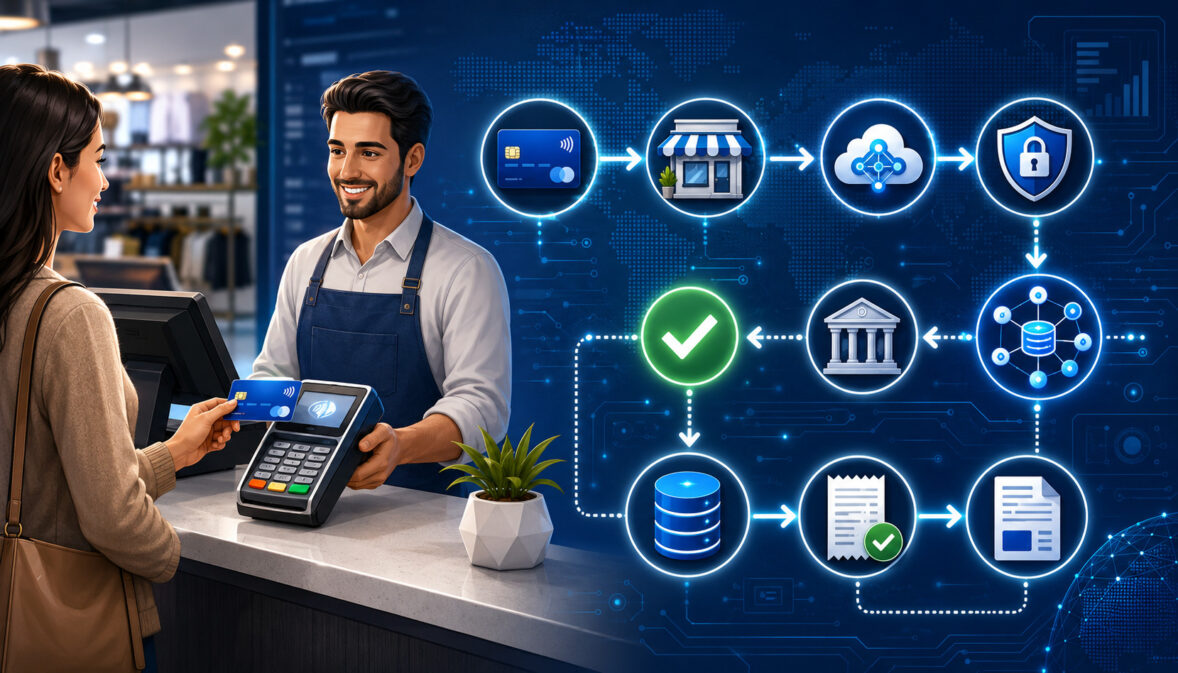
A card payment can feel almost instant. A customer taps a contactless card, inserts an EMV chip card, swipes, or enters card details online, and within seconds the checkout screen shows an approval or decline.
For the customer, that may seem like the entire payment. For the business, it is only the beginning of a much larger sequence.
The credit card transaction lifecycle is the full journey a card payment follows from the moment payment starts through authorization, capture, payment clearing, payment settlement, payment funding, and possible follow-up events such as refunds, voids, reversals, or chargebacks.
Understanding this lifecycle helps business owners, ecommerce sellers, service providers, and finance teams make better decisions about payment tools, cash flow, reconciliation, fraud prevention, and dispute management.
Behind every transaction approval are several parties working together: the cardholder, merchant, payment gateway, payment processor, acquiring bank, issuing bank, and card network.
Each party has a specific role in moving payment data, checking risk, confirming available funds or credit, calculating fees, and transferring money.
This guide explains the credit card transaction lifecycle step by step. It also covers the differences between card-present transaction and card-not-present transaction flows, what happens when a transaction is declined, how fees are connected to the credit card payment process, and why payment security matters at every stage.
What Is the Credit Card Transaction Lifecycle?
The credit card transaction lifecycle is the sequence of technical, financial, and operational steps that occur whenever a business accepts a card payment. It begins when a customer provides payment details and continues until the transaction is authorized, captured, cleared, settled, funded, and reconciled.
In some cases, the lifecycle continues even longer if the customer requests a refund, the merchant voids the payment, or the cardholder starts a chargeback process.
A simple purchase may look like one event at checkout, but a card payment transaction process is divided into several distinct stages. First, the customer initiates payment.
Next, the merchant’s payment system sends an authorization request through the payment gateway or payment processor. The request travels through the card network to the issuing bank, which reviews the cardholder account and sends back an authorization response.
If the transaction is approved, the merchant still has not been paid yet. Authorization only confirms that the issuer has approved the transaction at that moment. The merchant must capture the approved transaction, usually through batch processing.
Then payment clearing finalizes the transaction details, and payment settlement moves funds through the appropriate parties. Finally, payment funding deposits the net amount into the merchant’s bank account.
This matters because each stage can affect cash flow, costs, customer experience, fraud exposure, and accounting. A business that understands the credit card processing lifecycle can better answer questions such as:
- Why was a transaction approved but not deposited yet?
- Why did the deposit amount differ from gross sales?
- Why did a customer see an authorization hold?
- Why did a refund take time to appear?
- Why did a chargeback remove funds after settlement?
Key Participants in a Credit Card Transaction

A credit card payment process involves several participants, each handling a different part of the transaction. Some are visible to the customer, while others work behind the scenes. Understanding these roles makes the entire credit card transaction process easier to follow.
At the center are the cardholder and merchant. The cardholder is the customer using a payment card. The merchant is the business accepting the card payment for goods or services. The transaction may happen in person, online, over the phone, through a mobile device, or through recurring billing.
The payment gateway is commonly used for online payments and other card-not-present transaction environments. It securely transmits payment information from the checkout page, invoice, app, or virtual terminal to the processor. In a physical store, the payment terminal or POS system may connect more directly to the payment processor.
The payment processor routes transaction data between the merchant, acquiring bank, card network, and issuing bank. The acquiring bank, also called the acquirer, supports the merchant’s ability to accept card payments.
The issuing bank, also called the issuer, is the bank or financial institution that issued the card to the cardholder. The card network connects acquirers and issuers and sets many of the rules for authorization, clearing and settlement, interchange fees, and dispute handling.
These parties must coordinate quickly and securely. The authorization response often comes back in seconds, but clearing, settlement, and funding usually happen later. That delay is normal and is one of the most important distinctions for businesses to understand.
Cardholder and Merchant
The cardholder is the person or organization using a card to make a purchase. The cardholder may be buying groceries at a retail counter, paying an invoice through a secure payment link, ordering from an ecommerce checkout, booking a service appointment, or paying a monthly subscription through recurring billing. The cardholder starts the payment by presenting card credentials in a format the merchant can accept.
The merchant is the business accepting the card payment. A merchant may accept card-present transaction payments through a countertop terminal, mobile reader, POS system, or contactless payments device.
A merchant may also accept online payments through an ecommerce checkout, hosted payment page, payment gateway, invoice payment link, or virtual terminal.
This relationship seems simple: the customer pays, and the business gets paid. However, the merchant must also manage authorization, capture, batching, settlement, refunds, disputes, security requirements, and recordkeeping.
The cardholder expects a fast and reliable payment experience, while the merchant needs accurate deposits, low friction, and protection from fraud and chargebacks.
A good payment experience depends on both sides. Customers should recognize the billing descriptor, understand refund policies, and receive clear receipts. Merchants should use secure tools, train staff, and keep transaction records organized.
Payment Gateway, Processor, Acquirer, Issuer, and Card Network
The payment gateway is the secure bridge between the merchant’s payment environment and the processor, especially for ecommerce, mobile, invoice, and virtual terminal payments. It encrypts and transmits transaction details so the authorization request can move forward.
For businesses comparing online tools, this virtual terminal and payment gateway comparison can help clarify how different acceptance methods support remote payments.
The payment processor handles routing. It sends the authorization request to the appropriate card network, receives the authorization response, supports batch processing, and helps move transaction data through clearing and settlement. The acquiring bank supports the merchant account or acquiring relationship and receives settled funds on the merchant side.
The issuing bank reviews the cardholder’s account. It checks whether the card is valid, whether the account has available credit or funds, whether the transaction appears suspicious, and whether issuer rules allow the purchase. The card network connects the acquiring side and issuing side while applying network rules and fee structures.
These participants make the card payment lifecycle possible. The merchant may only interact directly with a processor, gateway, or payment platform, but the full lifecycle depends on all parties working together.
Step 1: Payment Initiation
Payment initiation begins when the customer provides card information to the merchant. This can happen in several ways.
A customer may insert an EMV chip card, tap a contactless card or mobile wallet, swipe a magnetic stripe, enter card details on an ecommerce checkout page, provide card data over the phone, click a payment link, or authorize recurring billing for future payments.
In a card-present transaction, the card or payment device is physically present at checkout. Examples include retail stores, restaurants, salons, repair shops, medical offices, and mobile service businesses using a card reader.
Card-present payments commonly use EMV chip, contactless payments, or mobile wallet technology. These methods can help reduce certain types of fraud because the cardholder uses a physical credential or device at the point of sale.
In a card-not-present transaction, the card is not physically presented to the merchant. Examples include online payments, keyed transactions, phone orders, mail orders, payment links, stored cards, and subscription billing.
These transactions often carry higher fraud risk because the merchant cannot physically inspect the card or interact with the cardholder face to face.
The merchant’s payment system collects the transaction amount, card data or token, merchant information, and other details needed to start the credit card authorization process.
In online environments, fraud screening may begin immediately. The system may check billing address, card verification code, IP address, device data, velocity patterns, order size, and customer history.
For recurring billing, initiation may happen automatically after the customer has provided permission. The first transaction often establishes the payment method, while later transactions rely on stored credentials, tokenization, and rules for recurring transactions.
Step 2: Authorization Request
The authorization request is the message asking whether the transaction should be approved. It is one of the most important parts of the credit card transaction lifecycle because it determines whether the merchant can proceed with the sale.
After payment initiation, the merchant’s POS system, website, app, virtual terminal, or invoice platform securely sends transaction data through the payment gateway or payment processor.
The processor routes the information to the card network, which forwards it to the issuing bank. The request usually includes the transaction amount, card account data or token, merchant category, merchant identification information, transaction type, currency, security data, and other risk-related details.
For card-present payments, the authorization request may include EMV chip data, contactless data, terminal capability, and cardholder verification information. For online payments, the request may include address verification information, card verification code results, ecommerce indicators, token data, and fraud screening signals.
The issuing bank uses this information to evaluate the transaction. It may check whether the card account is open, whether the card has been reported lost or stolen, whether the cardholder has enough available credit, whether the transaction fits normal spending behavior, and whether the merchant category is allowed.
Payment authorization is not the same as receiving money. It is a permission step. When approved, the issuer generally places a hold on the cardholder’s available credit or funds. The merchant must still capture the transaction and submit it for clearing and settlement.
Security is critical during this stage. Encryption protects data while it is transmitted, and tokenization can reduce exposure by replacing sensitive account data with a token. The official PCI data security standard overview explains the broader security framework used to protect payment account data.
Step 3: Issuer Review and Authorization Response
Once the issuing bank receives the authorization request, it reviews the transaction and sends an authorization response. This response tells the merchant whether the payment is approved, declined, or requires another action. The response travels back through the card network and processor to the merchant’s payment system.
A transaction approval means the issuer has approved the payment at that moment. It usually means the card is valid, the account has available credit or funds, and the transaction did not trigger a blocking risk rule. The merchant can generally complete the sale and later capture the transaction.
A declined transaction means the issuer did not approve the authorization request. Common reasons include insufficient available credit, suspected fraud, expired card, incorrect card number, wrong expiration date, incorrect security code, spending limits, issuer restrictions, account closure, or a temporary technical issue.
Some declines are soft declines, which may be resolved by retrying later or asking the customer to verify information. Others are hard declines, where the merchant should request another payment method.
The merchant does not always receive the full reason for the decline. Often, the response code gives only a general category. This protects cardholder privacy and issuer risk rules, but it can frustrate customers and staff.
Authorization also creates expectations. The customer may see a pending charge or hold even though the merchant has not yet received funds. If the transaction is not captured, the hold may fall off based on issuer timing. If the amount changes, such as with tips, hotel stays, rental deposits, or fuel purchases, the final captured amount may differ from the original authorization.
Step 4: Capture and Batch Processing
Capture is the step where the merchant confirms that an approved transaction should move forward for payment. Authorization says, “This transaction may proceed.” Capture says, “Submit this approved transaction for clearing and settlement.”
In many retail and ecommerce systems, capture happens automatically after authorization. For example, when a customer buys a product in a store or completes an online purchase, the transaction may be authorized and captured almost immediately.
In other situations, capture may be delayed. A hotel, rental business, service provider, or ecommerce seller may authorize first and capture later when the service is complete, the final amount is known, or the item ships.
Batch processing groups captured transactions together for submission. Many merchants close their batch at the end of the business day. Some systems batch automatically at a scheduled time, while others require manual batch close. If a batch is not closed, settlement and funding may be delayed.
Batch processing matters because it affects timing, reconciliation, and fees. Transactions that remain authorized but uncaptured do not move into clearing and settlement. This can create customer confusion because the cardholder may see a pending hold while the merchant does not receive funds.
A batch usually includes multiple approved transactions, including sales, captures, and sometimes credits or returns depending on the system. The processor sends the batch for clearing, where transaction details are finalized and fees begin to be calculated more precisely.
Businesses should monitor batch status daily. A missed batch close can delay payment funding, create settlement mismatches, and complicate bookkeeping. For multi-location businesses, batch timing should be consistent so finance teams can match deposits to sales reports.
Step 5: Clearing
Payment clearing is the stage where transaction details are finalized and exchanged among the payment processor, acquiring bank, card network, and issuing bank. If authorization is the “yes or no” stage, clearing is the stage where the transaction data is prepared for final financial movement.
During clearing, the captured transaction is submitted with details such as merchant information, transaction amount, card type, authorization code, transaction date, merchant category, and acceptance method.
The card network uses this information to determine how the transaction should be categorized. That categorization can influence interchange fees and other costs.
Clearing also helps align the records between the acquiring side and issuing side. The issuer needs accurate information to post the transaction to the cardholder’s account. The acquiring side needs accurate information so the merchant can be paid correctly. Any mismatch, missing data, or late submission may affect cost, settlement timing, or exception handling.
Interchange fees are a major part of this stage. Interchange is generally paid through the acquiring side to the issuing side and varies based on factors such as card type, merchant category, transaction method, risk level, and data quality.
Assessment fees are generally charged by the card network. Processor markup and other provider-related fees may be added separately depending on the merchant’s pricing model. This interchange fee guide provides more background on how interchange works and why it matters for merchants.
Clearing is mostly invisible to customers, but it matters greatly to businesses. It affects whether the transaction posts correctly, how fees are applied, and how quickly funds can move toward settlement.
Step 6: Settlement and Merchant Funding
Payment settlement is the movement of funds between the issuing side and acquiring side after clearing. Once transactions are cleared, the issuing bank transfers the transaction amount, minus applicable interchange and network-related amounts, through the card network and acquiring side.
The acquiring bank or payment processor then funds the merchant according to the merchant’s funding schedule and account terms.
Merchant funding is the final deposit into the merchant’s bank account. The deposited amount may not match gross card sales because fees, refunds, chargebacks, reserves, adjustments, or other deductions may be applied.
Some merchants receive gross deposits with fees billed later. Others receive net deposits after fees are deducted. This difference is important for reconciliation.
Funding timing depends on several factors. These may include batch close time, processor cutoff, banking schedules, weekends, holidays, risk reviews, merchant account status, transaction type, and whether the business is new or considered higher risk.
Some businesses may qualify for faster funding, while others may experience holds or reserves if the processor or acquiring bank needs to manage risk.
Settlement delays can happen for legitimate reasons. A batch may be submitted after the cutoff. A funding bank account may be under verification. A transaction may be flagged for review. A merchant may have unusual volume, a spike in refunds, or an increase in chargebacks.
Ecommerce sellers and service businesses should understand these possibilities because payment funding directly affects cash flow.
Reconciliation should compare POS or gateway reports, batch totals, processor statements, deposit records, refund activity, and chargeback activity. This helps identify missing batches, duplicate charges, settlement mismatches, and fee-related differences.
Step 7: Post-Transaction Events
The credit card processing lifecycle does not always end when funds are deposited. After settlement, several post-transaction events may occur. These include refunds, voids, reversals, retrieval requests, chargebacks, and dispute management actions. These events can affect cash flow, customer satisfaction, reporting, and risk standing.
A customer may request a refund because they returned an item, canceled a service, were billed incorrectly, or were dissatisfied with the purchase.
A merchant may void a transaction before settlement if the payment was entered incorrectly or the customer changed their mind quickly. A reversal may release an authorization hold or correct a transaction before it fully settles.
A chargeback is different from a refund. In a refund, the merchant voluntarily returns funds to the customer through the normal payment system. In a chargeback, the cardholder disputes the charge through the issuing bank, and the funds may be forcibly removed from the merchant while the dispute is reviewed.
Chargebacks can include reason codes related to fraud, authorization, processing errors, non-receipt, canceled recurring billing, duplicate billing, or product and service disputes.
Post-transaction events require documentation. Businesses should keep receipts, order confirmations, delivery proof, signed agreements, service records, refund communications, cancellation terms, and customer messages. These records support dispute management and help finance teams understand why settled funds changed later.
The business guidance on payments and billing emphasizes the importance of authorized charges and clear billing practices. For merchants, this reinforces the need for clear consent, accurate billing, and transparent recurring payment terms.
Refunds, Voids, and Reversals
Refunds, voids, and reversals are often confused, but they apply at different points in the card payment lifecycle. A void usually happens before a transaction settles. If the merchant catches an error on the same day, such as the wrong amount or duplicate entry, the merchant may void the transaction so it does not move forward in the batch.
A refund usually happens after settlement. Once the transaction has cleared and funds have moved, the merchant cannot simply cancel it. Instead, the merchant sends money back to the cardholder’s account through a refund. Refund timing depends on the merchant system, processor, issuer, and posting timelines.
A reversal often relates to an authorization hold. For example, if a transaction is authorized but not completed, a reversal may tell the issuer to release the hold sooner. This can help reduce customer frustration when a pending amount appears on the cardholder’s account.
Timing is the key difference. Before settlement, a void may be possible. After settlement, a refund is usually required. If a hold exists but no final charge will be submitted, a reversal may help clear the authorization.
Chargebacks and Disputes
A chargeback begins when the cardholder disputes a transaction with the issuing bank. The issuer reviews the claim and may send the dispute through the card network to the acquiring side. The merchant is then given an opportunity to accept the chargeback or respond with documentation.
The chargeback process is designed to protect cardholders from unauthorized or unresolved transaction problems, but it can be costly and time-consuming for merchants.
A chargeback can remove funds from the merchant account, trigger a chargeback fee, consume staff time, and increase risk monitoring. Too many disputes may lead to higher costs, reserves, or account restrictions.
Common causes include fraud claims, unclear billing descriptors, duplicate charges, refund delays, shipping problems, canceled subscriptions that continue billing, poor communication, and customers who do not recognize the merchant name on their statement. Strong dispute management starts before the dispute happens.
Businesses can reduce chargebacks by using clear descriptors, sending receipts, publishing refund policies, responding quickly to customer concerns, documenting delivery or service completion, using fraud screening, and confirming consent for recurring billing. Good records do not guarantee a win, but they improve the merchant’s ability to respond effectively.
Credit Card Transaction Lifecycle Table
The table below summarizes the major stages of the credit card transaction lifecycle and why each stage matters to the merchant. While the customer may only notice the checkout approval and later statement posting, the merchant’s payment operation depends on every step working correctly.
| Lifecycle Stage | What Happens | Main Parties Involved | Why It Matters |
| Payment initiation | Customer taps, inserts, swipes, keys, or enters card details online | Cardholder, merchant, POS system, gateway | Starts the transaction and determines whether it is card-present or card-not-present |
| Authorization request | Payment details are securely routed for approval | Merchant, gateway, processor, acquirer, card network, issuer | Confirms whether the transaction can proceed |
| Issuer review | Issuer checks card status, available credit, fraud risk, and account rules | Issuing bank, card network | Determines transaction approval or declined transaction |
| Authorization response | Approval or decline is sent back to the merchant | Issuer, network, processor, merchant system | Lets the merchant complete the sale or request another payment method |
| Capture | Approved transaction is marked for submission | Merchant, gateway, processor | Moves the transaction from approval toward payment |
| Batch processing | Captured transactions are grouped and submitted | Merchant, processor, acquirer | Affects settlement timing and funding |
| Clearing | Final transaction data is exchanged and fees are calculated | Processor, acquirer, network, issuer | Determines posting details, interchange fees, assessment fees, and fee categories |
| Settlement | Funds move from issuing side to acquiring side | Issuer, network, acquirer, processor | Converts approved transactions into fund movement |
| Payment funding | Net funds are deposited to the merchant account | Processor, acquirer, merchant bank | Impacts cash flow and reconciliation |
| Post-transaction events | Refunds, voids, reversals, disputes, and chargebacks may occur | Cardholder, merchant, issuer, processor, network | Affects customer satisfaction, risk, and final revenue |
This table also shows why the card payment lifecycle is not just a technical topic. Each stage has financial and operational consequences. A delayed batch can delay funding. A poor descriptor can increase disputes. Weak fraud screening can lead to more chargebacks. Incomplete reporting can make reconciliation harder.
Card-Present vs Card-Not-Present Transaction Lifecycle
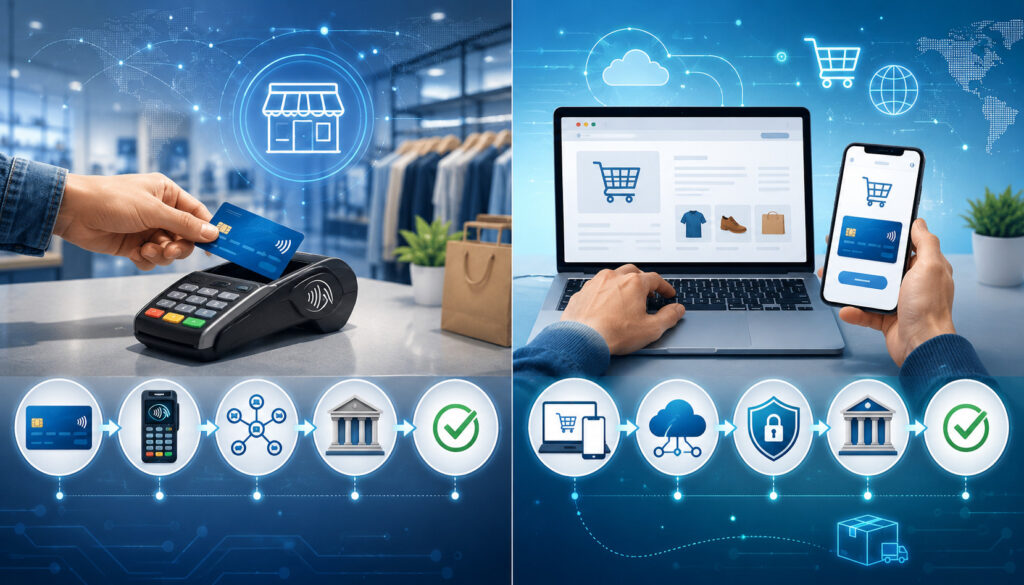
Card-present and card-not-present transactions follow the same general lifecycle, but the risk signals, security tools, fee treatment, and dispute exposure can differ significantly. Businesses that accept both in-person and online payments should understand how each environment affects the card payment transaction process.
In a card-present transaction, the customer physically presents the card or payment device. The transaction may use EMV chip, contactless payments, mobile wallet, or magnetic stripe fallback. EMV chip payments create dynamic transaction data that helps reduce counterfeit card fraud.
Contactless payments also use secure methods that support fast checkout while limiting exposure of sensitive data. For more background on chip-based payments, this EMV chip card overview is a useful reference.
In a card-not-present transaction, the merchant does not physically see the card. Online payments, keyed transactions, phone orders, stored credentials, and recurring billing all fall into this category.
Because the physical card is not verified at the terminal, businesses often rely on fraud screening tools such as AVS, CVV, device fingerprinting, velocity checks, tokenization, payer authentication, and order review rules.
Card-not-present transactions may carry higher fraud risk and higher chargeback exposure. They can also qualify for different interchange categories. Accurate data, secure checkout design, and clear customer communication become especially important.
Keyed transactions deserve special attention. Even if the customer is standing in front of the merchant, manually entering card details can be treated differently from chip or contactless acceptance. Keyed payments may have higher risk because the terminal did not read the card’s secure data.
Authorization vs Capture vs Settlement: What Is the Difference?
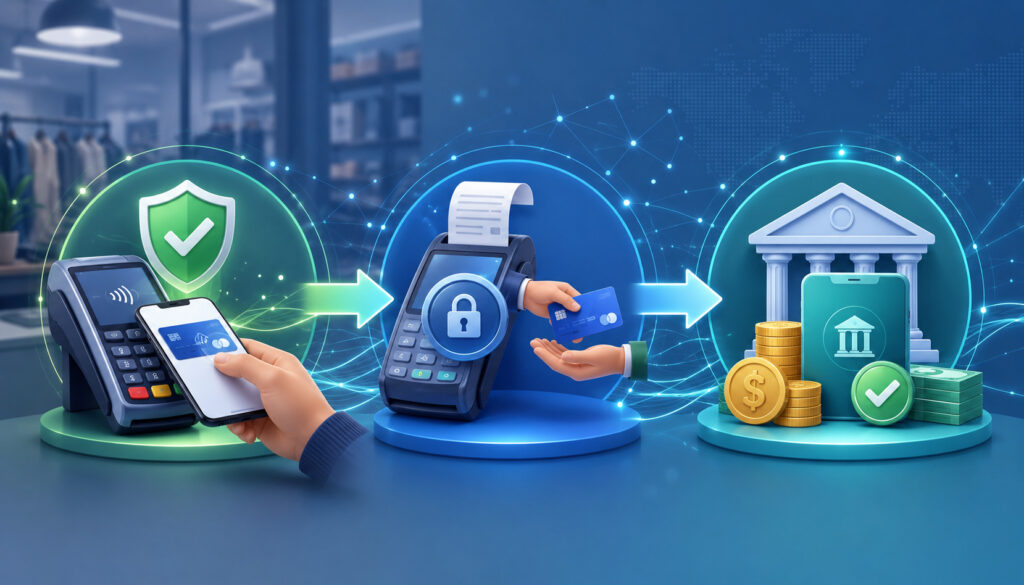
Authorization, capture, and settlement are three separate stages that are often mistaken for one another. Understanding the difference helps businesses explain pending charges, avoid missed deposits, and manage cash flow more accurately.
Authorization is the approval step. The issuer reviews the authorization request and decides whether to approve or decline the transaction. An approved authorization confirms that the merchant may proceed, but it does not mean the merchant has been paid. It may create a temporary hold on the cardholder’s available credit or funds.
Capture is the merchant’s confirmation that the approved transaction should be submitted for payment. Some systems capture immediately. Others allow delayed capture.
For example, an ecommerce seller may authorize when the order is placed but capture when the item ships. A service provider may authorize a deposit and capture after the final service amount is confirmed.
Settlement is the financial movement that happens after clearing. It is when the transaction amount moves through the card network and acquiring side so the merchant can be funded. The merchant sees the result as a deposit, usually adjusted for fees or other activity depending on the pricing and funding structure.
Consider a simple example. A customer orders a product online. The payment is authorized at checkout. The merchant captures the payment when the order is ready to ship.
Later, the transaction clears, settles, and appears in the merchant’s funding deposit. If the merchant never captures the authorization, the customer may see a temporary hold, but the merchant will not receive payment.
Common Fees Connected to the Credit Card Transaction Process
The credit card transaction process includes several cost components. These fees may be charged in different ways depending on the processor, pricing model, transaction type, and merchant agreement. Understanding them helps businesses compare payment processing options more accurately.
Interchange fees are usually the largest cost component. They are connected to the issuing side and vary based on card type, merchant category, transaction method, risk level, and data quality. A rewards card may cost more to accept than a basic card.
A card-not-present transaction may cost more than an EMV chip transaction. A transaction missing required data may be downgraded into a more expensive category.
Assessment fees are charged by the card network. These are usually smaller than interchange fees but still contribute to total cost.
Processor markup is the amount charged by the payment processor or payment provider for routing, service, support, technology, and risk management. This markup may appear as a percentage, per-transaction fee, monthly fee, authorization fee, or other charge.
Other possible costs include gateway fees, monthly statement fees, PCI fees, batch fees, chargeback fees, retrieval fees, address verification fees, tokenization fees, next-day funding fees, and equipment-related costs. Some businesses may also see fees related to refunds, recurring billing tools, or advanced fraud screening.
The merchant discount rate is the total effective cost of accepting card payments, often expressed as a percentage of card sales. It may include interchange, assessments, processor markup, and other charges depending on how the provider presents statements.
When comparing providers, businesses should look beyond the headline rate. The lowest advertised percentage may not reflect transaction fees, monthly fees, downgrade costs, chargeback costs, or gateway charges.
Security and Compliance Throughout the Transaction Lifecycle
Payment security applies throughout the entire card payment lifecycle, from payment initiation through storage, transmission, processing, reconciliation, and dispute handling. A business does not need to be a security expert to manage card payments responsibly, but it does need to use secure systems and follow required practices.
Encryption protects payment data during transmission. When card details move from a terminal, checkout page, or gateway to the processor, encryption helps prevent unauthorized parties from reading the data. Tokenization replaces sensitive card information with a token that can be used for future transactions without storing the actual card number in the merchant’s environment.
PCI compliance refers to meeting security requirements for businesses that store, process, or transmit cardholder data. The scope of PCI compliance depends on how the business accepts payments and what systems touch card data.
Hosted checkout pages, validated payment terminals, and tokenized storage can reduce risk, but they do not eliminate the need to follow security responsibilities. The official payment security standards overview explains how payment standards support different participants in the payment ecosystem.
EMV chip acceptance helps reduce counterfeit card fraud in card-present environments. Contactless payments and mobile wallets also support secure transaction data. For online payments, tools such as AVS, CVV, payer authentication, fraud screening, and velocity controls can help detect suspicious activity.
Secure operations matter too. Staff should never write down card numbers unnecessarily, store card data in spreadsheets, send card details by email, or keep printed receipts with full account information. Access to payment systems should be limited to employees who need it, and passwords should be protected.
Common Problems That Can Happen During the Transaction Lifecycle
Payment problems can happen at any stage of the credit card transaction lifecycle. Some are caused by customer input errors. Others result from issuer decisions, gateway outages, batching mistakes, fraud controls, settlement timing, or dispute activity.
Declined transactions are among the most common issues. A decline may be caused by insufficient available credit, incorrect card details, expired card, suspected fraud, issuer restrictions, or spending limits.
The merchant should not repeatedly retry a hard decline. Instead, the customer should use another payment method or contact the issuing bank.
Duplicate charges can happen when a transaction is submitted twice, a customer refreshes an online checkout page, a staff member retries without checking the previous response, or a system experiences a communication timeout. Good POS and gateway systems help prevent duplicates by flagging repeated amounts, card numbers, or order IDs.
Authorization holds can confuse customers. A cardholder may see a pending amount even if the transaction was voided, reversed, or not captured. The merchant may not control how quickly the issuer removes the hold, but clear communication can reduce frustration.
Delayed funding can occur when a batch closes after cutoff, a holiday interrupts banking schedules, a processor reviews risk, or a merchant account has a reserve. Batch errors and settlement mismatches can make it harder to reconcile sales to deposits.
Chargebacks are another major problem. They may result from fraud, unclear billing descriptors, refund delays, product issues, service disputes, or recurring billing misunderstandings. Gateway outages and integration errors can also interrupt the credit card payment process, especially for ecommerce businesses.
Best Practices for Businesses Managing Card Transactions
Strong payment management is built on consistent daily habits. A business does not need a large finance department to manage card transactions well, but it does need clear procedures for checkout, batching, reconciliation, refunds, security, and disputes.
Reconcile batches daily. Compare POS reports, gateway reports, processor reports, and bank deposits. Look for missing batches, duplicate transactions, unsettled authorizations, unexpected fees, and unusual refund activity. Daily review helps catch small issues before they become larger accounting problems.
Use clear billing descriptors. Customers often dispute charges they do not recognize. The descriptor should match the business name or a name the customer will understand. Receipts, order confirmations, and customer service contact details should be easy to find.
Train staff on payment procedures. Employees should know how to process EMV chip and contactless payments, what to do when a card is declined, when to void instead of refund, how to handle duplicate authorizations, and how to avoid writing down sensitive card data.
Keep refund and cancellation policies clear. Customers are less likely to dispute a charge when they understand the terms before paying. This is especially important for deposits, subscriptions, memberships, service appointments, custom orders, and delayed delivery.
Monitor chargebacks and fraud trends. Track reason codes, product categories, order channels, customer complaints, and repeat dispute patterns. Reviewing processor statements can also help identify pricing changes, downgrades, or unexpected fees.
How to Choose a Payment Setup That Supports a Smooth Transaction Lifecycle
Choosing the right payment setup can make the credit card processing lifecycle easier to manage. The best fit depends on how the business sells, how customers prefer to pay, how much risk the business carries, and how the finance team reconciles deposits.
Start with acceptance channels. A retail store may need EMV terminals, contactless payments, receipt printing, tipping, and POS integration. An ecommerce seller may need a secure payment gateway, fraud screening, tokenization, shopping cart integration, and recurring billing support.
A professional service provider may need invoices, payment links, card-on-file tools, and clear reporting. A mobile business may need wireless terminals or mobile readers.
Reporting matters. Look for dashboards that show authorizations, captures, batches, settlements, refunds, chargebacks, and deposits. A good reporting system helps match transactions to funding and reduces time spent searching through statements.
Fraud tools should match the business model. Online payments may need AVS, CVV, payer authentication, velocity checks, order risk scoring, and manual review settings. Card-present merchants should prioritize EMV chip and contactless acceptance.
Pricing transparency is also important. Businesses should understand interchange fees, assessment fees, processor markup, gateway fees, chargeback fees, batch fees, monthly fees, and funding costs.
A pricing model that looks simple may still be expensive if transaction types, card mix, or extra fees are not considered. This flat-rate processing overview can help merchants understand one common pricing approach.
Support quality matters most when something goes wrong. Funding delays, gateway errors, batch issues, and chargebacks require timely help. Choose tools that can scale with transaction volume, additional locations, ecommerce expansion, and more complex reporting needs.
Final Thoughts on the Credit Card Transaction Lifecycle
The credit card transaction lifecycle is more than a checkout approval. It is a multi-step process that includes payment initiation, payment authorization, authorization response, capture, batch processing, payment clearing, payment settlement, payment funding, and post-transaction events such as refunds, voids, reversals, and chargebacks.
For customers, the process should feel fast and reliable. For merchants, each stage affects revenue, cash flow, fees, risk, reconciliation, and customer satisfaction. A payment may be approved in seconds, but the business still needs proper capture, batching, settlement, and funding before the sale is complete from an accounting perspective.
Understanding the card payment lifecycle helps businesses reduce avoidable problems. It makes it easier to explain pending charges, investigate declined transactions, prevent duplicate billing, reconcile deposits, compare payment processing options, and respond to disputes.
It also supports better payment security, stronger PCI compliance practices, and more effective fraud screening.
The most successful payment operations combine secure technology with clear procedures. Use reliable payment tools, close and reconcile batches consistently, keep customer communication clear, monitor fees, document transactions, and review chargeback patterns.
When each part of the lifecycle is managed well, card payments become easier to track, safer to accept, and more predictable for cash flow.
What is the credit card transaction lifecycle?
The credit card transaction lifecycle is the full journey of a card payment from the moment the customer provides card details until the transaction is authorized, captured, cleared, settled, funded, and possibly adjusted after the sale. It includes both real-time steps, such as payment authorization, and later steps, such as settlement and funding.
The lifecycle may also include refunds, voids, reversals, retrieval requests, and chargebacks. For merchants, understanding this lifecycle helps explain why an approved payment may not be deposited immediately and why a settled payment can later be affected by a dispute or refund.
What are the main steps in the credit card transaction process?
The main steps are payment initiation, authorization request, issuer review, authorization response, capture, batch processing, clearing, settlement, merchant funding, and post-transaction activity. Each step has a different purpose.
Authorization confirms whether the issuer approves the payment. Capture submits the approved transaction for processing. Clearing finalizes transaction details and fee categories. Settlement moves funds between financial parties. Funding deposits the net amount to the merchant.
How long does a credit card payment take to settle?
Settlement timing varies by processor, batch time, banking schedule, merchant account terms, and risk review. Many standard card transactions settle and fund within a few business days, but timing can be affected by weekends, holidays, late batch submission, reserves, unusual activity, or account reviews.
Businesses should review their processor agreement and reporting dashboard to understand expected funding timing. Daily batch reconciliation can help identify whether delays are caused by missed batch close, processing cutoff, or another issue.
Is authorization the same as settlement?
No. Authorization and settlement are different stages. Authorization means the issuing bank approved the transaction at that moment. It may place a hold on the cardholder’s available credit or funds, but the merchant has not yet received money.
Settlement happens later, after capture and clearing. It is the stage where funds move through the card network and acquiring side so the merchant can be funded. A transaction can be authorized but never settled if it is not captured.
What is the difference between clearing and settlement?
Clearing is the exchange and finalization of transaction data. During clearing, the transaction details are submitted, categorized, and used to calculate fees such as interchange fees and assessment fees.
Settlement is the movement of money based on the cleared transaction. It is when funds move from the issuing side through the network and acquiring side. Clearing prepares the transaction for financial movement; settlement completes the movement between the payment parties.
Why was a transaction approved but not funded yet?
A transaction may be approved but not funded because approval is only the authorization stage. The merchant still needs to capture the transaction, submit it in a batch, and wait for clearing and settlement. Funding happens after those steps are completed.
Other reasons include missed batch close, late submission after cutoff, weekends, holidays, risk review, account reserve, or processor funding schedule. The first place to check is whether the transaction was captured and included in a settled batch.
What is a batch in credit card processing?
A batch is a group of captured transactions submitted for processing. Many businesses close batches at the end of each business day, though some systems do this automatically. Batch processing moves approved transactions toward clearing, settlement, and funding.
If a batch is not closed, funding may be delayed. Businesses should verify batch status daily and make sure batch totals match sales reports. This is especially important for businesses with multiple registers, locations, or sales channels.
What causes credit card transactions to be declined?
Transactions may be declined for many reasons, including insufficient available credit, expired card, incorrect card details, suspected fraud, issuer restrictions, spending limits, closed account, or technical issues. The merchant may receive only a general decline code.
When a card is declined, the best response is to ask the customer for another payment method or suggest they contact the issuing bank. Staff should avoid guessing the reason, since the issuer controls the decision and may not share details with the merchant.
What happens after a customer disputes a charge?
After a customer disputes a charge, the issuing bank reviews the claim and may send a chargeback or inquiry through the card network to the acquiring side. The merchant may be asked to provide documentation such as receipts, delivery proof, service records, refund policies, cancellation terms, or customer communication.
If the merchant accepts the dispute or fails to respond on time, funds may remain with the cardholder. If the merchant responds with strong evidence, the dispute may be resolved in the merchant’s favor. Deadlines and evidence requirements vary by network rules and reason code.
How can businesses reduce chargebacks?
Businesses can reduce chargebacks by using clear billing descriptors, sending receipts, publishing refund and cancellation policies, responding quickly to customer concerns, using fraud screening tools, confirming delivery, documenting service completion, and making recurring billing terms easy to understand.
Fraud prevention also matters. For online payments, tools such as AVS, CVV, tokenization, velocity controls, and payer authentication can help reduce suspicious transactions. For card-present payments, EMV chip and contactless acceptance can reduce certain counterfeit fraud risks.
Are online card transactions processed differently from in-person transactions?
Online and in-person transactions follow the same basic lifecycle, but they use different data and risk controls. In-person payments often rely on EMV chip, contactless payments, or mobile wallet credentials. Online payments rely more heavily on payment gateway security, fraud screening, AVS, CVV, tokenization, and customer authentication.
Card-not-present transactions often carry higher fraud exposure because the merchant cannot physically inspect the card. This can influence fees, review rules, and dispute risk. Ecommerce sellers should use secure checkout tools and monitor suspicious order patterns.
What role does PCI compliance play in the credit card payment process?
PCI compliance supports secure handling of cardholder data throughout the credit card payment process. It applies to businesses and service providers that store, process, or transmit card data. Requirements vary based on how the business accepts payments and which systems touch sensitive data.
Using secure payment tools, encryption, tokenization, hosted checkout pages, and validated terminals can reduce risk. However, merchants still need good practices, including access control, secure passwords, staff training, and avoiding unsafe storage of card data.
What is the difference between a refund and a chargeback?
A refund is initiated by the merchant to return money to the customer. It usually happens when the customer returns an item, cancels a service, or receives a credit from the business. Refunds are part of normal customer service and accounting.
A chargeback is initiated by the cardholder through the issuing bank. It is a dispute process that can remove funds from the merchant and may include additional fees. Chargebacks often require documentation and can affect the merchant’s risk profile if they occur frequently.
Conclusion
The credit card transaction lifecycle includes more than a quick approval message at checkout. Every card payment moves through multiple stages: initiation, authorization, issuer review, capture, batch processing, clearing, settlement, funding, and possible post-transaction events.
Each stage involves different parties, including the cardholder, merchant, payment processor, payment gateway, acquiring bank, issuing bank, and card network.
For businesses, understanding this lifecycle improves payment reliability and operational control. It helps teams explain pending charges, reduce declined transaction confusion, reconcile batches, manage payment funding, evaluate fees, strengthen payment security, and respond to disputes with better documentation.
A smooth card payment lifecycle depends on secure tools, accurate data, clear procedures, and consistent review. Businesses should choose payment systems that match their sales channels, support fraud screening, simplify reporting, protect card data, and provide visibility into authorization, capture, clearing and settlement, refunds, and chargebacks.
When merchants understand how the credit card transaction lifecycle works, they are better prepared to protect cash flow, reduce avoidable payment issues, support customers, and manage card payments with confidence.