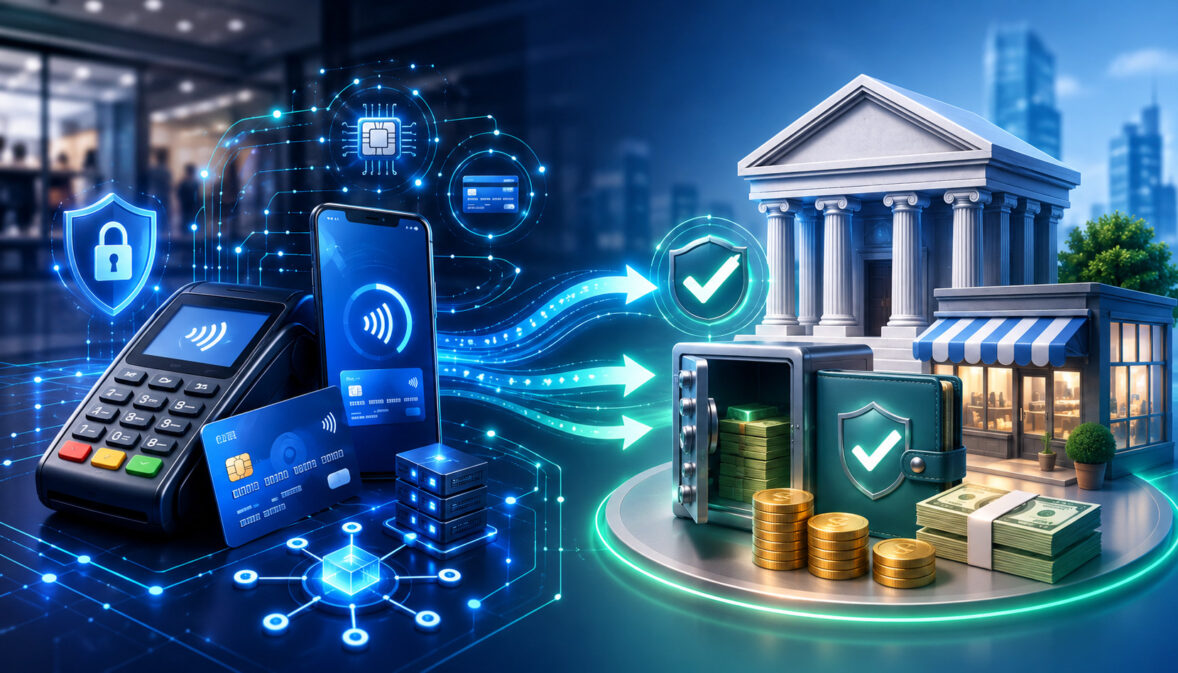
Accepting card payments can feel confusing when every provider uses similar terms in different ways. A business owner may hear about payment processors, merchant accounts, payment gateways, acquiring banks, payment facilitators, settlement, chargebacks, PCI compliance, and transaction fees before they even process their first sale.
The confusion is understandable. These services work together behind the scenes, but they are not the same thing. Understanding payment processor vs merchant account is important because the setup you choose affects approval, fees, funding speed, account stability, security responsibilities, reporting, chargeback management, and your ability to grow.
A payment processor helps move transaction data between your business, the card networks, banks, and other parties involved in card payment processing.
A merchant account is the financial account structure that receives card payment funds before they are transferred to your regular business bank account. Some providers bundle both services. Others use an all-in-one model that lets many businesses process under a shared structure.
This guide explains the payment processor and merchant account difference in practical terms. You will learn how each one works, when a business may need one or both, how fees compare, and how to choose the right setup for ecommerce payments, POS payments, recurring billing, service businesses, restaurants, professional firms, and higher-risk industries.
What Is a Payment Processor?
A payment processor is the technology and service provider that helps route card transaction information between your business and the financial institutions involved in approving, clearing, and settling payments. The simple payment processor’s meaning is this: it is the system that helps card payments move from “customer wants to pay” to “transaction approved or declined.”
When a customer taps a card at a terminal, enters card details online, pays through a mobile reader, or uses a stored card for recurring billing, the payment processor helps transmit that transaction data. It communicates with the payment gateway or POS system, the card network, the issuing bank, and the acquiring side of the transaction.
The issuing bank is the bank that issued the customer’s card. The acquiring bank is the bank that supports the merchant’s ability to accept card payments. The card network provides the rules and rails that allow the transaction to move between parties.
A processor does not simply “take money from a card.” It helps with several steps:
- Transaction authorization
- Fraud checks and response codes
- Batch submission
- Clearing and settlement support
- Reporting and reconciliation
- Chargeback communication
- Payment security tools
- Integration with gateways, POS systems, shopping carts, and accounting software
For in-person businesses, the processor connects card terminals, mobile readers, and POS payments to the payment network. For online sellers, the processor works with a payment gateway to support online payment processing.
For service providers, it may support invoices, payment links, keyed transactions, virtual terminals, and stored payment methods. For subscription businesses, it may support recurring billing and automated retries.
A payment processor is essential because card payments involve multiple parties that must exchange payment data quickly and securely. Without a processor, most businesses could not accept credit card processing or debit card payments in a reliable, standardized way.
What Is a Merchant Account?
A merchant account is a special type of account used to receive card payment funds after transactions are approved and settled. The simple merchant account meaning is this: it is not your regular business checking account, but a payment-specific account structure that temporarily holds card proceeds before funds are deposited into your business bank account.
This is where many businesses misunderstand merchant account vs payment processor terminology. A merchant account is not the same as a processor. The processor helps move transaction information. The merchant account is tied to the financial side of accepting card payments.
When customers pay by card, the funds do not instantly move from the customer’s bank to your checking account. The transaction must be authorized, submitted in a batch, cleared through the card network, and settled through the acquiring side. The merchant account is where card proceeds are routed before final funding to your operating bank account.
A merchant account is usually connected to an acquiring bank or payment provider. Because card payments carry risk, merchant accounts typically involve underwriting.
The provider may review your business type, ownership information, processing history, average ticket size, sales channels, refund policies, chargeback risk, financial stability, and whether the business falls into a higher-risk category.
This review matters because card transactions can be disputed. Chargebacks may occur weeks or months after the original sale. If a merchant goes out of business, commits fraud, or cannot cover refunds and disputes, the acquiring side may be financially exposed.
That is why merchant account applications may ask for:
- Business registration and ownership details
- Bank account information
- Website or product details
- Processing volume estimates
- Average transaction size
- Refund and cancellation policies
- Prior processing statements
- Industry and sales channel information
A dedicated merchant account often gives businesses more control, clearer underwriting, and potentially more stable processing than a basic all-in-one account. However, it may also require more documentation, monthly fees, and approval time.
Understanding how merchant accounts work is especially important for businesses with growing volume, large tickets, card-not-present sales, recurring billing, high chargeback exposure, or specialized industries that may need a high-risk merchant account.
Payment Processor vs Merchant Account: The Core Difference
The core difference is simple: a payment processor handles the communication and movement of transaction data, while a merchant account is the account structure used to receive and settle card payment funds.
When people search for payment processor vs merchant account, they are usually trying to understand whether they need one service, both services, or an all-in-one provider. The answer depends on how the provider structures its payment services.
A payment processor is operational. It helps authorize and process transactions. A merchant account is financial. It receives card payment proceeds and connects settlement to your business bank account.
Think of a restaurant taking a card payment at the counter. The POS system captures the card information. The processor routes the authorization request. The issuing bank approves or declines the transaction.
Later, the batch is submitted for settlement. The merchant account is where the approved funds are directed before being deposited into the restaurant’s business bank account.
For an online store, the payment gateway collects and encrypts card data at checkout. The processor routes the transaction for authorization. The merchant account receives funds after settlement. The gateway, processor, and merchant account may be provided by one company, but they still perform different roles.
This is why the difference between merchant account and payment processor is not just technical wording. It affects real business decisions. A payment facilitator may let a startup accept payments quickly without applying for a traditional dedicated merchant account.
A traditional merchant services setup may provide a dedicated merchant account, customized pricing, more underwriting visibility, and better scalability.
Neither model is automatically better. A small seller may value fast setup and simplicity. A growing business may value stability, pricing transparency, and account control. A higher-risk merchant may need a dedicated account because many basic processors may restrict or freeze activity after detecting risk signals.
Merchant Account vs Payment Processor: Side-by-Side Comparison
A side-by-side comparison helps clarify the merchant account vs payment processor distinction. The two services are connected, but they solve different problems. One handles transaction communication; the other supports the financial settlement structure.
| Category | Payment Processor | Merchant Account |
| Main purpose | Routes transaction data for authorization, clearing, and settlement | Receives card payment funds before deposit to the business bank account |
| Role in transaction | Communicates with gateways, POS systems, card networks, issuing banks, and acquiring side | Holds or receives settled card proceeds tied to the merchant |
| Approval process | May be quick in all-in-one models; may be tied to merchant account underwriting in traditional models | Usually involves underwriting, business review, risk assessment, and approval |
| Funding | Helps coordinate settlement and reporting | Connects settlement funds to the merchant’s business bank account |
| Fees | May include transaction fees, authorization fees, gateway fees, and processor markup | May include monthly fees, statement fees, PCI fees, chargeback fees, and reserve requirements |
| Risk management | Uses fraud filters, transaction monitoring, velocity controls, and dispute workflows | Assesses merchant risk, chargeback exposure, reserves, holds, and account stability |
| Chargeback handling | Helps route dispute information and evidence | Financially tied to chargeback debits, refunds, and reserve decisions |
| Control | Varies by provider and model | Dedicated accounts often provide more control than aggregated models |
| Scalability | Good processors support more channels, integrations, and reporting | Dedicated merchant accounts may scale better for higher volume or complex models |
| Best fit | Any business accepting card payments | Businesses that need stable settlement, customized pricing, underwriting clarity, or higher-risk support |
This comparison also helps explain payment processing vs merchant account decisions. If your provider is a payment facilitator, you may not receive a dedicated merchant account in your business’s name.
Instead, your transactions may be processed under a broader master account structure. This can be convenient, but it may also mean less control over risk decisions, reserves, holds, or sudden reviews.
A traditional merchant account payment processor setup may take longer to approve, but it can offer more predictable terms for businesses with steady volume, multiple locations, recurring billing, larger average tickets, or specialized transaction patterns.
For businesses comparing business payment solutions, the key is not simply whether a provider uses one label or another.
The key is how the setup affects daily operations: Can you accept cards in-store and online? Can you integrate with your software? How quickly are funds deposited? What happens during chargebacks? Are fees clear? Is support available when payments fail?
How Payment Processing Works Step by Step
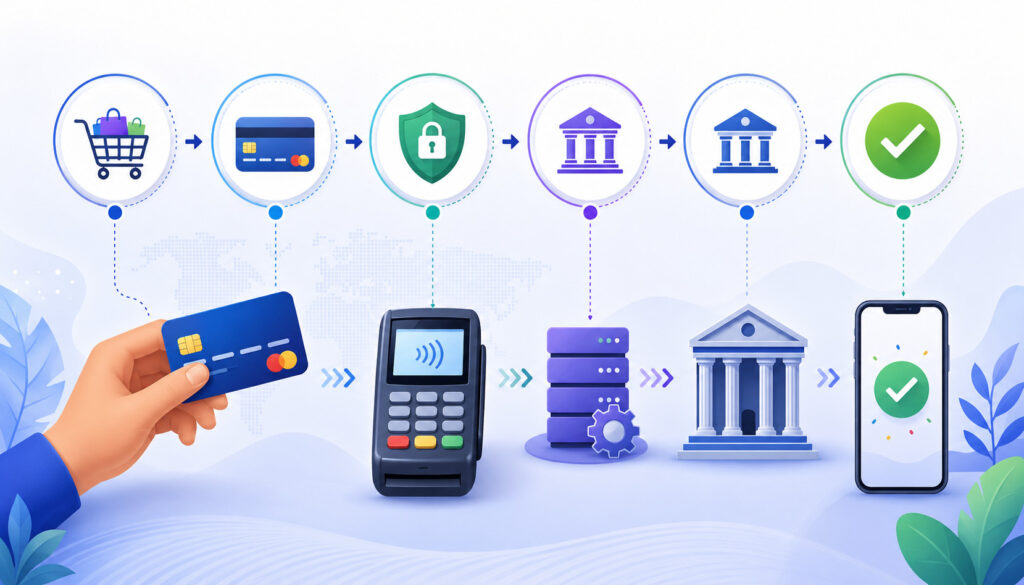
Understanding how payment processors work becomes easier when you follow the customer payment journey. The process may look instant from the customer’s perspective, but several steps happen behind the scenes.
First, the customer presents payment information. This may happen through a chip card, tap-to-pay wallet, keyed invoice, mobile reader, ecommerce checkout, or stored card for recurring billing.
For online payment processing, a payment gateway usually captures and encrypts the payment details before sending them to the processor.
Second, the processor sends an authorization request through the card network. The request reaches the issuing bank, which checks whether the card is valid, whether funds or credit are available, and whether the transaction appears suspicious. The issuing bank returns an approval or decline response.
Third, the business receives the authorization result. If approved, the sale can be completed. However, authorization is not the same as final funding. It only confirms that the transaction can proceed.
Fourth, approved transactions are batched. Many businesses submit batches at the end of the business day. Batching groups approved transactions for clearing and settlement. If a business does not batch properly, funding may be delayed.
Fifth, clearing and settlement occur. The card network calculates interchange, assessments, and other transaction details. Funds move from the issuing side through the network to the acquiring side.
The merchant account receives the settled funds, minus applicable payment processing fees or later billing adjustments depending on the pricing arrangement.
Finally, funds are deposited into the business bank account based on the provider’s funding schedule. Some businesses receive next-business-day funding, while others may have longer settlement timelines depending on risk, sales channel, industry, banking cutoffs, or account status.
Chargebacks are a separate but important part of the lifecycle. A customer may dispute a transaction through the issuing bank. The processor and merchant account provider help communicate the dispute, collect evidence, and apply the result. If the dispute is lost, the transaction amount and chargeback fee may be debited from the merchant.
For more context on payment gateway roles in online transactions, see this helpful resource on virtual terminals and payment gateways.
Do You Need Both a Payment Processor and a Merchant Account?

Many businesses need both payment processing and a merchant account function, but they may not always need to contract for them separately. The right answer depends on the provider model.
If you use a traditional merchant services setup, you commonly have a merchant account, a payment processor, and possibly a payment gateway. This arrangement is common for established retailers, restaurants, ecommerce stores, professional services, medical offices, B2B companies, subscription businesses, and organizations with higher monthly volume.
If you use an all-in-one payment facilitator, you may be able to start accepting payments quickly without a separate merchant account application. In this model, the provider acts as a payment facilitator and allows sub-merchants to process under a shared structure.
This can work well for small startups, side businesses, basic ecommerce sellers, and service providers that need a fast launch.
However, the all-in-one model is not ideal for every business. As volume grows, pricing may become less competitive. If risk signals appear, the provider may place funds on hold, request documents, delay settlement, or restrict the account. Businesses in higher-risk categories may also find that basic processors decline them or approve them initially and review them later.
A dedicated merchant account may be better when a business has:
- Consistent or growing card volume
- Higher average ticket sizes
- Multiple sales channels
- Subscription or recurring billing
- Higher chargeback exposure
- Industry-specific compliance needs
- Large seasonal spikes
- Multi-location operations
- A need for custom reporting or integrated payments
- Prior account holds or processor shutdowns
A small consulting firm may do fine with a simple payment link and basic processor. A restaurant with POS payments, online ordering, tips, refunds, and high daily volume may benefit from a more structured merchant services setup.
An ecommerce brand with recurring billing, fraud exposure, and growing volume may need both a strong gateway and a dedicated merchant account.
The best choice is based on how your business accepts payments, how much control you need, and how much risk your provider is willing to support.
Payment Facilitator vs Traditional Merchant Account
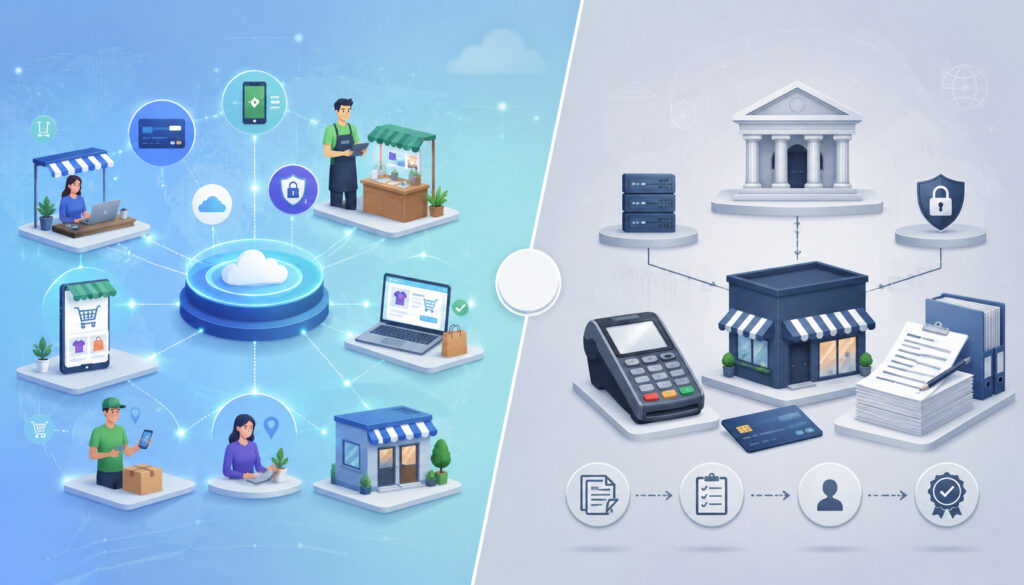
A payment facilitator model allows a provider to onboard many smaller merchants under a master merchant structure. This is why setup can feel fast and simple. The provider may ask for basic business information, approve the account quickly, and let the business begin processing with minimal documentation.
This model is useful for low-risk businesses that want convenience. It often includes online payment processing tools, invoicing, checkout pages, simple reporting, and flat-rate pricing. For a startup or small seller, that simplicity can be valuable.
A traditional merchant account works differently. The business usually receives a dedicated merchant account after underwriting. The provider reviews the business before approval rather than relying mainly on post-approval monitoring. This can take longer, but it may create clearer expectations around volume, ticket size, sales channel, reserves, and risk controls.
The payment facilitator model often prioritizes fast onboarding. The traditional model often prioritizes risk review and account stability. That distinction matters when disputes, chargebacks, unusual volume spikes, or large transactions occur.
With a payment facilitator, holds and reserves may happen if the provider’s risk system detects unusual behavior. In some cases, the business may not fully understand the threshold that triggered the review.
With a dedicated merchant account, risk decisions can still happen, but the upfront underwriting process may reduce surprises because the provider already understands the business model.
A traditional account can also support more specialized needs, such as high-risk merchant account placement, multiple MIDs, interchange-plus pricing, custom gateway connections, integrated payments, advanced reporting, and card-not-present fraud controls.
Key Fees to Compare Before Choosing a Payment Setup
Payment processing fees can be difficult to compare because providers structure pricing in different ways. Some advertise one simple rate. Others separate interchange, assessments, processor markup, gateway fees, monthly fees, PCI fees, and chargeback fees.
Transaction Fees and Pricing Models
Transaction fees are usually the most visible cost. They may include a percentage of each sale, a per-transaction amount, or both. Common pricing models include flat-rate, interchange-plus, tiered, and subscription pricing.
Flat-rate pricing charges one predictable rate for many transaction types. It is easy to understand, especially for newer businesses. However, it may cost more for certain merchants because it does not always show the underlying interchange cost. For more on this model, see this guide to flat-rate credit card processing.
Interchange-plus pricing separates the card network interchange cost from the processor markup. It can be more transparent and may be cost-effective for established businesses. Tiered pricing groups transactions into categories, but it can be harder to audit because businesses may not know why a transaction falls into one tier instead of another.
Subscription pricing may charge a monthly membership fee plus a smaller per-transaction markup. This can work for businesses with enough volume to justify the monthly cost.
Monthly, Gateway, and Account Fees
Beyond transaction fees, businesses should review monthly account fees, gateway fees, statement fees, batch fees, PCI compliance fees, PCI non-compliance fees, chargeback fees, retrieval fees, early termination fees, and equipment costs.
A low transaction rate may not be the lowest overall cost if the agreement includes expensive add-ons. Conversely, a provider with a monthly fee may be less expensive for a growing business if the per-transaction markup is lower.
For businesses processing commercial cards, Level 2 or Level 3 data may affect interchange qualification. This is especially relevant for B2B and government-card acceptance. You can learn more from this resource on Level 2 data processing.
Also pay attention to how fees are deducted. Some providers deduct fees daily from each batch. Others bill fees monthly. Monthly billing may make reconciliation easier because gross deposits are more visible.
Before signing, ask for a sample statement, pricing schedule, chargeback policy, funding schedule, PCI requirements, equipment terms, and cancellation terms.
Pros and Cons of Using an All-in-One Payment Processor
All-in-one payment processors are popular because they reduce setup friction. A business can often create an account, connect a bank account, add checkout or invoicing tools, and begin accepting payments quickly. This is appealing for new businesses, solo operators, online sellers, seasonal sellers, and service providers that do not want a lengthy application process.
The biggest advantage is convenience. Many all-in-one providers include a payment gateway, hosted checkout, payment links, invoices, basic reporting, mobile payments, and recurring billing tools in one platform. The pricing is often easy to understand, and the dashboard is usually built for non-technical users.
Another advantage is integration. Many platforms connect with ecommerce systems, booking tools, accounting software, shopping carts, and customer databases. For a small business trying to launch quickly, this can save time.
However, the same simplicity can create limitations. All-in-one processors often use aggregated payment structures. That means the business may not have the same level of underwriting visibility or account control as it would with a dedicated merchant account.
The provider may monitor transactions after approval and place holds if activity appears inconsistent, risky, or outside policy.
Pricing can also become less attractive as volume grows. Flat-rate pricing may be acceptable for low volume, but higher-volume businesses may benefit from more transparent or customized pricing.
Common drawbacks include:
- Less pricing flexibility
- Potential account holds or reserves
- Limited support for higher-risk industries
- Less control over underwriting decisions
- Fewer options for custom gateway setups
- Basic reporting compared with advanced merchant services platforms
- More difficulty negotiating terms at scale
All-in-one processors can be excellent for simple use cases. They may be less ideal for businesses that need stable funding, advanced integrations, high monthly volume, specialized support, or a dedicated high-risk merchant account.
Pros and Cons of a Dedicated Merchant Account
A dedicated merchant account gives a business a more tailored structure for card payment processing. Instead of being grouped under a broad aggregated model, the business is underwritten more directly. This can provide more stability and clearer expectations.
One major benefit is account control. Because the provider reviews the business model, sales channels, average ticket, volume, refund policy, and risk profile upfront, the merchant may have fewer surprises later. Holds and reserves can still happen, but the relationship is often more customized.
Dedicated merchant accounts may also provide better pricing options. Businesses with meaningful volume can often compare interchange-plus, subscription, or custom pricing. They may also gain access to better reporting, gateway flexibility, integrated payments, virtual terminals, recurring billing, ACH options, and multi-location support.
A dedicated account can be especially useful for businesses with complex needs. Examples include ecommerce brands, professional services, B2B companies, restaurants, contractors, medical offices, membership organizations, subscription businesses, and higher-risk industries.
The drawbacks are mostly related to setup and requirements. Approval may take longer. The provider may request documentation. Monthly fees may apply. Some businesses may need to complete PCI validation, provide processing statements, or agree to reserves depending on risk.
Potential drawbacks include:
- More paperwork during setup
- Underwriting review before approval
- Possible monthly or gateway fees
- More detailed compliance responsibilities
- Possible reserves for higher-risk merchants
- More contract details to review
For many established businesses, those tradeoffs are worth it. A dedicated merchant account may provide more transparency, support, and scalability than a basic processor. For very small or low-volume businesses, however, the additional structure may be unnecessary at first.
The best decision depends on your sales volume, risk level, payment channels, and long-term plans.
Payment Gateway vs Merchant Account vs Payment Processor
The phrase payment gateway vs merchant account often appears alongside payment processor comparisons because all three are part of the payment ecosystem. They are related, but they are not interchangeable.
A payment gateway is the technology that securely captures and transmits payment information, especially for online transactions. It is like the digital checkout connection between the customer-facing payment form and the processing network. In ecommerce payments, the gateway encrypts payment data and sends it to the processor.
A payment processor routes the transaction for authorization and settlement. It communicates with the card network, issuing bank, and acquiring side. It helps determine whether the transaction is approved and later supports clearing and settlement.
A merchant account receives card payment funds before they are deposited into the business bank account. It is tied to the merchant’s ability to accept card payments and manage settlement.
Here is a simple example. An online customer enters card details on a checkout page. The payment gateway securely captures the data. The processor routes the authorization request. The issuing bank approves or declines the transaction. After batching and settlement, the merchant account receives the funds before deposit.
For an in-person sale, the POS terminal or card reader may perform some gateway-like functions by securely capturing payment data. The processor still routes the transaction. The merchant account still supports settlement.
Some providers bundle all three. Others allow businesses to choose a separate gateway, processor, and merchant account. Businesses with custom ecommerce platforms, software integrations, or recurring billing needs should pay close attention to compatibility.
A provider may support one gateway but not another. A gateway may connect to multiple processors. A shopping cart may require a specific gateway. A POS system may require a particular processor. These details affect implementation and future flexibility.
For a deeper explanation of online checkout tools, this payment gateway overview can provide additional context.
Security, PCI Compliance, and Risk Management
Payment security should be part of every decision about payment processing. Card data is sensitive, and businesses that accept payment cards must understand their responsibilities.
PCI compliance is based on the Payment Card Industry Data Security Standard, which provides technical and operational requirements for protecting cardholder data. The official PCI DSS resource is a useful starting point for understanding these requirements.
Security responsibilities vary by setup. A business using a hosted checkout page may have less direct exposure to card data than a business that stores payment credentials or uses custom checkout forms. A company that keys payments into a virtual terminal has different risk considerations than a retailer using EMV chip terminals.
Important payment security tools include encryption, tokenization, fraud filters, address verification, CVV checks, velocity controls, device security, user permissions, and secure reporting access. Tokenization replaces sensitive card data with a token that can be used for future payments without storing the full card number in the business’s system.
PCI compliance is not just a technical issue. It also involves policies, employee access, vendor management, network security, software updates, and incident response. Businesses should ask providers what PCI support is included and what responsibilities remain with the merchant.
Risk management also includes chargebacks. A chargeback occurs when a cardholder disputes a transaction through the issuing bank. Excessive chargebacks can lead to higher fees, reserves, account reviews, or termination.
Businesses should maintain clear billing descriptors, refund policies, delivery documentation, signed agreements, customer communication records, and fraud prevention tools.
Higher-risk businesses may face additional controls such as rolling reserves, volume caps, delayed settlement, enhanced monitoring, or stricter underwriting. These controls are not always a sign of a bad provider; they may be part of managing financial exposure. The key is transparency.
Common Mistakes Businesses Make When Comparing Payment Options
One common mistake is choosing a provider only because of the lowest advertised rate. A low rate can be misleading if it applies only to certain transaction types or excludes other fees. Businesses should compare the full cost of processing, including monthly fees, gateway fees, PCI fees, batch fees, chargeback fees, equipment costs, and cancellation terms.
Another mistake is ignoring chargeback policies. Chargebacks are not just occasional inconveniences. They can affect cash flow, risk status, and account stability. Businesses should understand response timelines, evidence requirements, fees, and chargeback thresholds before choosing a provider.
Many businesses also misunderstand funding timelines. “Fast funding” may depend on batch time, bank holidays, risk status, transaction type, or industry. If cash flow is tight, settlement terms should be reviewed carefully.
Integration needs are another overlooked area. A provider may offer good pricing but fail to connect with your ecommerce platform, POS system, booking software, subscription platform, accounting tool, or customer database. Switching later can be costly.
Contract terms also deserve attention. Some agreements include early termination fees, equipment leases, automatic renewal clauses, minimum monthly fees, or reserve language. Businesses should read the agreement rather than relying only on sales summaries.
Another mistake is failing to plan for growth. A small business may start with basic payment links, but later need recurring billing, invoicing, integrated payments, multi-location reporting, or custom checkout. Choosing a provider that cannot scale may force a disruptive migration.
Businesses also underestimate underwriting. If your business sells regulated products, has high tickets, accepts large deposits, ships later, offers memberships, handles travel, or has elevated dispute risk, the provider needs to understand that from the beginning.
How to Choose the Right Payment Setup for Your Business
Choosing the right setup starts with your business model. A local service provider that sends invoices has different needs than a retail shop, ecommerce seller, restaurant, software platform, or subscription company. The best payment setup should match how customers pay and how your team operates.
Start with transaction volume. Low-volume businesses may prioritize simplicity and predictable pricing. Higher-volume businesses should compare interchange-plus, subscription, or customized pricing. Average ticket size also matters because percentage fees and per-transaction fees affect businesses differently.
Next, consider sales channels. Do you accept payments in person, online, over the phone, through invoices, through a mobile reader, through a POS system, or through recurring billing? A business with multiple channels may benefit from omnichannel reporting and integrated payments.
Risk level is another major factor. If your business has a high chargeback risk, delayed fulfillment, recurring billing, large tickets, or industry restrictions, a dedicated merchant account may provide better alignment than a basic payment facilitator.
Customer payment preferences matter too. Some customers expect tap-to-pay, cards on file, digital wallets, subscription billing, emailed invoices, or online checkout. Your payment setup should support the payment methods your customers actually use.
Review funding speed and cash flow needs. If you rely on fast deposits for payroll, inventory, or vendor payments, settlement timelines are important. Ask about holds, reserves, batch deadlines, funding delays, and what triggers account reviews.
Support quality is also critical. Payment problems can affect revenue immediately. A provider should offer responsive support for gateway errors, terminal issues, chargebacks, funding questions, and compliance needs.
Finally, evaluate contract flexibility. Month-to-month terms, transparent pricing, clear cancellation policies, and compatible equipment can reduce future headaches.
A strong decision process includes these questions:
- What monthly volume do you expect?
- What is your average and highest transaction size?
- Will you accept in-person, online, mobile, invoice, or recurring payments?
- Do you need a payment gateway?
- Do you need POS payments or ecommerce payments?
- Are you in a higher-risk category?
- How important is fast settlement?
- Do you need software integrations?
- What chargeback tools are included?
- What PCI compliance support is available?
- Are all fees clearly listed?
For businesses comparing pricing details, this guide to basis points in credit card processing can help explain how small rate differences can affect processing costs.
When to Consider Switching from a Basic Processor to a Merchant Account
A basic processor may work well early on, but some businesses outgrow it. The first sign is often rising volume. As card sales increase, flat-rate pricing may become expensive compared with more transparent merchant services pricing.
Another sign is account instability. If your processor frequently requests documents, delays settlement, places funds on hold, or flags normal transactions, your business may need a dedicated merchant account with clearer underwriting.
Chargeback concerns can also signal the need for a better setup. If disputes are increasing, you may need stronger fraud tools, better evidence workflows, clearer billing descriptors, or a processor that understands your business model.
Businesses may also switch when they need better reporting. Basic dashboards may be fine at first, but growing companies often need batch reports, location-level reporting, customer-level transaction history, recurring billing reports, chargeback tracking, and accounting integrations.
Advanced integrations are another trigger. If you need payments embedded into software, custom checkout, recurring billing automation, card-on-file tokenization, B2B data fields, multi-location POS, or inventory-connected payments, a dedicated merchant account and gateway setup may be more flexible.
Multi-location operations often need more structure as well. A single account may not provide the reporting, permissions, hardware management, or funding controls needed across locations.
Higher-risk businesses may need to switch because basic processors often have strict acceptable-use policies. Even if a business is legal and legitimate, it may require a high-risk merchant account due to chargeback exposure, regulatory complexity, future delivery, age-restricted products, or industry rules.
Switching should be planned carefully. Export customer data where allowed, review contract terms, confirm gateway compatibility, test the new checkout or POS setup, and understand how refunds and chargebacks will be handled during the transition.
Final Verdict: Which Option Is Better?
There is no universal winner in the payment processor vs merchant account comparison. The better option depends on your business model, transaction volume, risk profile, sales channels, support needs, and growth plans.
An all-in-one processor can be a strong choice for businesses that want fast setup, simple pricing, built-in tools, and minimal paperwork. It may be especially useful for new businesses, solo service providers, low-volume sellers, and straightforward ecommerce operations.
A dedicated merchant account can be a better fit for businesses that need pricing flexibility, account stability, underwriting clarity, advanced integrations, higher processing volume, recurring billing, multi-location support, or high-risk merchant account options.
The most important point is that payment processing is not just a checkout feature. It affects cash flow, customer experience, compliance, dispute handling, accounting, and long-term scalability.
If you are comparing merchant account vs payment processor options, focus on the complete payment environment rather than a single rate.
Look at authorization, settlement, funding, chargebacks, payment security, PCI compliance, reporting, integrations, and support. A slightly cheaper setup that creates funding problems or account instability may cost more in the long run.
The right setup should help customers pay easily, help your team reconcile payments accurately, protect sensitive data, and support growth without unnecessary disruption.
What is the main difference between a payment processor and a merchant account?
The main difference is function. A payment processor routes transaction data between your business, the card network, the issuing bank, and the acquiring side for authorization and settlement.
A merchant account is the account structure that receives card payment funds before they are deposited into your business bank account.
In simple terms, the processor helps the transaction move, while the merchant account helps the money settle. Many providers bundle these services, which is why the terms are often confused.
Is a merchant account the same as a payment processor?
No. A merchant account is not the same as a payment processor. The processor handles transaction communication and processing activity. The merchant account supports the financial settlement side of card acceptance.
Some providers offer both, and some all-in-one platforms make the distinction less visible to the business owner. However, the underlying roles remain different.
Can I accept payments without a merchant account?
You may be able to accept payments without applying for a dedicated merchant account if you use a payment facilitator or all-in-one processor. In that model, your business may process under the provider’s broader merchant structure.
However, there is still a merchant account function somewhere behind the scenes. The main difference is whether your business has its own dedicated account or uses an aggregated model.
Do online businesses need a merchant account?
Many online businesses need either a dedicated merchant account or access to a merchant account function through an all-in-one provider. Ecommerce payments usually require a payment gateway, processor, and settlement structure.
A small online seller may start with a payment facilitator. A growing ecommerce business may benefit from a dedicated merchant account, especially if it needs lower fees, stronger fraud tools, recurring billing, or better account stability.
What is the difference between a payment gateway and a merchant account?
A payment gateway securely captures and transmits payment information, especially during online checkout. A merchant account receives settled card payment funds before they move to your business bank account.
For example, the gateway collects card details from a customer’s online order. The processor routes the transaction. The merchant account receives the funds after settlement.
Are all-in-one payment processors good for small businesses?
All-in-one payment processors can be good for small businesses that need fast setup, simple tools, and predictable pricing. They often include invoices, checkout pages, payment links, basic reporting, and mobile payment options.
However, small businesses should still review fees, account hold policies, chargeback rules, funding timelines, and industry restrictions. Convenience is valuable, but it should not replace careful review.
Why do some businesses need a dedicated merchant account?
Some businesses need a dedicated merchant account because they have higher volume, larger transactions, recurring billing, higher chargeback risk, specialized software needs, or industry-specific requirements. A dedicated account may provide more control, clearer underwriting, and more flexible pricing.
Businesses that have experienced holds or account shutdowns may also benefit from a dedicated setup that better matches their risk profile.
Which option has lower fees?
The lower-cost option depends on your volume, average ticket, card mix, sales channels, and pricing model. Flat-rate processors may be simple and affordable for low-volume businesses. Interchange-plus or subscription pricing through a merchant account may be more cost-effective for growing or higher-volume businesses.
Always compare total cost, not just the advertised rate. Include monthly fees, gateway fees, PCI fees, chargeback fees, equipment costs, and contract terms.
Can a merchant account reduce payment holds?
A dedicated merchant account can reduce the likelihood of unexpected holds when the provider understands your business model upfront. Underwriting gives the provider more context about your volume, ticket size, industry, sales channels, and risk profile.
However, no account can guarantee that holds will never happen. Unusual activity, excessive chargebacks, suspected fraud, or policy violations can still trigger reviews.
What should I check before signing a payment processing agreement?
Review the full fee schedule, pricing model, funding timeline, chargeback policy, PCI compliance requirements, equipment terms, cancellation terms, reserve language, integration options, and support availability.
Also confirm whether you are getting a dedicated merchant account or processing through a payment facilitator model. That detail can affect control, underwriting, reserves, and scalability.
Conclusion
Understanding payment processor vs merchant account helps business owners make better decisions about accepting card payments. A payment processor moves transaction data for authorization, clearing, and settlement. A merchant account receives card payment funds before they are deposited into the business bank account.
The two are connected, but they are not the same. The processor supports transaction flow. The merchant account supports settlement and account structure. A payment gateway may also be needed, especially for online payment processing.
For some businesses, an all-in-one processor is enough. It offers fast setup, easy tools, and simple pricing. For others, a dedicated merchant account is a better long-term fit because it can provide more control, tailored pricing, stronger scalability, and clearer risk management.
The right choice depends on business size, transaction volume, average ticket, sales channels, risk level, support needs, integration requirements, funding expectations, and growth plans. Before choosing a provider, compare the complete setup rather than focusing only on the lowest advertised rate.
A strong payment system should make it easy for customers to pay, help your business receive funds reliably, protect sensitive card data, support compliance, and scale with your operations. When you understand the difference between a merchant account and payment processor, you can choose a payment setup that fits both your current needs and your future growth.