
When a customer taps a card, enters payment details online, or gives card information over the phone, the payment can feel instant. A receipt appears, the order confirmation loads, or the terminal says approved. From the customer’s point of view, the purchase is finished.
For the business, the process is not finished yet. Behind that approval are several connected steps involving payment technology, banks, card networks, security checks, and funding rules. The two most important stages are payment authorization and settlement.
Payment authorization confirms whether a transaction can be approved. Payment settlement is the process that helps move money from the customer’s card account through the payment system and eventually to the business. Between those stages, the transaction may be captured, batched, cleared, reviewed, funded, refunded, voided, or disputed.
Understanding payment authorization and settlement helps businesses make better decisions about cash flow, checkout design, fraud screening, reconciliation, and customer service. It also explains why a payment may show as approved but not yet appear in the business bank account.
This guide breaks down how authorization and settlement work, what happens at each stage, why delays happen, and how businesses can manage the process more effectively.
What Are Payment Authorization and Settlement?
Payment authorization and settlement are two separate but connected parts of a card transaction. Authorization is the approval stage. Settlement is the money movement stage.
During payment authorization, the business asks the cardholder’s issuing bank whether a card payment can be approved. This request checks key details such as the card number, transaction amount, account status, available credit or funds, security signals, and fraud risk.
The issuing bank then sends back an authorization response. The response may approve the transaction, decline it, or request additional action depending on the situation.
Settlement happens after the transaction has been captured and submitted for processing. In the payment settlement process, transaction details are finalized, fees are calculated, and funds move through the payment ecosystem.
The business receives funding after the relevant parties complete clearing and settlement and the acquiring bank or payment processor releases the net amount.
The important point is that authorization does not always mean the business has been paid. Authorization means the issuing bank has approved the transaction at that moment. Settlement means the transaction is moving toward final funding.
For example, a customer may buy a product online and receive an order confirmation immediately. That usually means payment authorization was successful. The merchant may not receive the funds until after payment capture, batch processing, payment clearing, transaction settlement, and merchant funding.
This difference matters because businesses often need to reconcile sales reports against deposits. Gross sales, approved transactions, settled transactions, refunds, chargebacks, processing fees, reserves, and adjustments may all affect the final funded amount.
Why Authorization and Settlement Matter for Businesses
Authorization and settlement affect more than payment acceptance. They influence cash flow, customer experience, fraud prevention, reporting accuracy, and operational reliability.
A smooth payment authorization process helps customers complete purchases without unnecessary friction. If the checkout asks for incorrect information, uses outdated equipment, or sends incomplete transaction data, legitimate payments may be declined.
A declined transaction can frustrate the customer, interrupt the sale, and lead to abandoned carts or longer checkout lines.
Payment settlement affects when the business receives money. A transaction may look complete to the customer even though the business has not yet received merchant funding. This timing difference matters for businesses that depend on daily deposits to pay suppliers, payroll, inventory costs, or contractors.
Authorization and settlement also matter for fraud management. During transaction authorization, payment systems can evaluate fraud signals such as unusual order size, mismatched billing details, suspicious device data, repeated attempts, or card-not-present risk.
If fraud screening is too weak, the business may face more chargebacks. If it is too strict, the business may block legitimate sales.
Reconciliation is another major reason to understand these stages. A business may see approved transactions in the POS system, captured transactions in the payment gateway, settled transactions in processor reports, and deposits in the bank account.
These numbers may not match perfectly because fees, refunds, voids, reversals, chargebacks, batch timing, and settlement adjustments can change the final amount.
Reliable payment processing authorization settlement procedures also help businesses respond quickly when problems occur. If a batch fails to close, a gateway outage interrupts orders, or a funding delay appears, the team needs to know where the issue sits in the transaction lifecycle.
Key Parties Involved in Authorization and Settlement

Card authorization and settlement involve several parties working together. The customer only sees the checkout screen or terminal. The business may see an approval message. Behind the scenes, multiple systems pass transaction data back and forth.
The cardholder is the customer using the payment card. The merchant is the business accepting the payment. The merchant’s checkout system may be a POS terminal, ecommerce payments page, mobile reader, virtual terminal, invoice payment link, or recurring billing platform.
A payment gateway securely transmits payment information between the merchant’s system and the payment processor, especially in online and keyed environments. A payment processor routes transaction data, communicates with networks and banks, manages authorizations, supports batch processing, and helps move transactions through clearing and settlement.
The acquiring bank is the bank or financial institution connected to the merchant account. The issuing bank is the institution that issued the customer’s card. The card network provides the rules and communication rails that connect acquiring banks, issuing banks, and processors.
A merchant account is the account relationship that allows a business to accept card payments and receive funds from settled transactions. Some payment setups bundle processing, gateway tools, and merchant services together. Others use separate providers for the payment gateway, processor, and merchant account.
For a broader foundation on the full payment ecosystem, this guide on how card payments move behind the scenes provides helpful context.
The Customer, Merchant, and Payment System
The customer begins the transaction by presenting payment credentials. In a card-present transaction, that may mean inserting an EMV chip card, tapping a contactless card, using a digital wallet, or swiping a magnetic stripe card when needed.
In a card-not-present transaction, the customer may type card details into an ecommerce checkout, provide details through a secure invoice link, or use a saved payment method for recurring billing.
The merchant’s system collects the details needed to request payment approval. A retail business may use POS payments through a countertop terminal. A service provider may use a virtual terminal for phone orders.
An ecommerce seller may use a checkout page connected to a payment gateway. A membership business may use recurring billing software that securely stores a token rather than raw card data.
The merchant system should capture accurate information, transmit it securely, and display the correct transaction result to the customer. Good setup matters because small errors can create big payment problems.
Incorrect amounts, duplicate submissions, missing billing fields, poor checkout design, or outdated terminal settings can increase declines, reconciliation issues, and customer confusion.
The Processor, Gateway, Banks, and Card Network
Once the merchant submits the payment, the transaction data moves through the payment system. In many ecommerce payments, the payment gateway encrypts and sends the transaction to the payment processor. The processor routes the authorization request through the acquiring side and card network to the issuing bank.
The issuing bank reviews the transaction. It may check whether the account is open, whether the card is expired, whether the cardholder has enough funds or credit, whether the transaction looks suspicious, and whether card security checks support approval. The issuer sends an authorization response back through the same chain.
If approved, the merchant can usually complete the sale. If declined, the merchant should not force the transaction without a valid approval path. Later, when the transaction is captured and included in a batch, the processor, acquiring bank, card network, and issuing bank participate in clearing and settlement.
This system is highly automated, but it is still rule-driven. Merchant category, transaction type, card type, entry method, risk level, and data quality can all affect approval behavior, fees, and settlement outcomes.
How the Payment Authorization Process Works
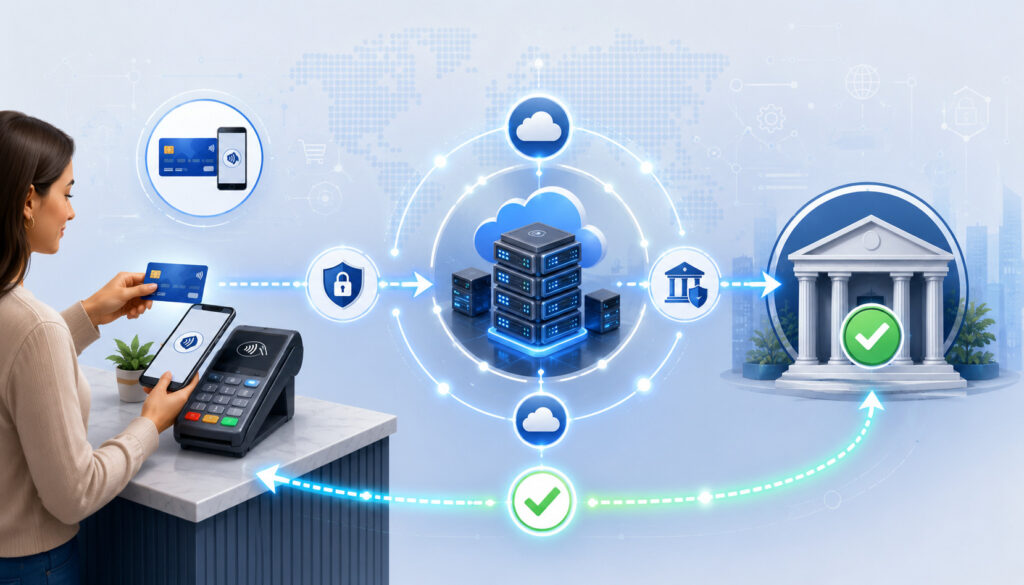
The payment authorization process begins when the merchant requests approval for a card payment. This can happen at a physical checkout, through an online cart, in a mobile app, with a payment link, through a virtual terminal, or during recurring billing.
First, the customer provides payment credentials. In a store, the terminal reads the card or digital wallet. Online, the checkout collects card data or uses a stored token. The merchant’s system sends an authorization request through the payment gateway or processor.
The request includes the transaction amount and other important details. The processor routes the request to the correct card network, which sends it to the issuing bank. The issuing bank checks the cardholder account and applies internal risk rules.
The issuer then returns an authorization response. If the response is approved, the merchant receives a payment approval code and can proceed. If it is declined, the merchant receives a decline message or code. Some declines are final. Others may be resolved if the customer updates billing details, uses another card, contacts the issuer, or retries later.
In a card-present transaction, the terminal may also support EMV chip validation or contactless authentication. In a card-not-present transaction, the payment system may rely more heavily on billing address checks, CVV, device data, velocity rules, fraud scoring, and tokenization.
Authorization usually happens quickly, but it is not the same as payment settlement. The authorization confirms that the transaction can move forward. The business still needs payment capture and settlement for the funds to be deposited.
What Happens During an Authorization Request?

An authorization request is a data message asking whether a specific card transaction should be approved. The better the data, the easier it is for the issuing bank and fraud tools to evaluate the transaction accurately.
A typical authorization request may include the card number or token, expiration date, transaction amount, merchant identification, merchant category, transaction type, card entry method, billing address details, security code result, device data, IP-related signals, order information, and fraud screening indicators.
For ecommerce payments, Address Verification Service results and CVV responses can be especially important. AVS compares billing address information against the cardholder records available to the issuer.
CVV helps confirm that the customer has access to the card information printed or displayed with the card. These checks do not guarantee that a transaction is legitimate, but they can help reduce risk.
For POS payments, chip and contactless data can help validate that the card or wallet credential is present. EMV data provides stronger protection than older magnetic stripe entry. Keyed transactions at a terminal may carry higher risk because the card is not being read directly.
Recurring billing may use stored credentials, tokens, and indicators that tell the payment system the transaction is part of an ongoing customer agreement. These details matter because recurring transactions are evaluated differently from one-time purchases.
Accurate data improves the chance of a correct authorization response. Incomplete or inconsistent data can trigger declines, manual reviews, higher fees, or later disputes.
Businesses that collect billing details carefully, use secure payment pages, keep terminals updated, and configure gateway settings properly tend to have cleaner authorization outcomes.
Why Transactions Get Approved or Declined
A transaction is approved when the issuing bank determines that it can accept the request. Approval usually means the card is valid, the account is in good standing, the customer has enough available credit or funds, and the transaction does not violate issuer rules or fraud controls.
A declined transaction means the issuer or payment system did not approve the request. Declines happen for many reasons. Some are simple, such as an expired card, incorrect card number, incorrect CVV, wrong billing address, or insufficient funds.
Others are risk-based, such as fraud alerts, unusual spending patterns, high transaction amounts, duplicate attempts, or purchases outside the customer’s normal behavior.
Issuer restrictions may also cause declines. A card may be limited by geography, merchant category, daily spending limits, account status, or cardholder settings. Corporate cards may block certain transaction types. Debit cards may decline if the account balance is too low or the bank requires cardholder confirmation.
Technical issues can also interrupt transaction authorization. A payment gateway outage, processor connectivity problem, terminal communication error, or timeout may prevent a clear approval or decline.
When outages occur, businesses should follow their processor’s guidance and avoid repeatedly submitting the same transaction without understanding whether it was already authorized. This resource on processing outage preparation is useful for planning response procedures.
Businesses can reduce avoidable declines by keeping equipment current, using clear checkout fields, training staff, monitoring decline codes, and giving customers safe ways to update payment details.
Authorization Holds and Pending Transactions
An authorization hold is a temporary hold placed on a cardholder’s available balance or credit line after a transaction is approved. The hold reserves funds for the merchant but does not mean the merchant has received the money.
To the customer, the transaction may appear as pending. A pending transaction can create confusion because the customer may think they have already been charged, even though the transaction has not fully settled.
In many cases, the pending amount is replaced by the final settled amount. In other cases, the hold falls off if the transaction is voided, expires, or is not captured.
Authorization holds are common in industries where the final amount may not be known when the card is first presented. Lodging, vehicle rentals, restaurants, fuel, and certain service businesses may authorize an estimated amount.
The final card payment settlement may be higher or lower depending on the completed service, tip, fuel amount, damage deposit, or final invoice.
Holds can remain visible for varying periods depending on the issuer, transaction type, and network rules. Businesses do not directly control how quickly an issuer removes a pending transaction from the cardholder’s online banking view. However, businesses can reduce confusion by explaining hold practices clearly before the customer pays.
Authorization holds can also affect customer satisfaction. If a hold is too high, lasts longer than expected, or appears in addition to a final charge, customers may contact the business. Clear receipts, staff training, and fast voids or reversals can help prevent misunderstandings.
Authorization vs Capture: What Is the Difference?
Authorization confirms that a transaction is approved. Payment capture tells the payment system that the merchant wants to finalize the approved transaction for settlement. This distinction is important because not every authorized transaction should be captured immediately.
In many retail settings, authorization and capture happen almost together. A customer buys an item, the terminal approves the transaction, and the payment is automatically captured for the final amount. This is common for straightforward POS payments where the amount is known at checkout.
In ecommerce payments, businesses may use automatic capture or delayed capture. Automatic capture is common when the item is ready to ship or the service is delivered immediately.
Delayed capture may be useful when an online seller wants to authorize the card at checkout but capture payment only after confirming inventory, preparing the order, or shipping the product.
Partial capture may happen when only part of an order can be fulfilled. For example, if a customer orders multiple items and one is unavailable, the merchant may capture only the amount for the shipped items, depending on system capabilities and applicable rules.
Manual capture gives the business more control but also requires discipline. If an authorized transaction is not captured within the allowed window, the authorization may expire. The business may need to request a new authorization, and that new request could be declined.
How the Payment Settlement Process Works
The payment settlement process begins after a transaction is captured. Once captured, the transaction is prepared for clearing, settlement, and merchant funding.
In many setups, captured transactions are collected into a batch. The batch may close automatically at a scheduled time or manually when the business ends the day. After the batch closes, the processor sends the captured transaction details through the acquiring side and card network for clearing.
Payment clearing is the stage where transaction details are exchanged and finalized among the relevant parties. Details such as transaction amount, merchant category, card type, authorization data, and other fields are used to confirm the transaction and calculate applicable fees.
Clearing helps determine what the issuer owes, what the acquirer receives, and how the transaction should be categorized.
Settlement is the stage where funds are moved between financial institutions according to the cleared transaction data. After settlement, the acquiring side or payment processor prepares merchant funding. The business receives the net deposit after fees, adjustments, reserves, chargebacks, refunds, or other deductions that apply to the account.
Settlement is not always instant because several steps must occur after authorization. The business must capture the transaction, close or submit the batch, allow clearing to happen, wait for interbank settlement, and receive funding according to the processor’s funding schedule.
For businesses comparing payment setups, understanding the credit card settlement process is just as important as comparing rates. A low rate is not helpful if reports are confusing, batch timing is unclear, or funding delays create cash flow pressure.
Batch Processing and End-of-Day Closing
Batch processing is the practice of grouping captured transactions together and submitting them for settlement. Instead of settling each transaction separately at the exact moment of purchase, many merchant systems collect approved and captured transactions into a batch.
A batch may contain card-present transaction records, card-not-present transaction records, refunds, adjustments, and other payment activity. At the end of the business day, the batch is closed and sent to the processor. Some systems close batches automatically at a scheduled time. Others require manual batch closing by a manager or staff member.
Batch timing affects settlement timeline and merchant funding. If a batch closes before the processor’s cutoff time, funding may begin sooner. If the batch closes after the cutoff, on a weekend, or around a banking holiday, the deposit may arrive later. A missed batch can delay funding and create reconciliation problems.
Manual batch closing gives businesses control but creates room for error. If staff forget to close the batch, the transactions may remain unsettled until the issue is corrected. Automatic batch closing reduces that risk, but the schedule should match the business’s operating hours and reporting needs.
Businesses with multiple terminals, multiple locations, ecommerce channels, phone orders, and recurring billing should pay close attention to batch reporting. A payment may be authorized in one system, captured in another, batched by a gateway, and funded through a processor report. Without clear procedures, reconciliation becomes difficult.
Clearing, Fees, and Network Rules
Clearing is the stage where captured transaction details are finalized for settlement. During clearing, payment information moves between the processor, acquiring bank, card network, and issuing bank. The goal is to confirm transaction details, categorize the payment correctly, and calculate the amounts owed among the parties.
Fees are also applied during or around the clearing and settlement process. Interchange fees are typically paid to issuing banks and are influenced by factors such as card type, transaction method, merchant category, data quality, and risk level.
Assessment fees are charged by card networks for use of their payment rails. Processor markup is the amount charged by the payment processor or merchant services provider for technology, support, risk management, and account services.
This is one reason the deposited amount may be lower than gross sales. A business may process a certain amount in card sales, but the funded deposit may reflect processing fees, refunds, chargebacks, batch adjustments, reserves, or other account-level deductions. Depending on pricing structure, fees may be deducted daily, per batch, or monthly.
Transaction categories matter. A chip-read card-present transaction may qualify differently from a keyed card-not-present transaction. Ecommerce payments with complete billing data may price differently from transactions missing important information. Recurring billing may require proper stored credential indicators.
Network rules also affect how transactions are handled. They can influence authorization validity, capture timing, refund handling, chargeback rights, data requirements, and fee qualification. Businesses do not need to memorize every rule, but they should use payment tools that help send accurate data and keep transaction handling consistent.
Merchant Funding: When the Business Receives the Money
Merchant funding is the stage when the business receives money from settled card transactions. Funding may go to a merchant account first and then to a business bank account, or it may appear as a deposit from the processor depending on the payment setup.
Funding timing depends on several factors. These include batch closing time, processor cutoff time, transaction type, risk profile, account history, banking schedule, weekends, holidays, reserves, chargeback activity, and account reviews.
Some businesses receive funding quickly under their agreement. Others may wait longer depending on their industry, risk level, or processing arrangement.
A funding delay does not always mean something is wrong. A batch submitted after cutoff may simply settle later. A new merchant account may be monitored more closely during the early processing period. A sudden spike in volume, unusually large ticket, high refund ratio, or elevated chargeback exposure may trigger review.
Reserves can also affect funding. A reserve is a portion of processed funds held to protect against future chargebacks, refunds, or losses. Reserves are more common for higher-risk industries, new businesses, businesses with delayed delivery, or accounts with dispute concerns.
Businesses should not rely only on bank deposits to understand payment performance. Processor reports often show gross sales, settled sales, fees, refunds, adjustments, and net funding. Comparing those reports against deposits helps identify missing batches, delayed settlements, fee deductions, and chargeback activity.
Payment Authorization and Settlement Table
The lifecycle of a card transaction is easier to understand when each stage is separated. Authorization, capture, clearing, settlement, and funding are connected, but each one answers a different question.
Authorization asks: “Can this transaction be approved?” Capture asks: “Should this approved transaction be finalized?” Clearing asks: “What exact transaction details and fees should be recognized?” Settlement asks: “How should funds move between financial institutions?” Funding asks: “When does the business receive the money?”
Businesses that understand these differences can troubleshoot more effectively. For example, if a customer sees a pending transaction, the issue may involve authorization holds.
If the sale is approved but not in the deposit, the issue may involve capture, batch processing, settlement timeline, or merchant funding. If the deposit is lower than sales, the issue may involve fees, refunds, chargebacks, or adjustments.
| Stage | What Happens | Main Parties Involved | Business Impact |
| Authorization | The merchant requests payment approval and receives an authorization response. | Cardholder, merchant, payment gateway, payment processor, acquiring bank, card network, issuing bank | Determines whether the sale can proceed. |
| Capture | The merchant finalizes the approved transaction for settlement. | Merchant, gateway, processor | Moves the transaction from approved to ready for settlement. |
| Clearing | Transaction details are exchanged, matched, categorized, and prepared for settlement. | Processor, acquiring bank, card network, issuing bank | Affects fee calculation, reporting, and transaction accuracy. |
| Settlement | Funds move between financial institutions based on cleared transaction data. | Acquiring bank, issuing bank, card network, processor | Moves the transaction toward merchant funding. |
| Funding | Net funds are deposited to the business according to the funding schedule. | Processor, acquiring bank, merchant account, business bank | Affects cash flow and reconciliation. |
This table is also useful for staff training. When employees know the difference between a pending transaction, a captured payment, a settled batch, and a funded deposit, they can answer customer questions more accurately and escalate issues to the right place.
Card-Present vs Card-Not-Present Authorization and Settlement
Card-present and card-not-present transactions move through the same broad lifecycle, but they carry different data, risks, and security expectations.
A card-present transaction happens when the customer is physically interacting with a payment device. Examples include EMV chip, contactless payments, mobile wallet taps, and POS payments at a terminal.
These transactions can include card-read data that helps prove the payment credential was present. EMV and contactless methods also support dynamic security data that helps reduce counterfeit card risk.
A card-not-present transaction happens when the card is not physically read by a terminal. Examples include ecommerce checkout, invoice links, keyed transactions, phone orders, mail orders, and recurring billing.
Because the merchant cannot physically inspect or read the card, fraud screening becomes more important. Businesses may rely on AVS, CVV, secure payment pages, device data, velocity rules, tokenization, 3D Secure, and manual review for higher-risk orders.
Settlement can also differ. Card-present sales are often captured immediately and batched at the end of the day. Ecommerce payments may use immediate capture, delayed capture, partial capture, or separate fulfillment-based capture rules. Recurring billing may process automatically on a schedule using stored payment credentials.
Chargeback exposure is often higher in card-not-present environments because it can be harder to prove that the legitimate cardholder authorized the transaction.
Good records matter. Businesses should keep order confirmations, delivery records, customer communications, service agreements, IP and device details when available, and refund policy acknowledgments.
For businesses that accept payments remotely, this guide to phone and keyed payments offers additional background on card-not-present acceptance.
Common Problems During Authorization and Settlement
Payment problems usually fall into two broad categories: authorization problems and settlement or funding problems. Knowing which category applies helps businesses act faster.
Authorization problems happen before or during approval. Examples include declined transactions, expired cards, incorrect card details, suspected fraud, duplicate attempts, issuer restrictions, terminal errors, gateway timeouts, and incomplete checkout data.
These issues can prevent a sale from going through or create uncertainty about whether payment approval occurred.
Settlement and funding problems happen after approval or capture. Examples include delayed settlement, batch errors, missing deposits, settlement mismatches, refund delays, chargeback deductions, duplicate authorizations, unresolved authorization holds, and funding reviews.
These issues may not be visible to the customer at checkout, but they can affect cash flow and bookkeeping.
Some problems are caused by business processes. A staff member may forget to close a batch. A tip adjustment may be entered incorrectly. An ecommerce order may be authorized but never captured. A refund may be initiated after settlement, causing timing differences between customer expectations and bank activity.
Other problems are outside the merchant’s direct control. Issuer systems, card network routing, processor maintenance, gateway outages, banking holidays, and risk reviews can all affect timing or transaction visibility. Businesses should still have procedures for monitoring, documenting, and escalating issues.
Authorization Problems
Authorization problems often begin with missing, incorrect, or suspicious transaction data. A customer may enter the wrong card number, expiration date, CVV, or billing address. A card may be expired, locked, over its limit, or restricted by the issuer. A transaction may also be declined because it looks unusual compared with the cardholder’s normal behavior.
Businesses can reduce avoidable authorization problems by improving data entry and checkout design. Ecommerce forms should clearly label billing address fields, show errors before submission, and avoid forcing customers to re-enter information unnecessarily.
POS terminals should be updated, connected reliably, and configured for chip and contactless payments when available.
Fraud tools should be balanced. Rules that are too loose may allow more fraud. Rules that are too strict may reject good customers. A better approach is to score transactions by risk and review suspicious orders before fulfillment when practical.
Staff training also matters. Employees should know how to handle declines respectfully, avoid repeated forced attempts, recognize duplicate authorization risks, and explain pending transactions without overpromising.
Settlement and Funding Problems
Settlement and funding problems often involve timing, batching, reporting, or risk review. A business may close a batch after the cutoff time, forget to close the batch, submit transactions with missing data, or experience a processor or gateway issue. Any of these can delay the payment settlement process.
Funding may also be delayed by account-level factors. A sudden increase in volume, unusual transaction size, high refund activity, delivery delays, or chargeback concerns can lead to review. In some cases, a reserve or funding hold may apply based on the merchant account agreement.
Businesses can prevent many settlement issues by closing batches on time, using automatic batch close when appropriate, reviewing processor notifications, reconciling deposits daily, and checking settlement reports against POS or gateway reports.
When a deposit does not match expected sales, compare gross sales, captured transactions, settled batches, refunds, chargebacks, fees, reserves, and adjustments. This approach is faster than searching bank deposits alone.
Refunds, Voids, Reversals, and Chargebacks
Post-transaction events are closely connected to authorization and settlement. The right action depends on where the transaction is in the lifecycle.
A void usually cancels a transaction before settlement. If a payment was authorized but not yet settled, voiding it may stop the transaction from moving forward. The customer may still see a pending transaction until the issuer removes the authorization hold.
A void is generally cleaner than a refund when the transaction has not settled because no completed sale needs to be returned.
A refund happens after a transaction has settled or is too far along to be voided. The business sends money back to the cardholder through the payment system. Refund timing can vary because the refund must be processed, cleared, and posted by the issuer. Customers may expect instant refunds, but the visible credit may take longer depending on banking processes.
A reversal can refer to actions that release or correct an authorization, often used when a transaction will not be captured or when the final amount changes. Reversals help reduce unnecessary holds and improve customer experience when supported by the payment setup.
A chargeback is different. It is initiated through the cardholder’s issuing bank when the customer disputes a transaction. Chargebacks may involve claims of fraud, non-receipt, duplicate billing, incorrect amount, canceled service, or product issues. Chargebacks can remove funds from the merchant, add fees, and require evidence if the business chooses to respond.
Businesses should document sales, fulfillment, communication, refund decisions, and customer authorization. Strong records help with chargeback responses and reconciliation.
Security and Compliance in Authorization and Settlement
Payment security protects customers, businesses, and the entire card ecosystem. Any business that stores, processes, or transmits cardholder data has responsibilities related to PCI compliance and safe payment handling. The official payment security standards are a key reference for understanding card data protection expectations.
Encryption protects payment data by making it unreadable to unauthorized parties during transmission or storage. Tokenization replaces sensitive card numbers with tokens that can be used for future transactions without exposing the original card data. Together, encryption and tokenization reduce the amount of sensitive data a business handles directly.
EMV chip and contactless payments help secure card-present transaction environments. For card-not-present payments, businesses often use AVS, CVV, fraud screening, 3D Secure, secure payment pages, device analysis, and velocity controls. These tools help identify suspicious activity before goods are shipped or services are delivered.
PCI compliance is not just a technical checklist. It also involves staff behavior. Employees should never write card numbers on paper, store card details in spreadsheets, send card data through unsecured messages, or reuse passwords for payment systems. Access to payment tools should be limited to trained employees who need it.
Security controls should support the customer experience rather than create unnecessary friction. For example, requiring CVV and billing ZIP code may be reasonable for many ecommerce payments. Sending every order to manual review may slow fulfillment and frustrate good customers.
For additional background on the security concepts involved in card payments, the payment card security standard overview provides a helpful educational reference.
Best Practices for Managing Authorization and Settlement
Businesses can improve authorization and settlement outcomes by combining good technology with consistent daily procedures. The goal is not only to accept payments, but to accept them accurately, securely, and in a way that supports cash flow.
Start by reviewing payment reports regularly. Authorization reports show approval and decline activity. Batch reports show what was submitted for settlement. Settlement reports show which transactions moved forward. Deposit reports show what reached the business. These reports should be compared often.
Reconcile batches daily. Confirm that each POS terminal, ecommerce channel, virtual terminal, and recurring billing platform submitted transactions correctly. If the business has multiple locations or sales channels, separate reporting by channel can make reconciliation easier.
Use clear billing descriptors. Customers are more likely to dispute a transaction when they do not recognize the name on their statement. A clear descriptor helps reduce avoidable chargebacks and customer service calls.
Train staff on payment basics. Employees should know how to handle declines, voids, refunds, duplicate attempts, tips, partial approvals, and customer questions about pending transactions. They should also know when to escalate an issue.
Set fraud rules carefully. Use fraud screening tools, but monitor false declines. Review high-risk transactions before fulfillment when possible, especially for large card-not-present orders.
Keep refund policies clear. Customers should understand how refunds are requested, when they are issued, and when they may appear on card statements.
Businesses still evaluating acceptance options may also benefit from this overview of accepting cards for business.
How to Choose a Payment Setup That Supports Smooth Authorization and Settlement
A good payment setup should support the way the business sells. Retailers, restaurants, ecommerce sellers, service providers, membership businesses, and mobile vendors may all need different combinations of hardware, software, gateway features, fraud controls, reporting, and funding options.
Start with sales channels. If the business accepts in-person payments, look for reliable POS payments, EMV chip support, contactless payments, tip handling if needed, and easy end-of-day batching.
If the business accepts ecommerce payments, look for a secure payment gateway, hosted payment page or checkout integration, tokenization, fraud screening, AVS, CVV, and clear capture settings. If the business uses recurring billing, look for stored credential support, account updater options, retry management, and customer notification tools.
Reporting is just as important as checkout. The dashboard should make it easy to view authorizations, captures, batches, settlements, refunds, chargebacks, fees, and deposits. Reports should export cleanly for accounting or finance teams.
Pricing should be transparent. Businesses should understand interchange fees, assessment fees, processor markup, monthly fees, chargeback fees, gateway fees, PCI-related fees, and any funding or reserve terms. The lowest advertised rate is not always the lowest total cost.
Support quality matters because payment issues are time-sensitive. When a batch does not close or funding is delayed, the business needs useful help, not generic answers.
Scalability also matters. A payment setup should support new locations, additional users, online sales, invoicing, subscriptions, mobile payments, and integrations as the business grows.
Final Thoughts on Payment Authorization and Settlement
Payment authorization and settlement work together, but they do not mean the same thing. Authorization confirms whether a transaction can be approved. Settlement helps move the captured transaction through clearing, fee calculation, interbank movement, and merchant funding.
For customers, the process may appear simple. For businesses, each stage affects operations. Authorization influences whether a sale is approved or declined. Capture determines whether the merchant finalizes the transaction. Batch processing affects settlement timing. Clearing and settlement affect fee calculation and financial movement. Merchant funding affects cash flow.
Understanding authorization and settlement also helps businesses communicate better with customers. When a customer asks why a charge is pending, staff can explain authorization holds. When a refund is not visible immediately, the business can explain that refunds move through card payment settlement steps.
When a sale is approved but not deposited, the finance team can check capture status, batch reports, settlement reports, and funding notices.
The practical value is control. Businesses that understand the transaction lifecycle can reduce errors, prevent missed captures, avoid unnecessary refund confusion, monitor declines, manage fraud, and reconcile deposits more accurately.
Payment systems will always involve multiple parties and rules. Business owners do not need to become network engineers or banking specialists. They do need a working understanding of payment authorization, payment settlement, and the steps in between.
What is payment authorization and settlement?
Payment authorization and settlement are two major stages in a card transaction. Authorization is the approval step. The merchant sends an authorization request through the payment system, and the issuing bank decides whether to approve or decline the transaction.
Settlement happens after the transaction is captured and submitted. During settlement, transaction details are cleared, funds move between financial institutions, and the business receives merchant funding according to its processing schedule.
What is the difference between authorization and settlement?
Authorization checks whether the transaction can proceed. Settlement moves the finalized transaction toward funding. A payment can be authorized without being settled yet.
For example, an online order may be approved at checkout, but the merchant may capture it later when the order ships. Settlement happens only after capture and batch submission.
Is an authorized transaction the same as a completed payment?
No. An authorized transaction is approved, but it is not always completed from the business’s funding perspective. The transaction still needs to be captured, cleared, settled, and funded.
Customers may see a pending transaction after authorization. The business may not receive funds until the payment settlement process is complete.
How long does payment settlement take?
Settlement timeline depends on batch timing, processor cutoff times, banking schedules, transaction type, risk review, and the merchant account agreement. Many businesses see deposits after a short processing window, but timing can vary.
Weekends, holidays, late batch closing, account reviews, chargeback exposure, and reserves can extend the time between payment approval and funding.
Why is a transaction approved but not funded yet?
A transaction may be approved but not funded because authorization is only the first stage. The transaction may still need payment capture, batch processing, clearing and settlement, and merchant funding.
The business should check whether the transaction was captured, whether the batch closed, whether settlement was completed, and whether any fees, refunds, chargebacks, or reserves affected the deposit.
What is payment capture?
Payment capture is the step where the merchant finalizes an authorized transaction for settlement. Without capture, an approved authorization may expire and never become a settled payment.
Capture may happen automatically at checkout or manually later. Some businesses use delayed capture when they need to confirm inventory, shipping, service completion, or final amount.
What is batch processing in payment settlement?
Batch processing groups captured transactions and submits them for settlement. A batch may close automatically at a set time or manually at the end of the business day.
Batch timing affects funding. If a batch closes after the processor’s cutoff, the deposit may arrive later than expected.
Why do authorization holds happen?
Authorization holds reserve part of the cardholder’s available credit or balance after approval. They help ensure funds are available when the transaction is later captured and settled.
Holds are common when the final amount is not known at the start, such as lodging, rentals, restaurants, fuel, and certain service transactions.
Conclusion
Payment authorization and settlement are separate but connected stages in the card payment lifecycle. Authorization determines whether a transaction can be approved. Settlement helps move the captured transaction through clearing, fee calculation, financial movement, and merchant funding.
For business owners, ecommerce sellers, service providers, and finance teams, this knowledge is practical. It explains why an approved sale may not be deposited immediately, why pending transactions appear, why batch timing matters, why fees reduce gross sales, and why refunds or chargebacks can affect deposits.
Businesses that understand payment authorization and settlement can manage cash flow more confidently, reduce payment errors, improve reconciliation, train staff more effectively, prevent avoidable disputes, and create a smoother payment experience for customers.
The best approach is consistent: use secure payment tools, collect accurate transaction data, monitor declines, close batches on time, review reports daily, communicate clearly with customers, and choose payment systems that fit the way the business sells.